
PCB assembly price in India: What actually drives the cost
 Utsav
•
Nov 11, 2026
Ask three EMS companies in India to quote the same board and the totals can differ widely. That is rarely because one of them is cheap and the others are greedy. Each one is pricing a different set of assumptions about the components, the volume, the inspection and the testing, and most of those assumptions are never written on the quote.
For a buyer, the useful question is not simply what the PCB assembly price in India is, but what the price actually pays for, and which parts of it can be controlled. This guide breaks a quote into its parts, explains what moves each one, and lists what to send a manufacturer so the number that comes back is one you can compare.
What a PCB assembly quote is made of
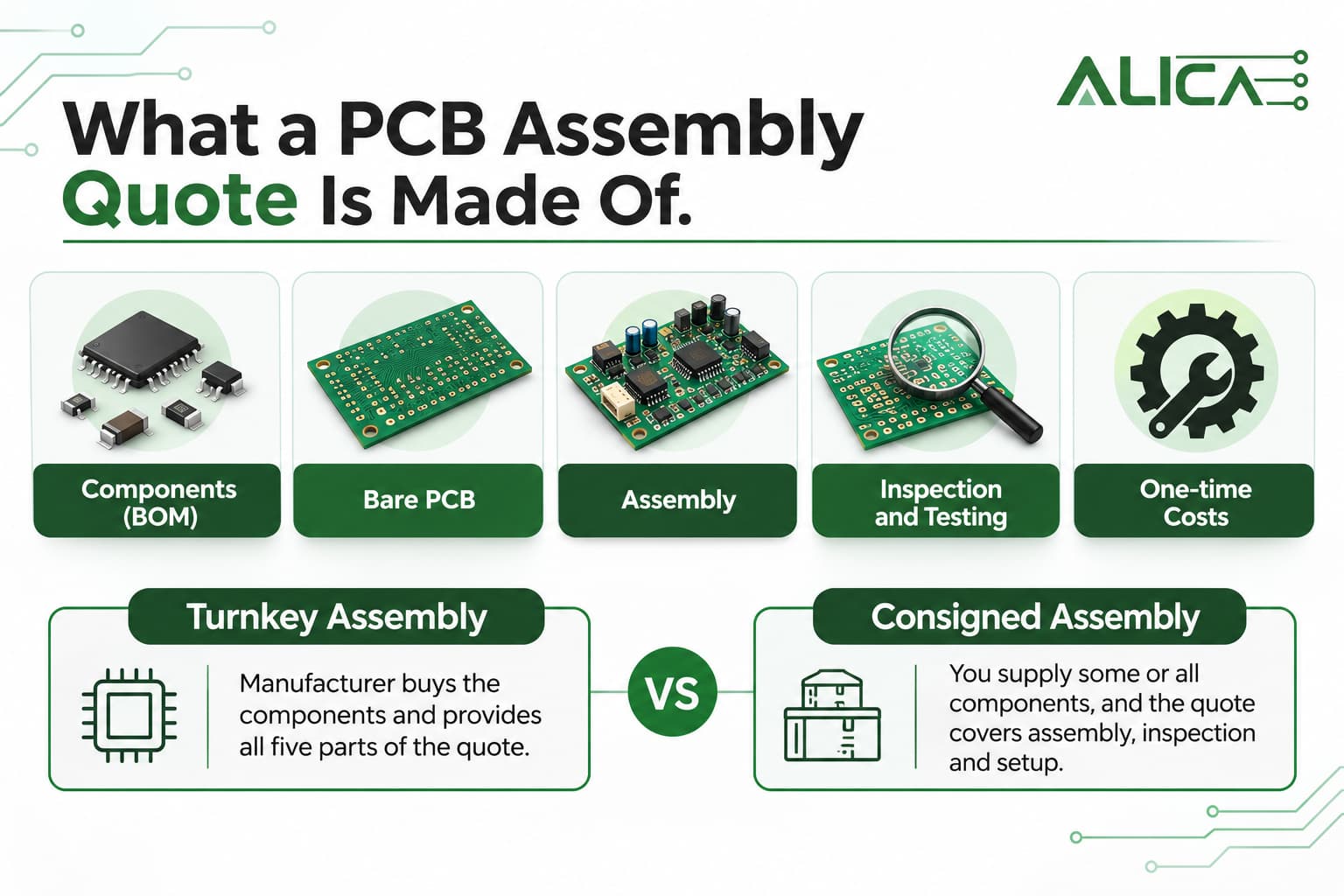
A quote for an assembled board usually has five parts, even when they are not all shown separately:
- Components (the BOM): the parts that go on the board. For most products this is the largest share of the unit price, and the part that moves most with the market.
- Bare PCB: the fabricated board itself, priced by layer count, size, material and surface finish.
- Assembly: placing and soldering the parts. This depends on how many placements there are, whether both sides are populated, and how much through-hole or hand work is needed.
- Inspection and testing: solder paste inspection, AOI, X-ray where hidden joints need it, and functional testing.
- One-time costs: stencils, machine programming, test fixtures and first-article setup. These are paid once per design revision, not once per board.
Under a turnkey model the manufacturer buys the components and quotes all five. Under a consigned model the customer supplies some or all of the parts, and the quote mainly covers assembly, inspection and setup. The benefits and process of turnkey PCB assembly explain how much this changes what a quote includes, so check which model each quote assumes before comparing them.
What drives PCB assembly price in India
Component choice and availability
Because components make up most of the price, decisions made during design move the total more than anything on the factory floor. Single-source parts, end-of-life parts and parts with long lead times all add cost, either directly or through the stock a manufacturer has to hold against shortages. Allowing approved alternates for passives and common parts gives the sourcing team room to buy well. Minimum order quantities matter too: a full reel bought for a 200-board run means paying for stock the build will not use.
Board complexity
Layer count, board size and fine-pitch packages affect both the bare board and the assembly. A dense multi-layer board with BGA and QFN packages needs tighter process control, and its hidden joints need X-ray inspection that a simple two-layer board does not. Populating both sides adds a second pass through the line.
Mixed technology
Boards that combine surface-mount and through-hole parts cost more to assemble than all-SMT boards, because the through-hole parts need a separate soldering step and often hand work. Sometimes that is the right call: connectors, transformers and large capacitors are often through-hole for good mechanical or electrical reasons. The trade-offs between SMT and THT assembly are worth reviewing before the layout is frozen.
Volume and batch size
Setup work is spread across the batch. A run of 50 boards needs the same stencil, programming and first-article effort as a run of 5,000, so the price per board falls sharply as volume rises. Splitting one annual requirement into many small batches raises the unit price, even when the total volume stays the same.
Inspection and test scope
Inspection adds cost, but it usually saves more by catching defects before boards ship. The level of testing should match the product: a consumer gadget, an industrial controller and a patient monitor do not need the same coverage. Functional testing needs a fixture and a written test procedure, which are one-time costs worth agreeing early.
Lead time
Expedited builds cost more, mainly because components bought at short notice cost more and because the build has to jump the production plan. A realistic schedule agreed at the start is often the cheapest saving available.
| Cost driver | What raises it | What lowers it |
|---|---|---|
| Components | Single-source, end-of-life or long-lead parts | Approved alternates and early sourcing |
| Bare PCB | More layers, larger size, special materials | A standard stack-up and finish where the design allows |
| Assembly | Double-sided boards, fine-pitch parts, many through-hole parts | Surface-mount parts where possible, panelised boards |
| Inspection | Hidden joints that need X-ray | Correct pad and stencil design from the start |
| One-time setup | Frequent design revisions, many small batches | A frozen design and fewer, larger batches |
| Lead time | Expedited builds | Realistic schedules and shared forecasts |
Why the lowest quote is not always the lowest cost
The price per board is only one line of the real cost. A board that fails in the field costs a replacement, a service visit and some of the end customer’s trust. A quote that leaves out inspection, or assumes the customer will find the hard-to-source parts, can look lower and end up higher. When comparing quotes, ask every manufacturer the same questions: what inspection is included, what testing, who carries the component risk, and what happens when a part is not available. Choosing a PCB assembly partner on these points gives a fairer comparison than the bottom line alone.
For procurement: getting a quote you can compare
Most quoting delays and surprises come from missing information. Sending a complete package up front gets a faster and more accurate number:
- Bill of materials with manufacturer part numbers, quantities and reference designators
- Approved alternates, or a note on which parts must not be substituted
- Gerber files, the centroid (pick-and-place) file and the assembly drawing
- Annual volume, batch sizes and target delivery dates
- Required inspection and testing, including any functional test procedure
- Whether you need an assembled board or a complete box build
- Any parts you will supply yourself
For R&D teams: design decisions that lower cost
Engineering teams set most of the cost before a quote is ever requested. A PCB designed for high-yield assembly uses standard packages where performance allows, keeps parts on one side where it can, and leaves room for test points. A DFM review before tooling catches problems while they are still cheap to change, rather than after the stencil has been cut.
For operations: costs that appear after the build
Rework, failed batches and field returns are costs too, even though they never appear on the quote. Consistent inspection on every board, documented process steps and component traceability make those costs smaller, and make them easier to trace back to a cause when something does go wrong.
How Alica Technologies prices PCB assembly
Alica Technologies, an EMS company in Changodar, Ahmedabad, offers turnkey sourcing with full BOM management and a transparent cost breakdown, so buyers can see what each part of the price covers. Builds go through 3D solder paste inspection, AOI and 2.5D/3D X-ray, with functional testing available, as set out on the testing and inspection page. Early DFM review is offered before tooling, which is where most avoidable cost sits.
Frequently Asked Questions
What is the biggest factor in PCB assembly price in India?
For most products it is the components. The bill of materials usually makes up the largest share of an assembled board’s price, so part choice, approved alternates and early sourcing have more effect on cost than assembly labour.
Why does the price per board fall at higher volumes?
One-time costs such as stencils, machine programming and first-article inspection are the same whether the batch is 50 boards or 5,000. Spread over a larger batch, they add less to each board, and component prices usually improve with larger purchases too.
Is turnkey PCB assembly more expensive than consigned assembly?
A turnkey quote is larger because it includes the components, but the total cost is not necessarily higher. The manufacturer handles purchasing, stock and shortages, which would otherwise take the customer’s own time and staff. Which model is cheaper depends on how much sourcing capacity the customer already has.
Get a quote broken down line by line
For a PCB assembly quote with each cost shown separately, send your BOM, Gerber files and volumes through the Alica Technologies contact page, or review the full list of manufacturing capabilities first.
Looking for a reliable EMS partner?
Get a quote for PCB assembly, turnkey manufacturing, or prototype builds.
Get in Touch