
PCBs in Cars: Automotive PCB Assembly Guide
 Utsav
•
Nov 12, 2026
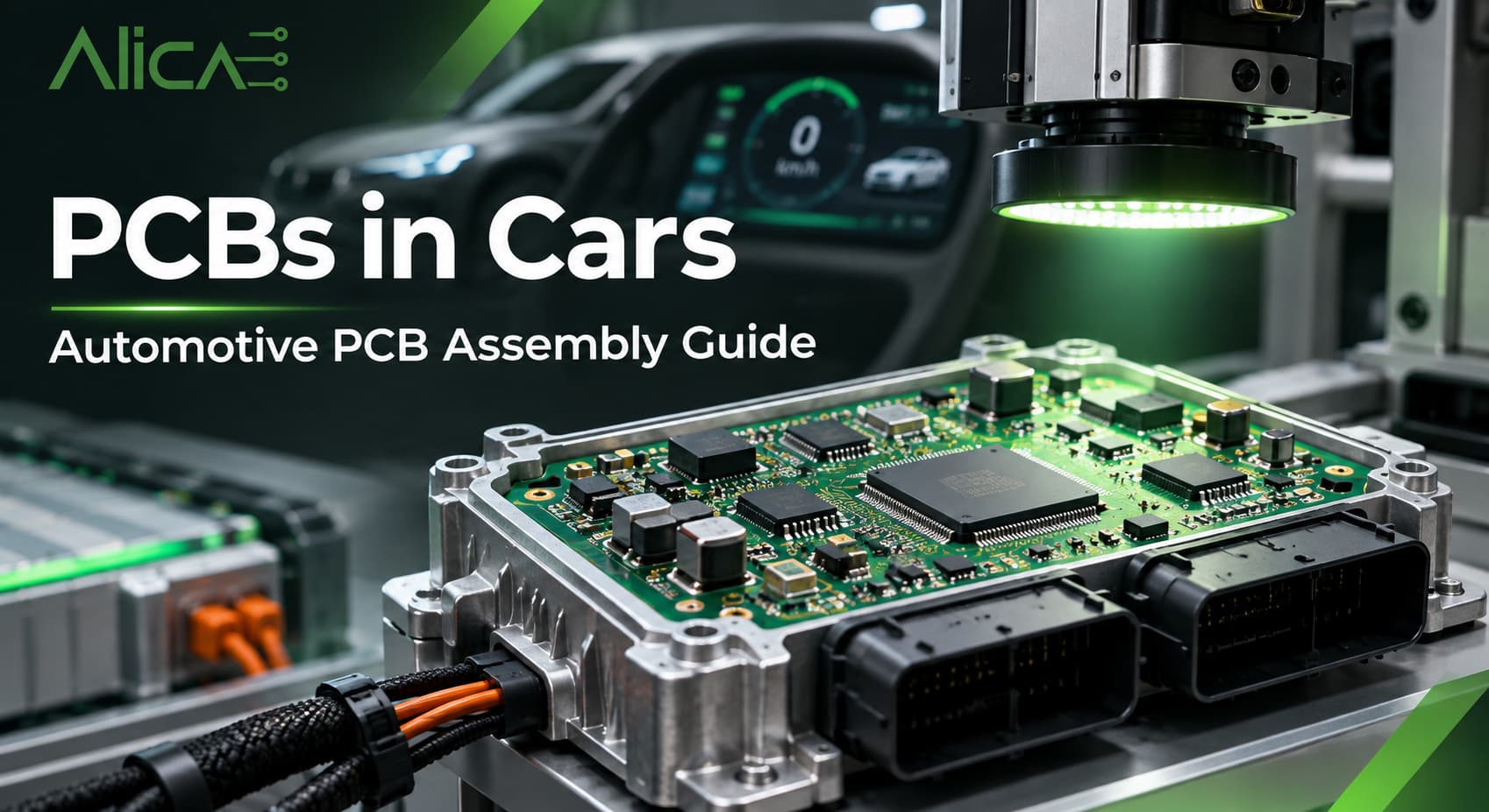
A board that works on the bench can still fail in a car. It sits next to an engine that cycles from a cold morning start to full heat several times a day, it is shaken on every pothole for years, and it shares a wiring harness with motors, relays and ignition systems that throw noise and voltage spikes onto every line. Automotive PCB assembly is about building boards that survive that life, not just boards that pass a functional test on the day they ship.
For hardware teams building vehicle electronics in India, whether that is a telematics unit, a body controller, an EV charger or a battery management system for a two-wheeler pack, the hard part is rarely the schematic. It is turning a design into hundreds or thousands of boards where every solder joint is consistent, every part is the one that was qualified, and every unit can be traced if something goes wrong in the field. This guide explains what makes automotive electronics difficult to assemble, what engineering teams should settle with their assembly partner, and where an EMS partner such as Alica Technologies fits.
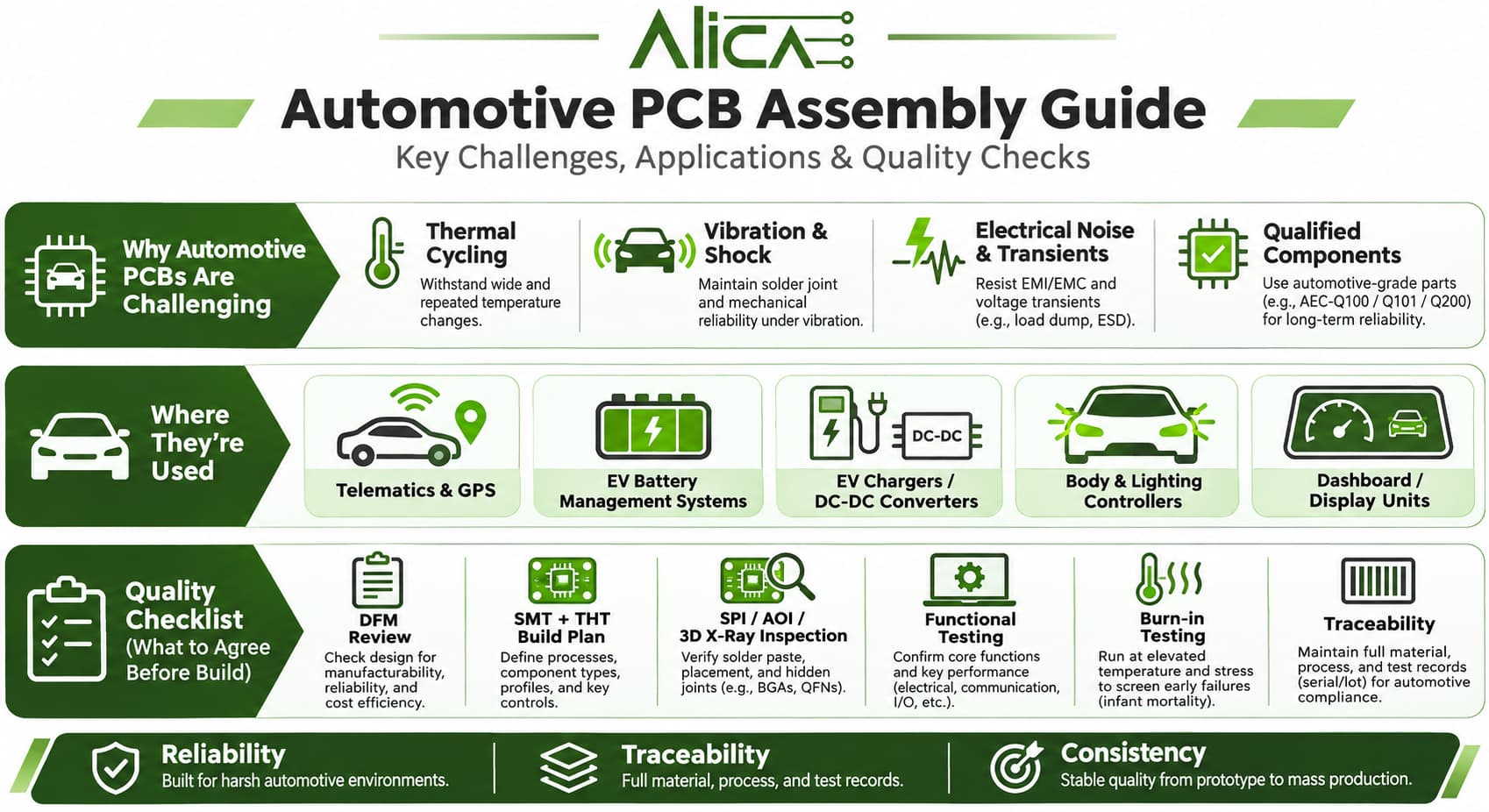
Why automotive PCB assembly is harder than it looks
Most of the difficulty comes from the operating environment and the length of the service life. A consumer gadget may be replaced in two or three years. A vehicle is expected to run for much longer, and its electronics are expected to keep working through that whole time.
Thermal cycling
Every time a vehicle starts, warms up and cools down, the board and its components expand and contract at different rates. Over thousands of cycles, that mismatch fatigues solder joints, especially under large packages such as BGAs and QFNs where the joint cannot be seen. A joint with too little solder, a void, or poor wetting may pass every test at the factory and then crack after a season of use.
Vibration and shock
Heavy components such as electrolytic capacitors, inductors, connectors and transformers act like small weights on the board. Under constant vibration, their leads and pads take the load. Through-hole parts and good mechanical fixing matter here, which is why many vehicle boards mix SMT and THT on the same assembly.
Electrical noise and transients
Vehicle power rails are noisy. Load dumps, cranking dips and inductive switching put stress on protection circuits, which means the protection parts, their placement and their solder joints must be exactly as designed. A wrong or reversed TVS diode is not a cosmetic defect.
Component qualification
Automotive programmes usually specify parts qualified to the Automotive Electronics Council (AEC) standards: AEC-Q100 for integrated circuits, AEC-Q101 for discrete semiconductors and AEC-Q200 for passive components such as resistors, capacitors and inductors. These are qualification standards for the components, set by the part maker, and they are generally a customer or programme requirement rather than a legal one. For the assembler, the job is to buy exactly the qualified part numbers on the approved BOM, from traceable sources, and never substitute a commercial-grade equivalent without written approval.
What R&D teams should settle before an automotive PCB assembly build
Engineering leads carry most of the risk in an automotive programme, because a design choice made early decides how the board behaves in assembly and in the field. These are the points worth closing with the manufacturing partner before the first build.
Design for manufacturability, early
A DFM review before tooling catches pad geometry that invites tombstoning, thermal pads with no paste windowing, fine-pitch parts placed too close to tall components, and test points that cannot be reached. Changes are cheap at this stage and expensive after a stencil is cut. The principles in designing PCBs for high-yield assembly apply directly to vehicle boards, with more attention to large thermal pads and heavy parts.
Mixed technology on one board
Power stages, connectors and heavy passives often need through-hole mounting for strength, while control and communication circuits are dense SMT. Deciding which parts go through-hole, and in what order the board is built, affects both reliability and cost. The trade-offs are covered in more depth in this technical guide to SMT vs THT assembly. Alica’s SMT and THT PCB assembly service handles both on the same board.
Inspection of hidden joints
Many automotive controllers use BGA, QFN and other bottom-terminated packages. Their joints are hidden, so visual inspection and AOI alone cannot confirm them. Solder paste inspection (SPI) checks the paste deposit before placement, AOI checks visible joints and component placement after reflow, and 3D X-ray inspection checks voids and bridging under the package. The common failure modes are explained in common PCB assembly defects and how inspection catches them.
Functional and burn-in testing
Inspection proves the board was built as designed. Functional testing proves it works. Burn-in testing runs boards under power, often at raised temperature, to bring out early-life failures before the boards leave the factory. For vehicle electronics, agree the test fixture, the pass criteria and the burn-in profile with the assembler before the pilot build, so that the numbers mean the same thing to both sides.
Where automotive electronics are used, and what each one asks of assembly
| Application | Typical assembly challenge | What to agree with the assembler |
|---|---|---|
| Telematics and GPS trackers | Dense SMT, RF modules, small enclosures | Module placement, antenna keep-outs, functional test of GNSS and cellular links |
| EV battery management systems | Many measurement channels, high-current paths, balancing circuits | X-ray of AFE packages, cell simulation test, traceability per board |
| EV chargers and DC-DC converters | Heavy magnetics, power semiconductors, large thermal pads | THT and SMT build order, void limits on thermal pads, burn-in under load |
| Body and lighting controllers | Mixed technology, connectors, relay drivers | Connector solder fill, polarity checks, functional test of every output |
| Dashboard and display units | Fine-pitch processors, display connectors | BGA inspection, connector alignment, cosmetic standards for visible parts |
Battery management is one of the fastest-growing areas in Indian vehicle electronics. Alica has written separately about BMS PCB assembly for EV, energy storage and industrial packs, which covers the specific inspection and test needs of those boards.
For procurement teams: sourcing and traceability
For sourcing managers, automotive programmes add one firm rule: the approved part is the only acceptable part. That makes turnkey sourcing with full BOM management useful, because the assembler buys from authorised channels against the exact approved part numbers and flags shortages early instead of substituting quietly. Ask for a transparent cost breakdown so that component cost, assembly and test can be compared line by line, and ask how the partner records lot and date codes against each batch. Domestic manufacturing in Ahmedabad also reduces the import steps between the assembled board and a vehicle plant elsewhere in India.
For operations teams: consistency from batch to batch
Plant heads care less about the first good board and more about the thousandth. Consistent results come from documented, repeatable work: IPC-recommended procedures on the line, 100% inspection coverage, and the same reflow profile, stencil and test fixture from one batch to the next. If the product ships as a finished unit, a partner that also handles box build saves a hand-off between the board assembler and the integrator, which is one less place for damage or mix-ups.
Automotive PCB assembly checklist for your next build
- Approved BOM with qualified part numbers (AEC-Q100, Q101 or Q200 where your programme requires them) and a written no-substitution rule
- DFM review completed and closed before the stencil is ordered
- Clear split of SMT and THT parts, with the build order agreed
- Inspection plan covering SPI, AOI and 3D X-ray for BGA, QFN and large thermal pads
- Agreed void and solder fill acceptance criteria for power and thermal joints
- Functional test fixture, test software and pass or fail limits signed off before the pilot
- Burn-in profile (duration, temperature, load) agreed in writing
- Traceability: board serial numbers linked to component lots and test results
- Any certification your vehicle maker requires from suppliers, confirmed with the partner in writing before you place the order
- Pilot build reviewed and signed off before volume production
Frequently Asked Questions
What is automotive PCB assembly?
Automotive PCB assembly is the process of mounting and soldering components on circuit boards used in vehicles, such as telematics units, battery management systems, chargers and body controllers. It needs tighter control of component sourcing, solder joint quality, inspection and testing than consumer electronics, because the boards must survive heat, vibration and electrical noise for many years.
Do automotive boards need AEC-Q qualified components?
Most automotive programmes specify components qualified to AEC-Q100 for integrated circuits, AEC-Q101 for discrete semiconductors and AEC-Q200 for passive parts. These qualifications are set by the component maker and are usually a requirement of the vehicle programme rather than a law. The assembler’s job is to buy exactly the approved parts and never substitute them without approval.
Why is X-ray inspection important for automotive electronics?
Many vehicle controllers use BGA and QFN packages whose solder joints sit under the component, where cameras cannot see them. 3D X-ray inspection shows voids, bridges and insufficient solder in those joints. Such defects may pass a functional test at the factory and then fail after repeated heating and cooling in the vehicle.
Build your automotive electronics with Alica Technologies
Alica Technologies is an EMS partner in Changodar, Ahmedabad, offering mixed SMT and THT assembly, inline SPI, AOI and 3D X-ray inspection, functional and burn-in testing, turnkey sourcing and box build for hardware teams across India. If you are planning a vehicle electronics build, talk to the Alica team about your automotive board or review the full list of Alica’s manufacturing capabilities.
Tagged in
Looking for a reliable EMS partner?
Get a quote for PCB assembly, turnkey manufacturing, or prototype builds.
Get in Touch