
PCB Assembly cost calculation: How to price your build
 Utsav
•
Nov 12, 2026
Purchase teams are often asked a simple question by management: what will this board cost us per unit? The honest answer is usually “it depends”, which does not help anyone build a budget. A PCB assembly cost calculation turns that answer into a number you can defend, by breaking the price into parts you can check, compare between suppliers and plan around.
The problem is that quotes arrive in different shapes. One supplier gives a single per-board figure, another splits components, assembly and testing, a third adds setup charges on a separate line. Without a method, it is easy to pick the quote that looks lowest and then discover the real cost later in setup fees, shortages or rework. This guide sets out a practical way to calculate the cost of your own build, the inputs you need, and how to use the result when you compare quotes. It explains the method; it does not quote rates, because rates depend on your design and volume.
Why PCB assembly cost is hard to estimate
Three things make the cost of a board hard to pin down early.
First, components usually make up the largest share of the cost, and their prices move with availability, order quantity and the source. A BOM that was cheap to buy six months ago may have one part on allocation today.
Second, many costs are fixed per job, not per board. Stencils, programming, test fixture set-up and first article inspection cost about the same whether you build 50 boards or 5,000. Spread over a small batch, they dominate the unit price. Spread over a large one, they almost disappear.
Third, the design itself sets the assembly effort. Board size, layer count, the number of placements, fine-pitch and BGA packages, through-hole parts and double-sided assembly all change how long the board spends on the line and how much inspection it needs. The factors are covered in detail in what drives PCB assembly price in India. This article is about putting them together into a calculation.
The PCB assembly cost calculation, step by step
The per-board cost for a build can be written as one simple formula:
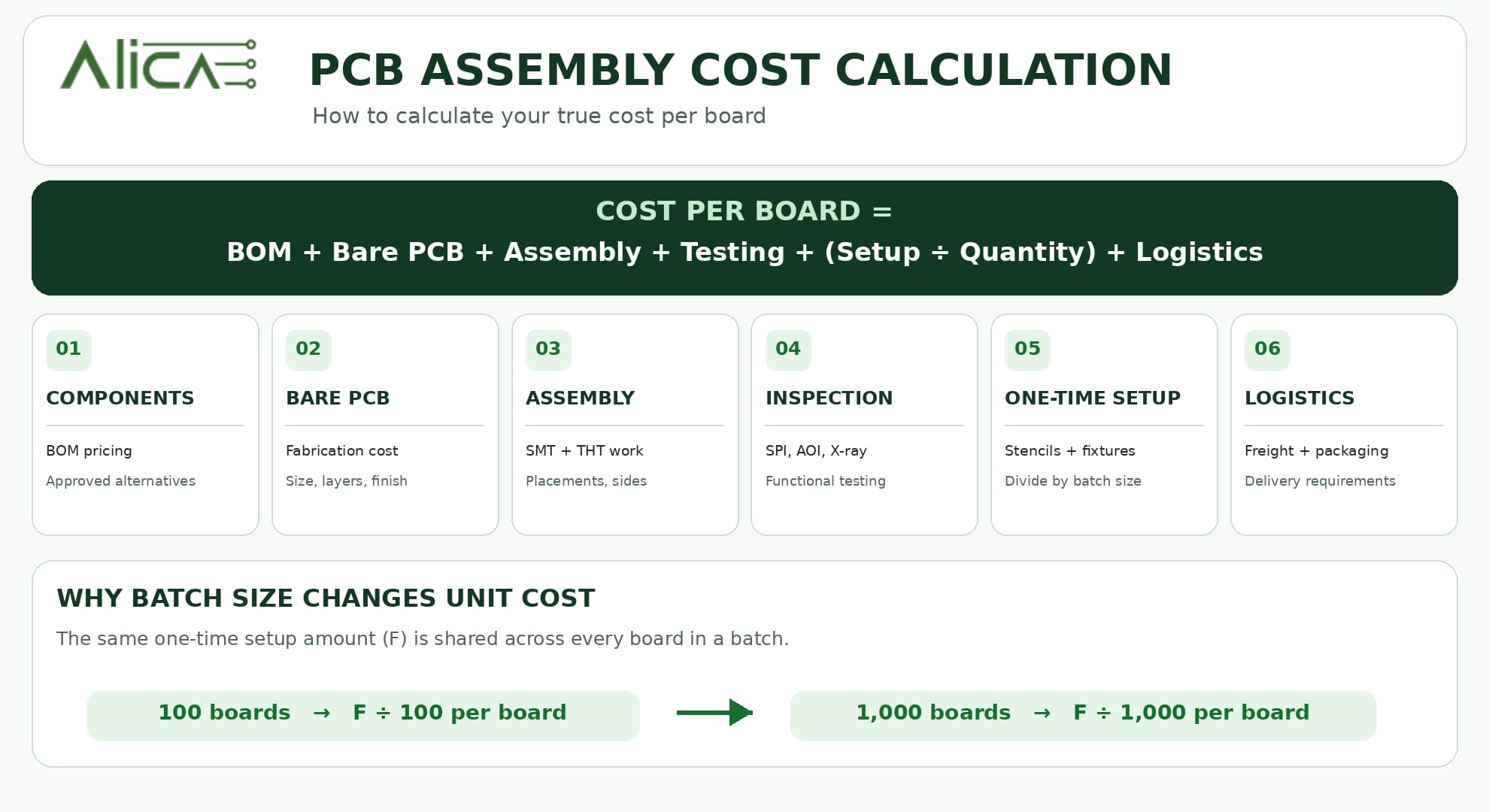
Cost per board = components + bare PCB + assembly + inspection and test + (one-time costs divided by quantity) + logistics
Each part is worked out separately.
Step 1: Components
Multiply the quantity of each line on the BOM by the unit price at your build quantity, then add them up. Add an allowance for attrition on small parts such as resistors and capacitors, because reels lose parts at the start and end of a run. Note any part with a long lead time or a minimum order quantity far above your need, because those change the real cost of the build even if the unit price looks low.
Step 2: Bare PCB
The fabricated board is priced by size, layer count, material, finish and quantity. Ask for it as a separate line so you can see it, even if the assembler is buying it for you.
Step 3: Assembly
Assembly cost follows the work on the board: the number of SMT placements, the number of through-hole joints, whether one or both sides are populated, and how many fine-pitch or bottom-terminated packages need extra care. Boards that mix SMT and THT take more steps, which is explained in the SMT vs THT assembly guide for product engineers.
Step 4: Inspection and test
List each step you need: solder paste inspection, AOI, X-ray for BGAs and QFNs, functional testing and burn-in. Each adds time per board. Treat test as part of the cost, not as an option to trim, because a defect found in the field costs far more than one found on the line. Alica’s testing and inspection services page lists the steps it offers.
Step 5: One-time costs, divided by quantity
Add stencils, programming of placement machines, functional test fixture and software, and first article inspection. Divide the total by the number of boards in the batch. This is the step most buyers leave out, and it is the reason a prototype quote and a production quote for the same board look so different.
Step 6: Logistics and packaging
Add freight, insurance, packaging and, for imported builds, duties and clearance. Domestic manufacturing removes the import steps for boards used in India.
A worked example without invented prices
The arithmetic matters more than the rupee figures, so here is the logic using quantities only.
Suppose the one-time costs for a board come to a fixed amount, call it F. At a batch of 100 boards, each board carries F divided by 100. At 1,000 boards, each carries F divided by 1,000, one tenth as much. If F is large compared with the per-board costs, the unit price at 1,000 will be far lower than at 100, even if nothing else changes. That is why the same supplier can honestly quote very different unit prices for a pilot and for production.
Now suppose one component on the BOM has a minimum order quantity of 3,000 and you are building 1,000 boards. Unless the leftover parts will be used on a later batch, the real cost of that line is the cost of 3,000 parts spread over 1,000 boards. Ask your supplier how it handles excess stock before you compare quotes.
How the cost breaks down, and what moves it
| Cost element | Fixed or variable | What makes it rise | How to bring it down |
|---|---|---|---|
| Components | Variable | Shortages, small order quantities, single-source parts | Approved alternates, consolidated orders, early sourcing |
| Bare PCB | Variable | More layers, larger size, special materials | Panel design that fits the fabricator’s standard sizes |
| Assembly | Variable | More placements, double-sided build, mixed technology | DFM changes that cut hand work and second-side runs |
| Inspection and test | Variable | Complex functional tests, long burn-in | Test points designed in, fixtures planned early |
| One-time costs | Fixed per job | Design changes that need new stencils or fixtures | Freeze the design before tooling, reuse fixtures across batches |
| Logistics | Variable | Imports, urgent freight | Domestic manufacturing, planned delivery schedules |
For procurement: comparing quotes on the same basis
Once you have your own calculation, use it to normalise supplier quotes. Ask each supplier to split the price into the same six lines. Check whether the quote is turnkey, where the assembler buys the components, or consigned, where you supply them. The difference is explained in what turnkey PCB assembly covers and how it works. A turnkey quote includes sourcing effort and stock risk that a consigned quote leaves with you, so the two are not directly comparable. Alica’s turnkey project delivery includes full BOM management with a transparent cost breakdown, which makes this comparison easier.
For R&D teams: design choices that set the cost
Most of the cost of a board is fixed when the design is released. Part choice, package type, board size and whether both sides are populated are all engineering decisions. An early DFM review shows where a small layout change removes a hand-soldered part or a second reflow pass.
For operations teams: the cost of quality
A low unit price means little if one batch in five needs rework. When you compare suppliers, look at what inspection is included and how consistently they build from batch to batch. The checklist for choosing a PCB assembly partner covers the questions to ask.
Checklist: inputs for an accurate PCB assembly cost calculation
- Final BOM with manufacturer part numbers and approved alternates
- Gerber files, assembly drawing and pick-and-place file
- Build quantities for prototype, pilot and production, plus expected annual volume
- Number of SMT placements and through-hole joints, and whether both sides are populated
- List of BGA, QFN and other fine-pitch packages
- Inspection and test steps required, including functional test and burn-in
- One-time costs listed separately: stencils, programming, fixtures, first article
- Minimum order quantities and how excess stock will be handled
- Turnkey or consigned model, stated clearly in every quote
- Delivery location, packaging and freight terms
Frequently Asked Questions
How do you calculate PCB assembly cost per board?
Add the component cost, the bare PCB cost, the assembly cost and the inspection and test cost for one board. Then add the one-time costs, such as stencils, programming and test fixtures, divided by the number of boards in the batch, plus freight and packaging. The result is the true cost per board for that quantity.
Why is the cost per board higher for small batches?
One-time costs such as stencils, machine programming and test fixtures are about the same for a small batch as for a large one. In a small batch those costs are shared by fewer boards, so each board carries a bigger share. Component prices are also usually higher at small order quantities.
What files do I need for an accurate PCB assembly quote?
Send a complete BOM with manufacturer part numbers, Gerber files, the pick-and-place file and assembly drawing, the quantities you plan to build, and your inspection and test requirements. State whether you want a turnkey or consigned quote. Missing information forces the supplier to guess, and guesses usually raise the price.
Get a clear cost breakdown for your build
Alica Technologies, based in Changodar, Ahmedabad, provides turnkey PCB assembly with full BOM management and a line-by-line cost breakdown, so you can check every part of the price. Send your BOM and files to request a detailed PCB assembly quote from Alica, or see Alica’s assembly, inspection and test capabilities.
Looking for a reliable EMS partner?
Get a quote for PCB assembly, turnkey manufacturing, or prototype builds.
Get in Touch