
Smart Meter Component Sourcing: Metering ICs, MCUs and Comms Modules
 Utsav
•
Nov 20, 2026
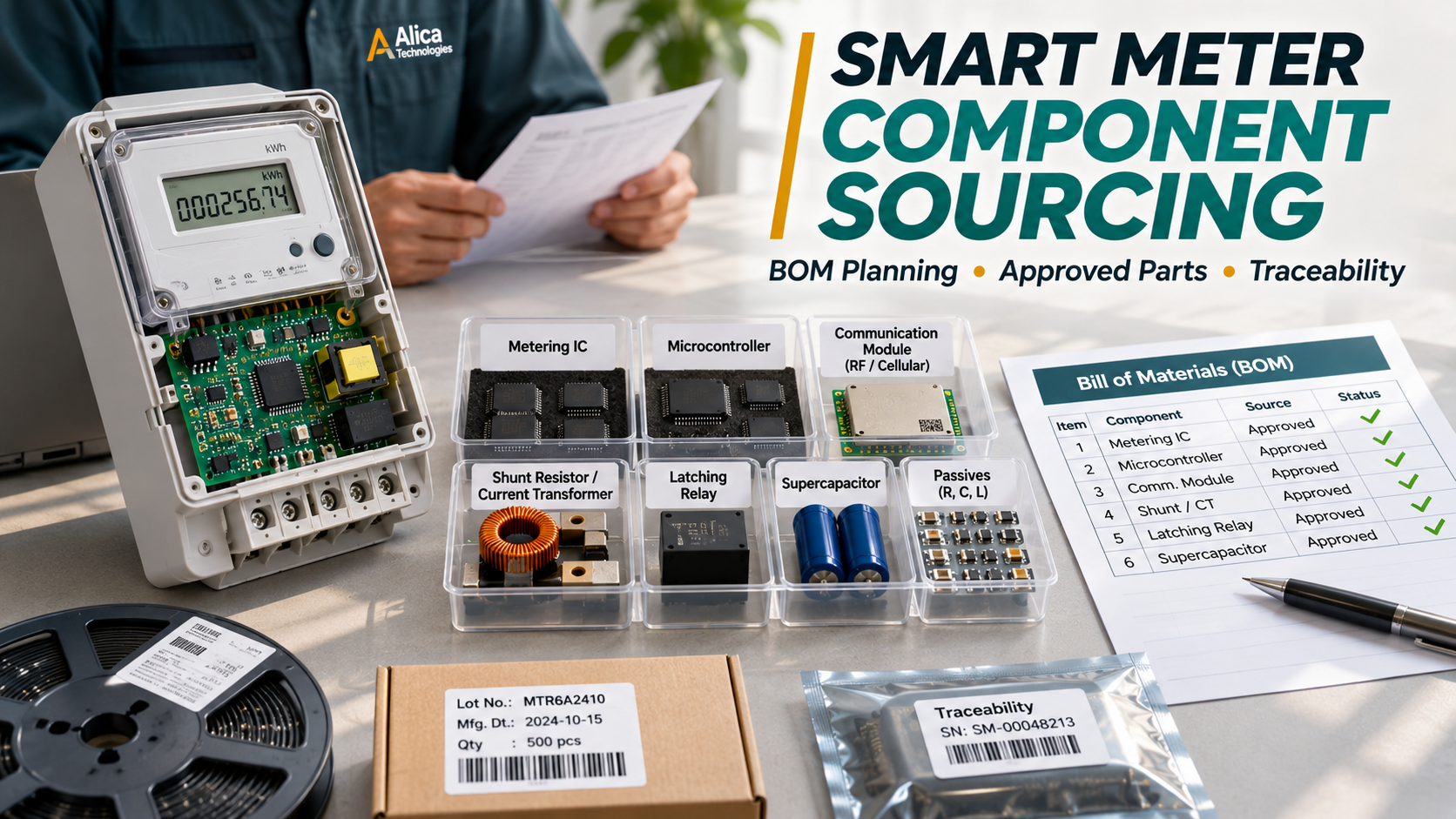
For a meter OEM, the hardest part of a large utility order is often not the design or the assembly. It is getting every component on the bill of materials, in the right quantity, from an approved source, before the delivery schedule starts to slip. Smart meter component sourcing has become a planning problem in its own right: the metering IC, microcontroller and communication module may each have only one or two qualified sources, and utility tenders leave little room to change the design once a meter type has been tested.
Purchasing teams sit in the middle of this. They need to keep cost under control, avoid buying from risky channels, and still have material on the line when production starts. This guide explains which smart meter components carry the most risk, how a turnkey EMS partner can share the load, and what engineering and operations teams should expect from the sourcing plan.
Why smart meter component sourcing is difficult
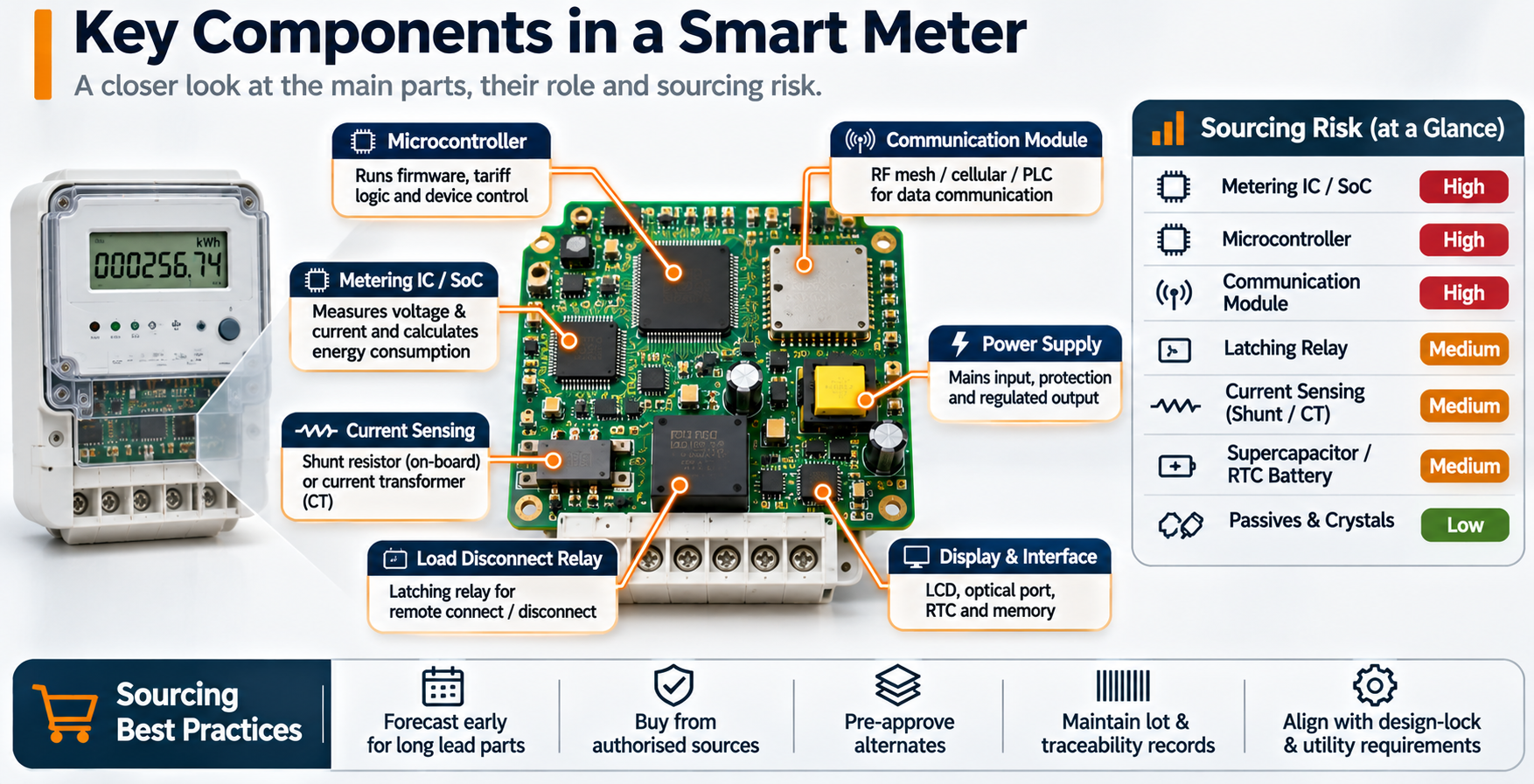
A smart electricity meter looks simple from the outside, but its BOM combines parts from very different supply chains. A typical single-phase or three-phase meter includes:
- A metering IC or metering SoC that measures voltage and current and calculates energy. Many meters use a dedicated metrology chip; others use a microcontroller with a built-in metering front end.
- A main microcontroller that runs the meter firmware, tariff logic, display, data logging and security functions.
- A communication module or chipset for RF mesh, cellular, power line communication or a combination, depending on the utility’s network.
- Current sensing parts such as a shunt resistor or current transformer, plus voltage dividers.
- A power supply section with a mains input stage, protection components and, in many designs, a supercapacitor or battery for the real-time clock.
- A load disconnect relay or latching relay for prepaid and remote disconnect functions.
- Display, optical port parts, memory, crystals and connectors, plus the plastic enclosure, terminal block and seals.
Several of these are design-locked. The meter type is tested against the utility’s specification and the OEM’s product standard, such as IS 16444 for smart meters in India, and changing the metering IC, MCU or comms module can mean repeating that testing. So a shortage of one part cannot always be solved by buying a similar part from another manufacturer. That is what makes sourcing for meters different from sourcing for many consumer products.
The highest-risk lines on a smart meter BOM
Not every line needs the same attention. Procurement teams get the most value by focusing on the few parts that are expensive, single-sourced or hard to substitute.
| Component | Why it is a sourcing risk | What to agree with the EMS partner |
|---|---|---|
| Metering IC or metering SoC | Usually single-sourced; firmware and calibration depend on it | Forecast early, buy only from authorised channels, keep lot records |
| Main microcontroller | Firmware is built for one part number and memory size | Lock the exact ordering code, plan for end-of-life notices |
| Communication module or chipset | Linked to the utility’s network and to wireless approvals | Confirm module version and firmware, track allocation risk |
| Shunt or current transformer | Affects accuracy; changing source can shift calibration | Approve alternates only after an engineering check |
| Latching relay | Large, specialised part with limited makers | Agree approved makers and incoming inspection |
| Supercapacitor or RTC battery | Shelf life and storage conditions matter | Agree date code limits and storage handling |
| Passives, crystals, protection parts | Usually multi-sourced, but volume can be high | Pre-approve alternates so the line is not held up |
How turnkey sourcing changes the buyer’s job
Many meter OEMs still buy the key chips themselves and consign them to an assembler, while the assembler buys the rest. This can work, but it splits responsibility: when a build is short of one part, it is not always clear who should have ordered it. With a turnkey model, the EMS partner buys the full BOM, manages stock and shortages, and delivers finished boards or meters. The OEM still controls the approved vendor list and part numbers, but the day-to-day work of ordering, chasing and receiving moves to the partner.
For procurement teams, a good turnkey sourcing and BOM management service should offer:
- A costed BOM with a transparent line-by-line breakdown, so the buyer can see which parts drive the price and where alternates could save money.
- Early warnings on long lead time, allocation or end-of-life parts, raised before the build date rather than on it.
- Purchase from authorised distributors or the original manufacturer for critical parts, with lot and date code records.
- A clear process for proposing alternates, where the OEM’s engineering team approves every change in writing.
- Component traceability that links each meter or board serial number to the lots of its key components.
Understanding what drives PCB assembly price in India also helps buyers compare turnkey quotes fairly, since component cost is usually the largest part of the total.
Building a smart meter BOM that is easier to source
Sourcing risk is easiest to reduce before the design is frozen. Procurement can ask engineering to consider a few points during the design and DFM stage:
- Use parts with more than one approved maker where accuracy and approvals allow, especially for passives, protection devices and connectors.
- Avoid parts that are already marked not recommended for new designs.
- Pick standard package sizes that several makers offer.
- Where the metering IC or MCU family has pin-compatible memory options, check whether the firmware could run on more than one.
- Record approved alternates on the BOM itself, not in an email thread.
The smart meter PCB design for manufacturability checklist covers the layout side of this, such as footprints that accept more than one package option.
What R&D teams need from the sourcing plan
Engineering teams care about one thing above all: that the production meter is built from the same parts as the meter that passed type testing. They should own the approved part list, sign off any alternate, and receive lot information for critical parts when a field problem needs investigation. A sourcing partner that understands this will never substitute a metering IC, shunt or relay without approval, even when it would make a delivery easier.
What operations teams need from the sourcing plan
For plant and operations teams, sourcing shows up as line stoppages and incomplete kits. They need kits that are complete before the build starts, moisture-sensitive parts stored and baked correctly, and clear rules on date codes for parts with shelf life. When a meter build combines end-to-end electronics manufacturing with box build and testing at one site, the number of handovers between suppliers falls, and so does the number of places where a shortage can hide.
Smart meter sourcing checklist for buyers
- Is there an approved vendor list for every BOM line, with alternates marked?
- Which lines are single-sourced, and is there a forecast or buffer plan for them?
- Are metering ICs, MCUs and comms modules bought only from authorised channels?
- Does the partner keep lot and date code records linked to meter serial numbers?
- How are end-of-life and allocation notices passed to the OEM, and how quickly?
- Who approves alternates, and is approval recorded in writing?
- Is the costed BOM shared with a transparent breakdown by line?
- Are storage and baking rules defined for moisture-sensitive parts and supercapacitors?
- Is the sourcing plan aligned with the utility delivery schedule, not just the first build?
For a wider view of meter production, see the smart meter PCB assembly and box build guide and the guide to choosing a smart meter contract manufacturer in India.
Frequently Asked Questions
What is smart meter component sourcing?
Smart meter component sourcing is the planning and purchase of every part on a meter’s bill of materials, including the metering IC, microcontroller, communication module, current sensing parts, relay and power supply components. It covers approved vendors, alternates, lead times, authorised channels and traceability so production meters match the tested design.
Can a turnkey EMS partner change components on a smart meter BOM?
Only with the OEM’s written approval. A turnkey partner can propose alternates when a part is short or reaching end of life, but design-locked parts such as the metering IC, MCU, shunt and comms module should never be changed without an engineering review, because the change can affect accuracy and type test results.
Why should meter OEMs buy critical chips from authorised channels?
Authorised distributors and original manufacturers supply parts with known origin, lot records and proper storage. Parts from unverified brokers can be counterfeit, remarked or poorly stored, which creates accuracy and reliability problems that may only show up after meters are installed in the field.
Talk to Alica about your smart meter BOM
Alica Technologies supports metering OEMs with turnkey sourcing, full BOM management, transparent cost breakdowns and component traceability, alongside PCB assembly, inspection, testing and box build at its facility in Changodar, Ahmedabad. Review Alica’s manufacturing and sourcing capabilities, or send your smart meter BOM to the Alica team for a costed review.
Looking for a reliable EMS partner?
Get a quote for PCB assembly, turnkey manufacturing, or prototype builds.
Get in Touch