
Industrial Automation PCB Assembly: PLCs, Drives and Controllers
 Utsav
•
Nov 19, 2026
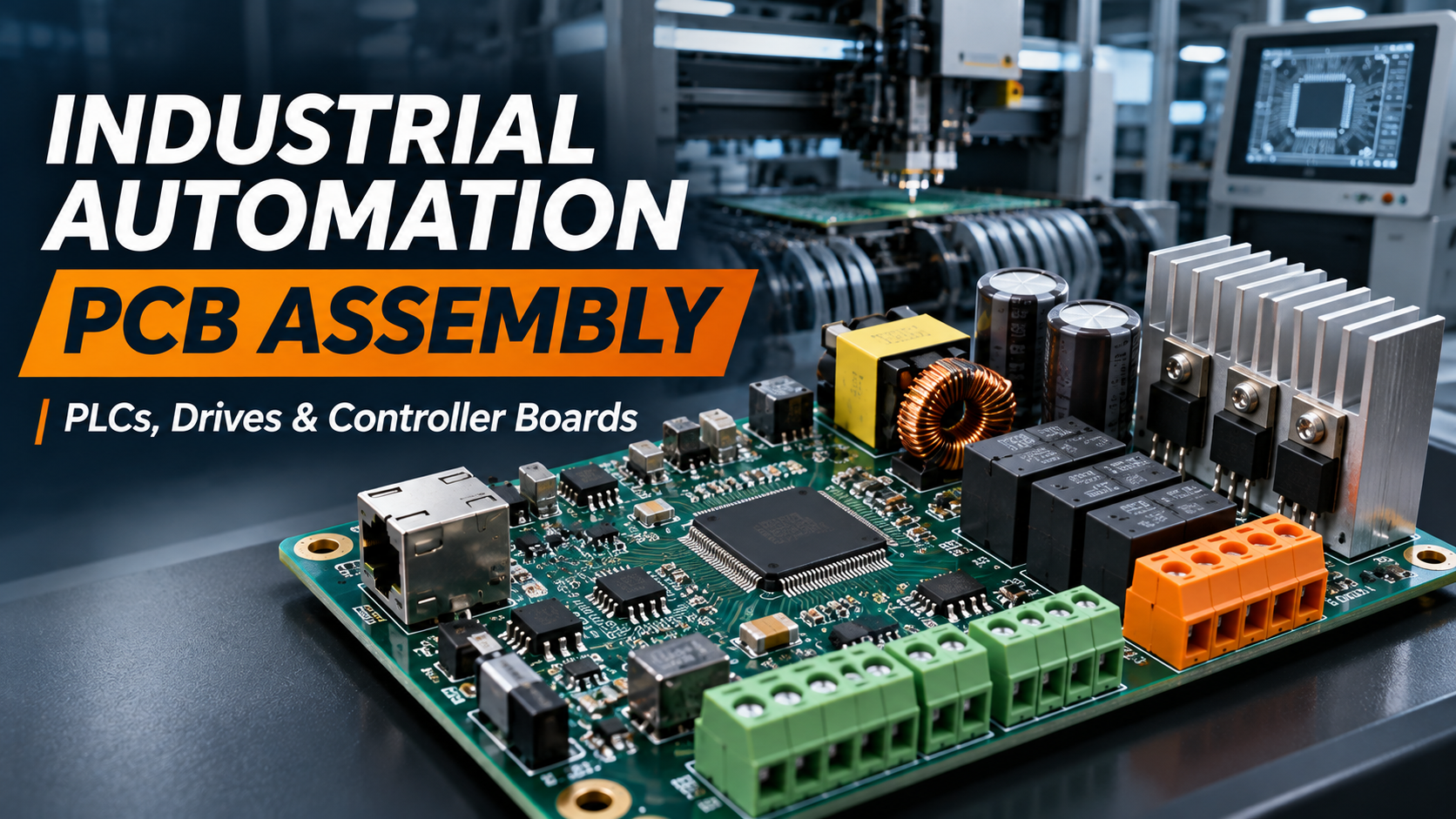
A PLC, motor drive or machine controller is expected to run for years in a panel that is hot, dusty and electrically noisy, often next to contactors and variable frequency drives that throw spikes onto every cable. When one of these boards fails, a production line stops, and the cost of that stoppage is far larger than the price of the board. For hardware teams, industrial automation PCB assembly is the point where a robust design either becomes a robust product or picks up the weak solder joints and loose connectors that show up as field returns months later.
The problem is that industrial boards do not look like consumer boards. They mix fine-pitch processors with heavy terminal blocks, relays, transformers and power semiconductors. They are built in moderate volumes with many variants, and they stay in production for a long time. This guide explains what makes PLCs, drives and controllers hard to build, what R&D teams should agree with an assembly partner, and how purchasing and plant teams fit into the decision.
Why industrial automation PCB assembly is hard
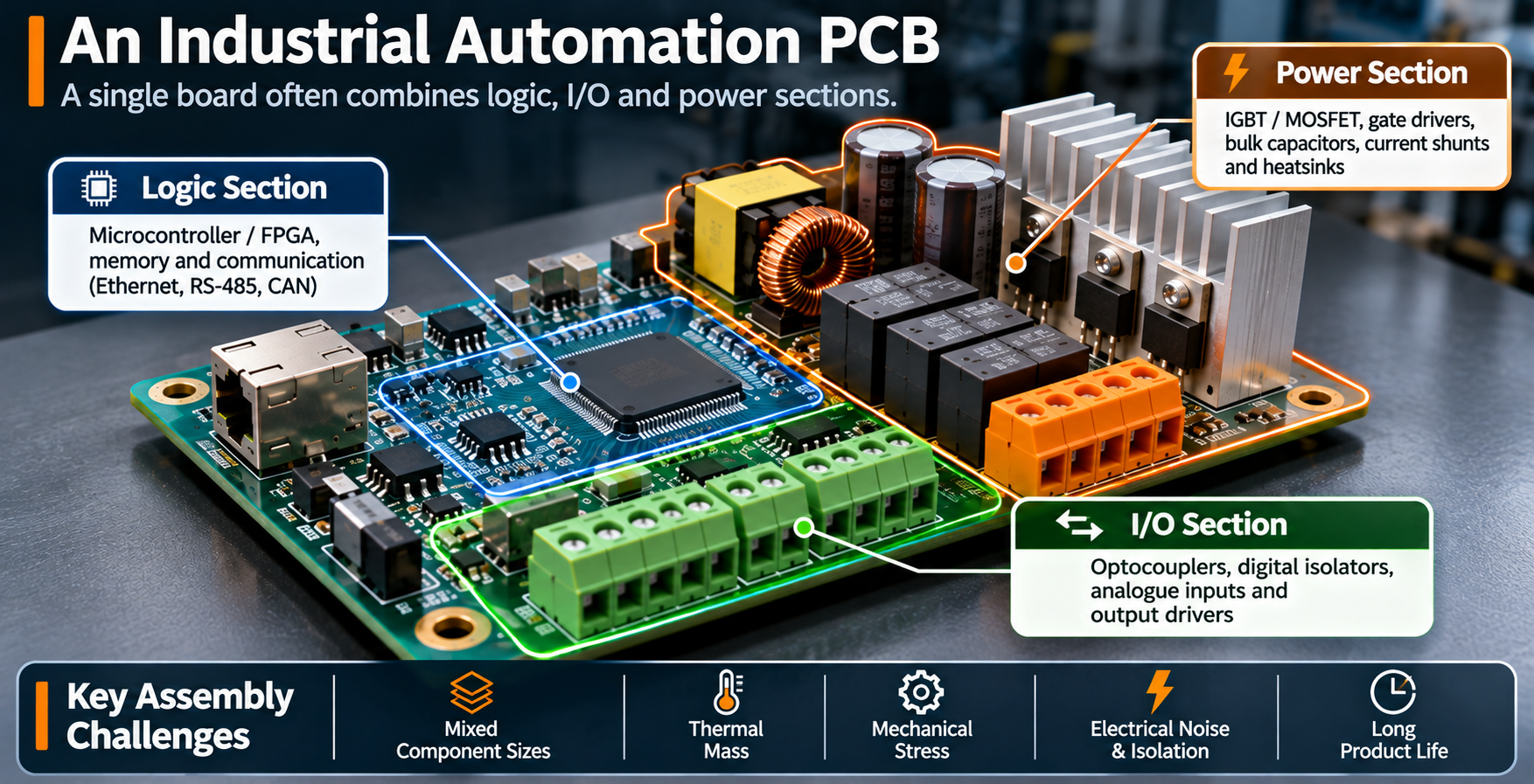
Most industrial control products combine three very different kinds of circuit on one or two boards. There is a logic section with a microcontroller, FPGA or application processor, memory and communication interfaces such as Ethernet, RS-485, CAN or fieldbus transceivers. There is an I/O section with optocouplers, digital isolators, analogue input stages and output drivers. And there is a power section, which in a motor drive can include IGBT or MOSFET modules, gate drivers, bulk capacitors, current shunts and heatsinks.
Each section stresses the assembly process in its own way:
- Mixed component sizes. A 0.5 mm pitch QFP or BGA sits next to a terminal block with large through-hole pins. Paste, placement and soldering have to suit both on the same board.
- Thermal mass. Heavy copper planes, large connectors and power parts soak up heat, so joints can be cold or poorly wetted if the soldering profile is not set for the board.
- Mechanical stress. Field wiring is screwed into terminals and pulled during installation. Connectors, relays and transformers must be soldered with full barrel fill so they survive vibration and handling.
- Electrical noise and isolation. Clearance and creepage around isolation barriers is set by the designer, but solder balls, flux residue or a bridged slot can undo it during assembly.
- Long product life. Industrial products are often sold for ten years or more, so component obsolescence, lot changes and repeat builds need to be managed carefully.
The product itself is usually designed to standards such as IEC 61131-2, which sets functional and electromagnetic compatibility requirements and verification tests for programmable controllers and similar industrial control equipment. Meeting that standard is the OEM’s design responsibility. The assembly partner’s job is to build the released design faithfully, so that the boards tested for compliance and the boards shipped to customers are the same.
What R&D teams should expect from industrial automation PCB assembly
For the hardware lead or NPI manager, the useful questions are about process, not promises. These are the areas that decide whether a controller design builds cleanly.
SMT and THT on the same board
Almost every industrial controller is a mixed technology board. Fine-pitch SMT parts carry the logic, while terminals, relays, power connectors, large electrolytic capacitors and magnetics are through-hole for mechanical strength. Splitting this work between two suppliers adds handling, delays and finger-pointing when a defect appears. Alica Technologies handles high-density multi-layer SMT and THT assembly on the same board, described on the SMT and THT PCB assembly service page. The trade-offs between the two methods are covered in the technical guide to SMT vs THT assembly.
DFM review before tooling
An early design for manufacturability review catches problems that are cheap to fix in the layout and expensive to fix on the line. For industrial boards, the most useful checks are thermal relief on pads connected to heavy copper, hole and pad sizes for terminal pins, component spacing for soldering and rework around tall parts, fiducials, test point access for the functional test fixture and panel layout for boards with large connectors on the edge. Alica runs DFM review before tooling, so these points are raised while they are still a file change rather than a stencil or fixture change.
Inspection of fine-pitch and hidden joints
Inline solder paste inspection checks paste volume and position before placement, which matters on fine-pitch processors and on the large pads of power parts. AOI after reflow checks placement, polarity and visible joints. 3D X-ray confirms BGA balls, QFN centre pads and the thermal pads under power MOSFETs and regulators, where voids reduce heat transfer. The article on common PCB assembly defects and how inspection catches them shows which method finds which fault. Alica works to IPC-recommended procedures with 100% inspection coverage across SPI, AOI and X-ray, as set out on the testing and inspection page.
Functional testing and burn-in
Inspection shows that the board was built correctly. Functional testing shows that it works: I/O channels switch, analogue inputs read within tolerance, communication ports respond and the power stage behaves under load. For drives and power supplies, burn-in testing runs units for a period under load so early-life failures appear in the factory. The OEM usually defines the test specification and limits, and the EMS partner builds and runs the tests as part of production.
PLC, drive and controller boards compared
Different industrial products put the weight of the build in different places. The table below is a starting point when planning inspection and test focus with an assembly partner.
| Product | Typical board features | Main assembly risk | Inspection and test focus |
|---|---|---|---|
| PLC CPU and I/O modules | Processor, memory, isolated digital and analogue I/O, backplane connector | Fine-pitch joints, connector alignment, isolation spacing | SPI, AOI, X-ray on BGAs, I/O functional test |
| Motor drives and VFD control boards | Gate drivers, power modules, shunts, bulk capacitors, heatsinks | Voids under power parts, cold joints on heavy copper | X-ray on thermal pads, THT joint inspection, load and burn-in test |
| CNC and robotic controllers | Multi-axis motion processors, encoder interfaces, high pin count connectors | Dense layouts, many connectors, long cable runs | AOI, X-ray, functional test of each axis interface |
| Industrial gateways and edge controllers | Application processor, Ethernet, fieldbus, wireless modules | BGA joints, module placement, RF parts | X-ray, AOI, communication and firmware test |
| Industrial power supplies | Transformers, magnetics, power semiconductors, large capacitors | Through-hole fill, thermal stress, creepage contamination | THT joint inspection, functional test under load, burn-in |
Industrial electronics manufacturing for procurement teams
For purchasing and supply chain teams, industrial products bring a sourcing problem as much as an assembly one. Boards stay in production for years, so parts go end of life, lead times move and substitutes need engineering approval. Turnkey sourcing with full BOM management puts that work in one place: the EMS partner buys components, tracks lifecycle status and proposes alternates for approval rather than silently swapping parts. Alica offers turnkey sourcing with transparent cost breakdowns, so buyers can see what drives the price of each build. Domestic manufacturing from Ahmedabad also reduces the import and logistics steps for OEMs selling into Indian plants.
Ruggedised box build for operations teams
Plant heads and operations managers care about what arrives at the customer’s panel: a finished unit that works the same way in every batch. Many industrial OEMs prefer to receive complete products, with boards fitted into enclosures, wired to front panels and connectors, programmed, labelled and tested. Box build assembly and mechanical integration remove a step from the OEM’s own floor. The stages are explained in box build assembly from bare PCB to finished product, and Alica’s end-to-end electronic manufacturing service covers the full flow. Component traceability links each serial number to its build records, which helps when a field issue needs to be traced to a lot or a date.
Checklist: before you release an industrial controller for assembly
- Is the design released with a complete BOM, approved alternates and the manufacturer part number for every line?
- Have hole and pad sizes for terminals, relays and power connectors been checked against the actual part datasheets?
- Do pads on heavy copper planes have thermal relief, and is the soldering approach for large parts agreed?
- Are clearance and creepage areas marked, and does the assembler know to keep them free of residue and solder balls?
- Which joints need X-ray: BGAs, QFNs, power MOSFET and regulator thermal pads?
- Is there a written functional test specification with pass and fail limits for every I/O type?
- Does the product need burn-in, and for how long and under what load?
- How will end-of-life components and substitutions be proposed and approved?
- Is serial-level traceability needed, and what records should the partner keep?
- Will the partner deliver bare boards or a finished box build unit, and who handles labelling and packing?
Frequently Asked Questions
What is industrial automation PCB assembly?
Industrial automation PCB assembly is the manufacture of the circuit boards inside PLCs, motor drives, CNC and robotic controllers, industrial gateways and power supplies. It usually combines fine-pitch SMT with through-hole terminals and power parts, followed by inspection, functional testing and often burn-in.
Why do industrial control boards need both SMT and THT assembly?
The logic and communication parts are small surface mount devices, while terminal blocks, relays, transformers and large connectors are through-hole because they carry field wiring and mechanical load. Building both on the same board with one partner avoids extra handling and keeps quality responsibility in one place.
Is the EMS partner responsible for meeting standards such as IEC 61131-2?
No. The OEM designs the product to the standards it needs and arranges compliance testing. The EMS partner builds the released design, inspects and tests it as agreed, and keeps build records, so production units match the units that were tested.
Discuss your industrial controller build with Alica
Alica Technologies builds PCB assemblies and complete box build units for industrial automation OEMs from its facility in Changodar, Ahmedabad. The team combines mixed SMT and THT assembly, SPI, AOI and 3D X-ray inspection, functional and burn-in testing, and turnkey sourcing. Review the full list of manufacturing capabilities, or send your design files to the Alica team for a DFM review and quote.
Tagged in
Looking for a reliable EMS partner?
Get a quote for PCB assembly, turnkey manufacturing, or prototype builds.
Get in Touch