
Patient Monitor PCB Manufacturing: Precision and Traceability
 Utsav
•
Nov 19, 2026
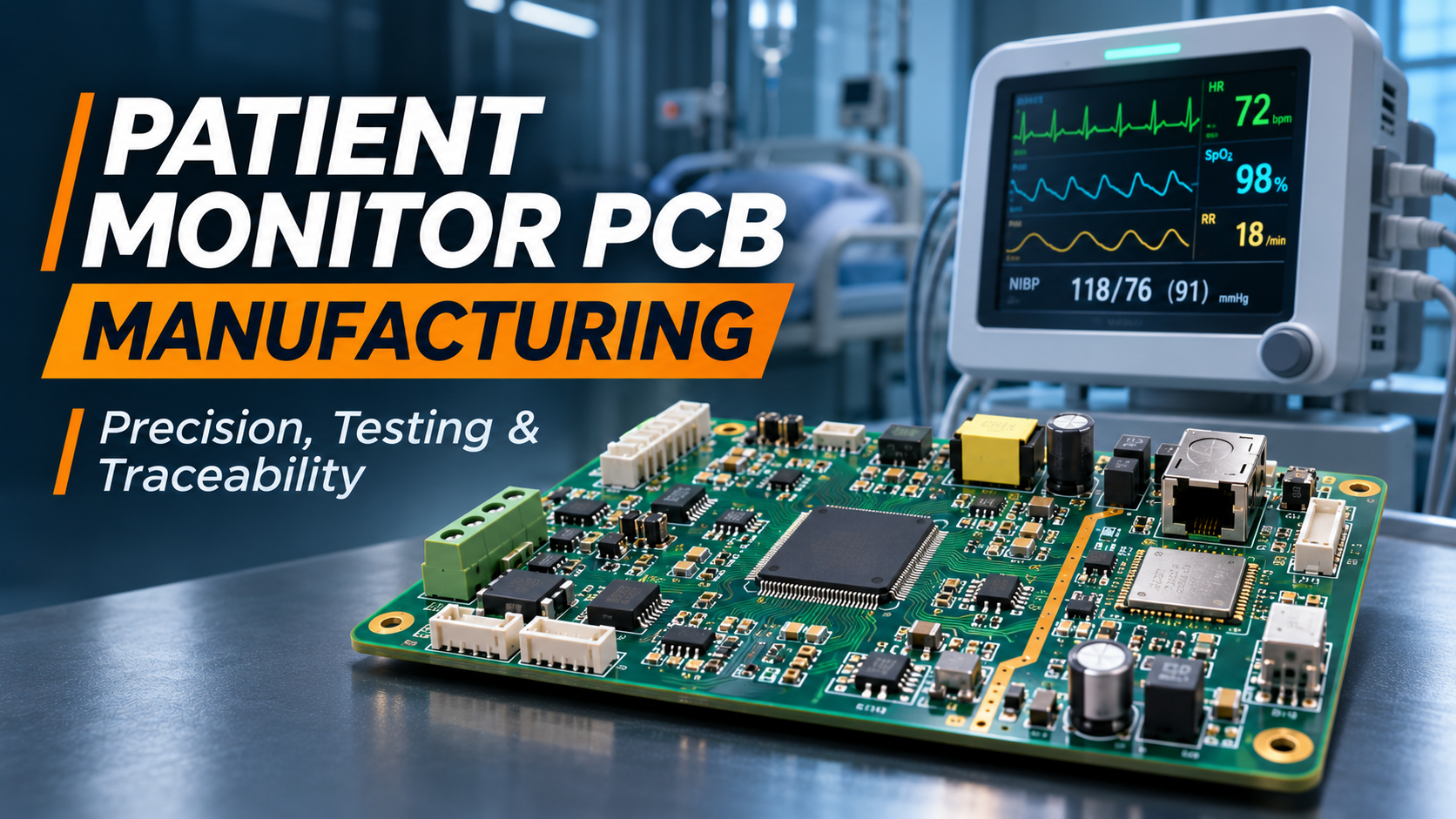
A bedside or transport monitor has to show a heart rate, an SpO2 value and a blood pressure reading that clinicians can trust, and it has to raise an alarm when one of them goes wrong. Behind the screen sit several dense boards, each with its own sensitive measurement circuit. If one of those boards carries a weak joint under a processor, a drifting passive in an analogue front end or a part from an unrecorded lot, the problem may not show up until the device is in a hospital. For hardware teams, patient monitor PCB manufacturing is about building every unit the same way and being able to prove it.
Two pressures make this harder than most electronics work. The first is precision: the boards combine low-level analogue measurement, isolated patient-connected circuits, processors, displays and wireless links in a small space. The second is traceability: when a field issue appears, the OEM must be able to say which units are affected and why. This guide covers both, for R&D teams first and then for purchasing and operations.
What makes patient monitor PCB manufacturing difficult
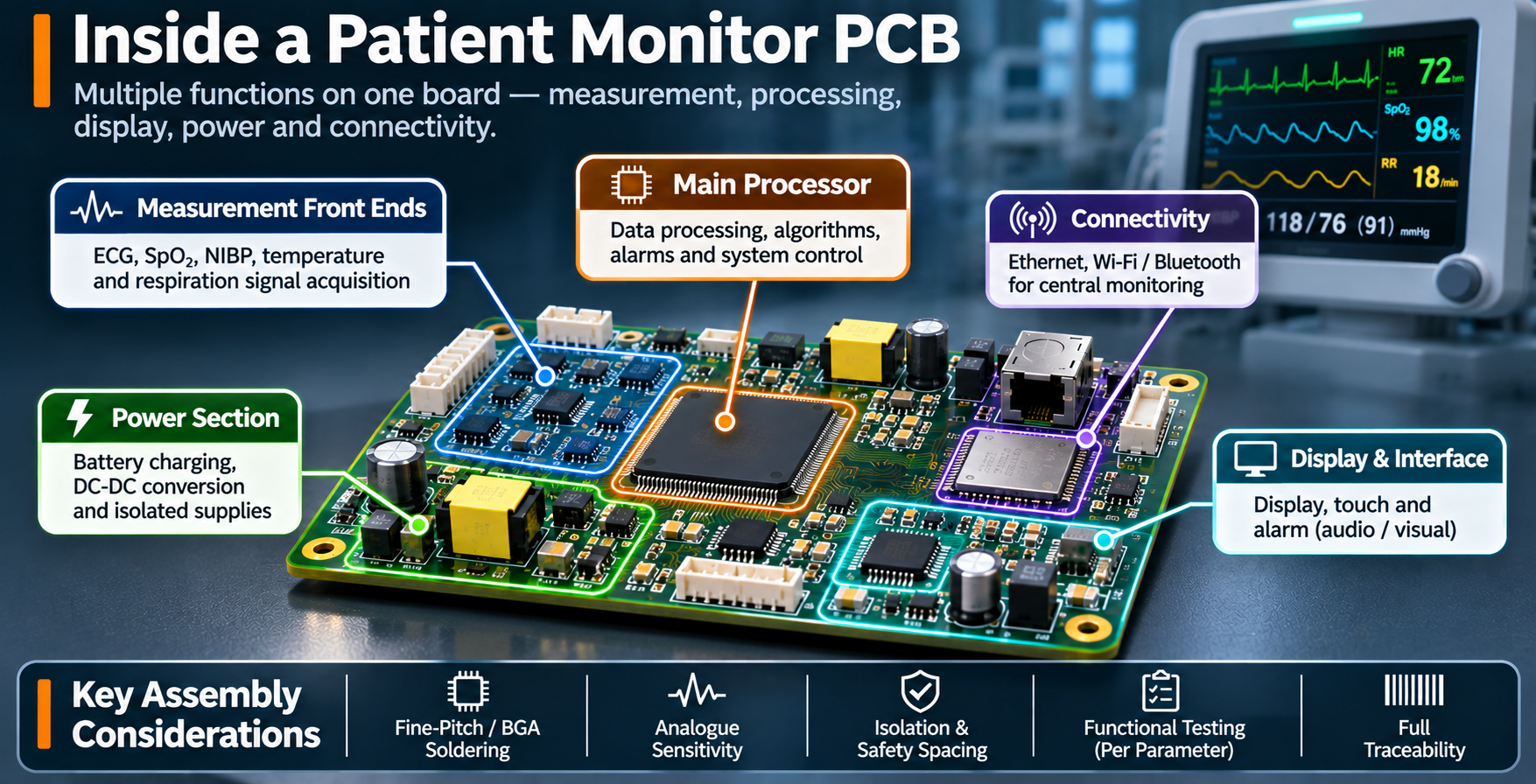
A multiparameter patient monitor typically measures several of the following: ECG, SpO2, non-invasive blood pressure, temperature, respiration and, in higher-end models, invasive pressure and capnography. Each parameter needs a front end that picks up a very small signal, conditions it and converts it to digital data. These front ends are often built as separate modules or as isolated sections on a main board.
Around them sit a main processor board with a BGA or fine-pitch processor and memory, a display and touch interface, a power board with a battery charger and isolated supplies, an alarm speaker and indicator circuit, and connectivity such as Ethernet, Wi-Fi or Bluetooth for central station links. That mix produces several assembly risks at once:
- Hidden joints. Processors, memory and many front-end ICs are BGA or QFN parts whose joints cannot be seen by eye or by AOI.
- Analogue sensitivity. Leakage paths, contamination and component tolerance can shift readings on circuits that measure microvolts.
- Isolation barriers. Patient-connected sections are separated from mains and other circuits by isolation spacing set in the design. Solder balls, flux residue or a misplaced part across that gap can compromise it.
- Dense layouts. Portable and transport monitors pack components closely, leaving little room for rework.
- Long service life. Monitors stay in service for years, so latent defects matter more than they would in a consumer product.
The device itself is designed to medical standards. IEC 60601-1 sets general requirements for basic safety and essential performance of medical electrical equipment, and IEC 80601-2-49 is the particular standard for multifunction patient monitors, with individual parameters such as ECG and pulse oximetry covered by their own particular standards. In India, devices are also regulated under the Medical Devices Rules, 2017. All of these are the device manufacturer’s obligations. The manufacturing partner builds the released design and keeps the records that show it did.
Precision in patient monitor PCB assembly: what R&D teams should check
For the hardware lead or NPI manager, these are the process points that decide whether a monitor design builds consistently.
DFM review focused on the front ends
Design for manufacturability review is most valuable before the stencil is cut. On monitor boards, useful checks include paste apertures for BGA and QFN thermal pads, spacing around fine-pitch front-end ICs, keeping test points accessible without placing them in sensitive analogue areas, fiducials on every panel, and component choices that are close to end of life. Alica Technologies carries out DFM review before tooling. The general approach is covered in the guide to designing PCBs for high-yield assembly.
Paste, placement and X-ray inspection
Inline solder paste inspection checks paste volume and position before components are placed, which prevents many bridges and opens on fine-pitch parts. AOI after reflow checks placement, polarity and visible joints. 3D X-ray then confirms the joints under BGAs and QFNs, including voids. Alica runs SPI, AOI and 3D X-ray with 100% inspection coverage, following IPC-recommended procedures; the methods are described on the testing and inspection page, and the article on PCB assembly defects and how inspection catches them explains which fault each method finds.
Mixed technology for connectors and power
Patient cable connectors, battery terminals, power inlets and some larger components are usually through-hole, because they take repeated mechanical stress. Building SMT and THT on the same board with one partner keeps the process consistent. Alica’s SMT and THT assembly service covers both.
Functional testing per parameter
A visual or X-ray pass does not prove that a front end reads correctly. Functional testing with patient simulators or test signals, run to the OEM’s specification, confirms that each parameter, the alarm path and the communication ports work before the board moves on. The OEM defines the limits; the EMS partner runs the tests and records the results against each serial number.
Traceability: what to record for every monitor
Traceability is what lets a medical OEM answer a field complaint quickly and narrowly. If a reading drifts on units in one hospital, the OEM needs to know which component lots, build dates, test results and rework records apply to those serial numbers, so it can act on the affected units rather than the whole installed base. Alica provides component traceability, linking each unit to its build records. The table below shows the records that are worth agreeing before the first production order.
| Record | What it captures | Why it matters for a monitor OEM |
|---|---|---|
| Component lot and date code | Which reel or batch each critical part came from | Limits a recall or field action to units built with a suspect lot |
| Board and unit serial number | Unique identity for each PCB and finished unit | Links a field unit back to its full build history |
| Inspection results | SPI, AOI and X-ray outcomes per board | Shows hidden joints were checked, not assumed |
| Functional test results | Measured values against the OEM’s limits per parameter | Gives evidence that each unit met specification when shipped |
| Rework and repair log | What was reworked, how and by whom | Helps identify patterns behind field failures |
| Revision and firmware version | PCB revision, BOM revision and firmware loaded | Confirms which design and software each unit carries |
The wider picture of building medical products, including diagnostics and wearables, is covered in the pillar guide to medical device PCB assembly in India.
For procurement teams: sourcing for patient monitors
Purchasing teams face long product lives and strict change control. A monitor that has been verified with one set of components cannot casually take a substitute, so the BOM needs approved alternates agreed early and a clear process for any change. Turnkey sourcing with full BOM management lets the EMS partner buy parts, track lifecycle status and raise end-of-life warnings in time for a planned change. Alica offers turnkey sourcing with transparent cost breakdowns, and its turnkey project delivery service brings sourcing, assembly and test under one order.
For operations teams: consistent batches and box build
Operations heads want every batch to behave like the qualified one. That depends on a fixed process, documented work instructions, full inspection and the same test steps for every unit. Many OEMs also prefer to receive finished or semi-finished units, with boards fitted into housings, wired and tested, so that their own floor focuses on final configuration and release. Alica provides box build and mechanical assembly integration alongside board assembly, with functional and burn-in testing where the OEM specifies it.
Checklist for patient monitor PCB manufacturing
- Is every critical component marked in the BOM, with approved alternates listed?
- Are isolation areas marked on the assembly drawing so the line keeps them clear of residue and solder balls?
- Which parts need X-ray inspection, and what void limits will you accept?
- Is there a written functional test specification for each parameter, the alarm path and communications?
- What traceability records do you need per serial number, and for how long should they be kept?
- How will component changes and substitutions be proposed, approved and recorded?
- Will the partner deliver tested boards or a box build unit, and who loads and verifies firmware?
- Which supplier quality system certifications does your regulatory plan require, and has the partner confirmed them in writing?
- Who owns regulatory submissions and product standard testing, and is that written into the agreement?
Frequently Asked Questions
What is patient monitor PCB manufacturing?
Patient monitor PCB manufacturing is the assembly, inspection and testing of the circuit boards inside bedside, transport and portable patient monitors. These boards carry the measurement front ends for parameters such as ECG, SpO2 and blood pressure, along with the processor, power, display and communication circuits.
Why is traceability important for patient monitor boards?
Traceability links each serial number to its component lots, inspection results, test results and rework records. If a field issue appears, the OEM can identify exactly which units are affected and act on those units instead of the whole installed base.
Does the EMS partner make the monitor compliant with IEC 60601-1?
No. The device manufacturer designs the monitor to IEC 60601-1, IEC 80601-2-49 and any other applicable standards, and arranges compliance testing. The EMS partner builds the released design, inspects and tests it as agreed, and keeps the records the manufacturer needs.
Plan your patient monitor build with Alica
Alica Technologies builds medical PCB assemblies and box build units from its facility in Changodar, Ahmedabad, with SPI, AOI and 3D X-ray inspection, functional testing, component traceability and full BOM management. Review the capabilities overview, or share your monitor design files with Alica for a DFM review and quote.
Looking for a reliable EMS partner?
Get a quote for PCB assembly, turnkey manufacturing, or prototype builds.
Get in Touch