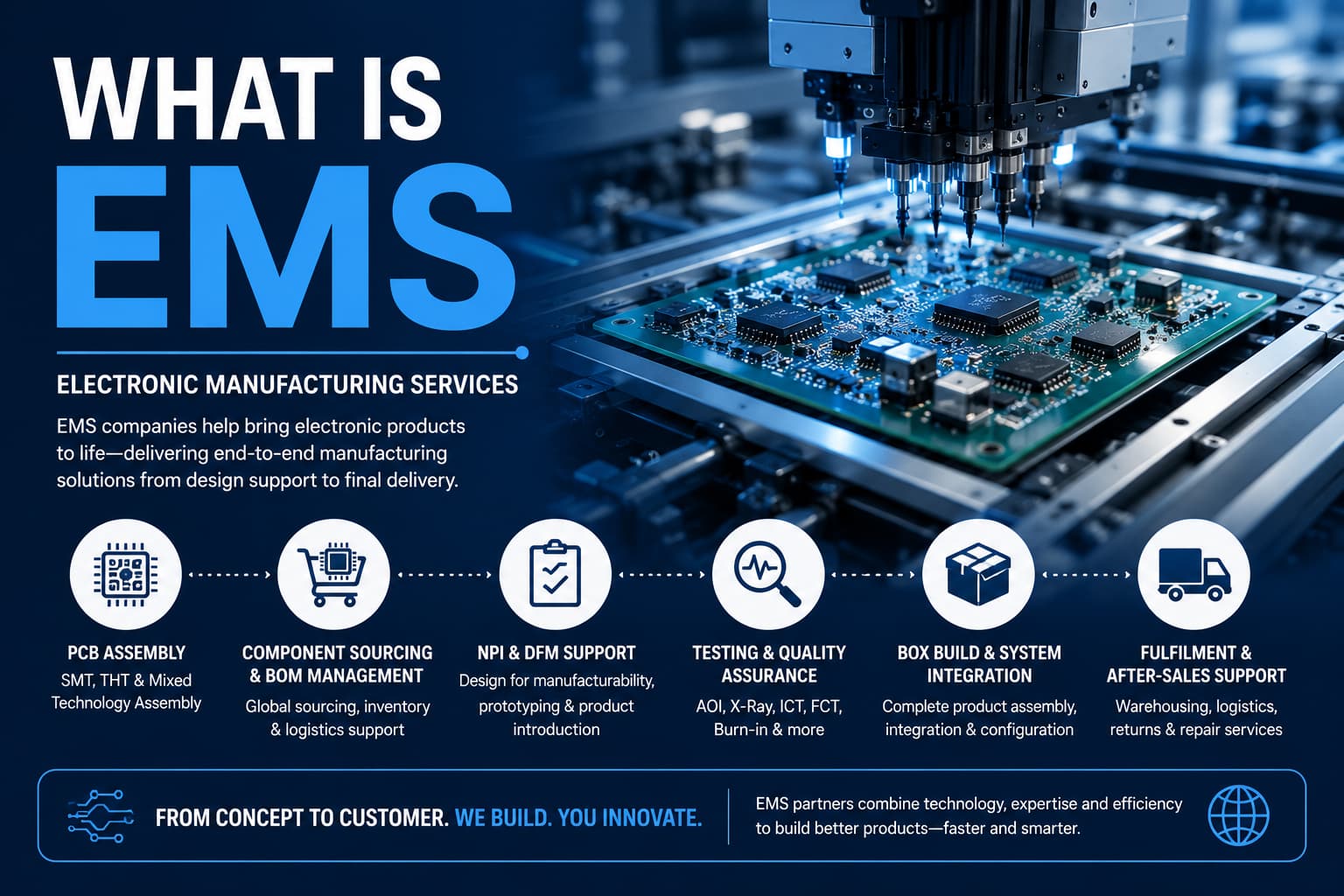

Search “best EMS provider in India” and you’ll find dozens of listicles ranking companies by name, with no visible methodology behind the ranking. The truth is more useful than any of those lists: “best” isn’t a fixed title one company holds — it depends on your product’s complexity, your volume, your quality requirements, and how much design-stage support you actually need.
This guide breaks down the criteria that genuinely separate strong EMS providers in India from the rest, so you can evaluate any company — including us — against a real standard rather than a marketing claim.
Why “Best EMS provider in India” rankings are usually unreliable
Most published rankings of EMS companies are built on directory submissions, SEO reach, or self-reported claims — not verified production data, third-party audits, or customer outcomes. Before trusting any “top 10” list, ask what it’s actually measuring. A more reliable approach is evaluating providers directly against a fixed set of criteria that map to real production risk.
What actually defines a strong EMS provider
1. Inspection depth as standard, not add-on
The clearest signal of a serious EMS provider is whether Solder Paste Inspection (SPI), Automated Optical Inspection (AOI), and X-ray inspection for hidden joints run on every job by default — not as a premium option you have to specifically request. Ask any shortlisted provider directly: what’s inspected on a standard job, with no add-on fees?
2. IPC-A-610 class commitment
IPC-A-610 defines three acceptance classes — Class 1 (general electronics), Class 2 (dedicated service), and Class 3 (high reliability, for aerospace, medical, and defence-grade work). The best providers state clearly which class they build to by default, and can scale to Class 3 when your product demands it — not as a hypothetical future capability.
3. Component traceability and BOM risk management
A provider capable of tracing every component back to its Certificate of Conformance, detecting counterfeit parts, and qualifying alternate components when something goes end-of-life mid-production is managing real supply chain risk on your behalf. This is one of the most overlooked criteria — and one of the most expensive to get wrong.
4. NPI and DFM engagement
The strongest EMS partners get involved at the Design for Manufacturability (DFM) stage during New Product Introduction, catching layout, clearance, and thermal issues before your first prototype run — not after a failed batch. A provider that only engages once Gerber files are “final” is offering assembly labour, not manufacturing partnership.
5. Mixed-technology capability under one roof
Most real-world PCBs need both SMT and THT. Providers who sub-contract one of the two processes to a second vendor introduce a coordination and accountability gap. Look for SMT, THT, and selective soldering capability in a single facility.
6. Scalability without re-qualification
| Criterion | What to Look For |
|---|---|
| Prototype-to-volume path | Same facility, same quality process, no vendor switch required |
| Line utilisation transparency | Provider states real capacity, not just quoted lead times |
| Process documentation | SOPs consistent across prototype and production runs |
Why Alica Technologies are among the best EMS provider in India
We don’t claim to be “the best EMS provider in India” as a blanket statement — we’d rather show you exactly where we stand against the criteria above and let that speak for itself.
- Inspection depth: SPI, post-placement AOI, post-reflow AOI, and X-ray inspection run as standard on every job at Alica — not offered as a premium add-on.
- Quality standard: Our processes follow IPC-recommended SOPs, with first-article inspection built into every new job before a full panel run scales.
- Mixed-technology under one roof: SMT, THT, and selective soldering for mixed-technology boards are all handled at our Ahmedabad facility — no sub-contracted assembly steps.
- NPI and DFM engagement: Our team reviews designs at the DFM stage for prototype and NPI builds, surfacing manufacturability issues before tooling is finalised.
- Track record: 500,000+ PCBs assembled and 90+ successful projects delivered with 100% inspection coverage across builds.
- Scalability: The same facility, process discipline, and quality checkpoints carry from rapid prototyping through to full production volume — no re-qualification with a second vendor.
Turning criteria into a shortlist
Once you’ve evaluated providers against these criteria, the next step is a structured RFQ process. Our detailed EMS partner selection checklist walks through the specific questions to ask before signing.
Frequently asked questions
How do I verify if an EMS provider’s quality claims are real?
Ask for a facility walkthrough, a sample first-article inspection report, and written confirmation of which inspection stages run on every job by default.
Is a larger EMS provider always a better choice?
Not necessarily. Larger providers often offer more capacity, but smaller, specialised providers can offer closer engineering collaboration and faster turnaround on prototype and NPI work.
What’s the difference between IPC Class 2 and Class 3?
Class 2 is for dedicated service electronics where high performance and extended life are required. Class 3 is for high-reliability electronics like aerospace, medical, and defence, where failure is not an acceptable outcome.
Should I trust “top 10 best EMS provider” listicles?
Treat them cautiously unless the methodology is disclosed. Most are built on directory submissions or SEO visibility rather than verified production data or audited outcomes.
What questions should I ask before choosing an EMS provider?
Ask which inspection stages run by default, which IPC class they build to, how they manage component traceability, and whether they engage at the DFM stage during NPI.