

If you are a product company, OEM, or startup building an electronic product, at some point you will face a decision that determines the cost, quality, and speed of everything downstream: do you manufacture your electronics in-house, or do you partner with an Electronic Manufacturing Services (EMS) company?
EMS is one of the most important and least understood segments of the global electronics industry. Apple, Bosch, Siemens, and virtually every major electronics brand in the world uses EMS partners to produce some or all of their products. Yet for many mid-sized OEMs and hardware startups evaluating contract manufacturing for the first time, the EMS landscape: the terminology, the service tiers, the evaluation criteria can be opaque and confusing.
This guide explains exactly what EMS is, what EMS companies do, how the industry is structured, when outsourcing to an EMS partner makes sense, and what to look for when evaluating one, particularly in the context of India’s growing electronics manufacturing ecosystem.
What is EMS? And what does it stand for?
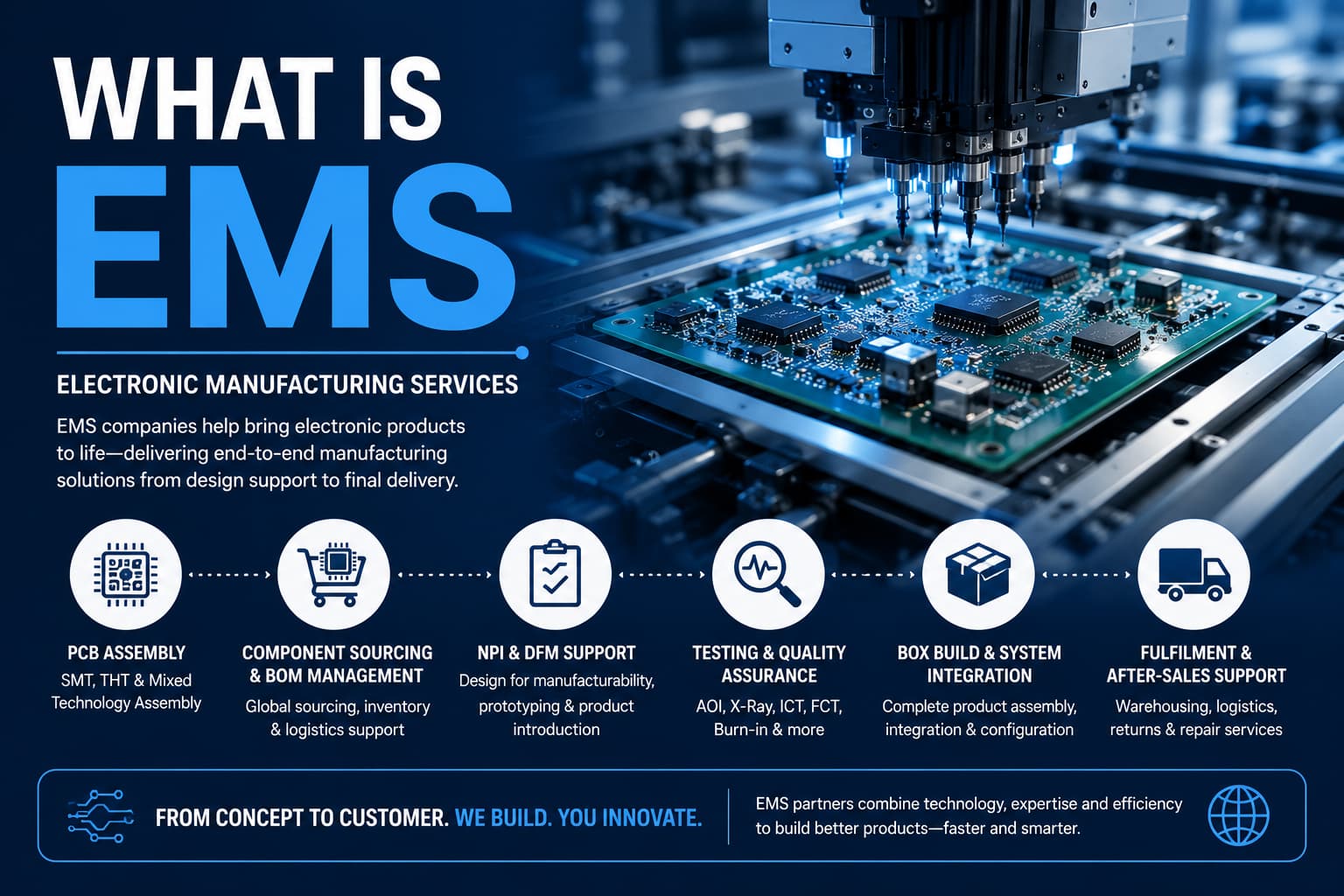
EMS stands for Electronic Manufacturing Services. It refers to companies that design, manufacture, test, distribute, and provide return and repair services for electronic components and assemblies on behalf of original equipment manufacturers (OEMs).
An EMS company does not sell products under its own brand. Instead, it manufactures electronic assemblies: printed circuit boards, sub-assemblies, and complete box-build products to the specifications of its OEM clients, who then brand and sell the finished products.
EMS is sometimes used interchangeably with the term Contract Electronics Manufacturing (CEM) or Contract Manufacturing, though EMS is the more widely accepted industry term today.
What do EMS companies actually do?
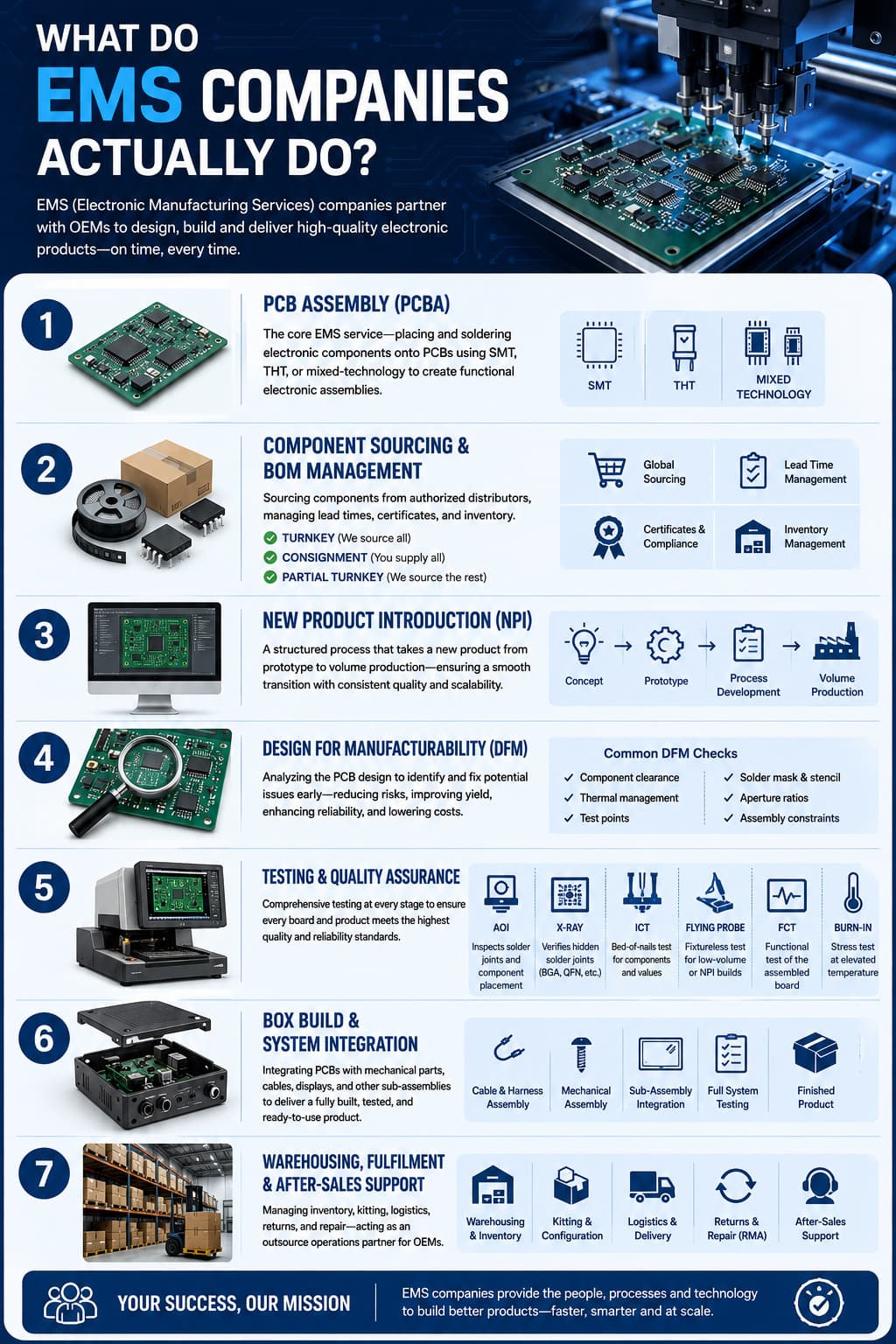
The scope of services offered by EMS companies varies widely from highly specialised single-process providers to full-service partners offering cradle-to-grave support. The core services that define the EMS offering are:
1. PCB Assembly (PCBA)
The most fundamental EMS service is Printed Circuit Board Assembly, the process of placing and soldering electronic components onto bare PCBs to produce functional electronic assemblies. This includes Surface Mount Technology (SMT), Through-Hole Technology (THT), and mixed-technology assembly. PCB assembly is the core competency around which all other EMS services are built.
2. Component Sourcing and BOM Management
Most EMS companies offer component procurement as part of their service, sourcing components from authorised distributors, managing lead times, handling certificates of conformance, and maintaining inventory. This is particularly valuable for OEMs who lack a dedicated procurement function or who are building in low volumes where their purchasing power is limited.
A complete EMS engagement where the provider sources all components is referred to as a turnkey service. An engagement where the OEM supplies all components and the EMS company provides only assembly is called consignment. Most real-world engagements sit somewhere in between partial turnkey where the OEM supplies certain components and the EMS partner sources the rest.
3. New Product Introduction (NPI)
NPI is the structured process of taking a new product from engineering prototype to volume production. A capable EMS partner manages NPI as a formal programme, reviewing the design for manufacturability (DFM), building and validating prototype assemblies, documenting assembly processes, and creating the production tooling and quality records needed to scale consistently.
The quality of the NPI process is one of the most important differentiators between EMS companies. A poor NPI process produces a shaky production baseline, one that generates recurring yield problems, quality escapes, and engineering firefighting throughout the product’s life.
4. Design for Manufacturability (DFM) Review
Before assembly begins on a new product, a capable EMS partner conducts a formal DFM review, analysing the PCB design for features that will cause assembly yield losses, reliability problems, or unnecessary cost. Common DFM issues include insufficient component clearance, thermal pad imbalances, missing test points, and stencil aperture ratio problems.
DFM is one of the highest-value services an EMS partner can provide. A well-executed DFM review on a new product can prevent weeks of debugging and multiple expensive board re-spins after the first prototype build.
5. Testing and Quality Assurance
Testing is the gate between assembly and shipment. EMS companies offer a range of test services depending on product complexity and volume:
- Automated Optical Inspection (AOI): Camera-based inspection verifying component placement and solder joint quality after reflow
- X-Ray Inspection: Verifying hidden solder joints under BGA and QFN packages
- In-Circuit Testing (ICT): Bed-of-nails fixture testing verifying individual component values and placement
- Flying Probe Testing: Fixtureless electrical testing for low-volume or frequently changing designs
- Functional Testing (FCT): Full system-level testing validating the assembled board performs to its specification
- Burn-In Testing: Extended stress testing at elevated temperature to precipitate early-life failures before shipment
6. Box Build and System Integration
Beyond PCB assembly, many EMS companies offer complete product build, integrating the assembled PCB into an enclosure with cables, mechanical parts, displays, and other sub-assemblies to produce a finished, shippable product. This is referred to as a box build or system integration service.
7. Warehousing, Fulfilment, and After-Sales Support
Full-service EMS partners can also manage finished goods inventory, kitting, logistics, and even returns and repair, effectively acting as an outsourced operations function for the OEM.
How Is the EMS Industry Structured?
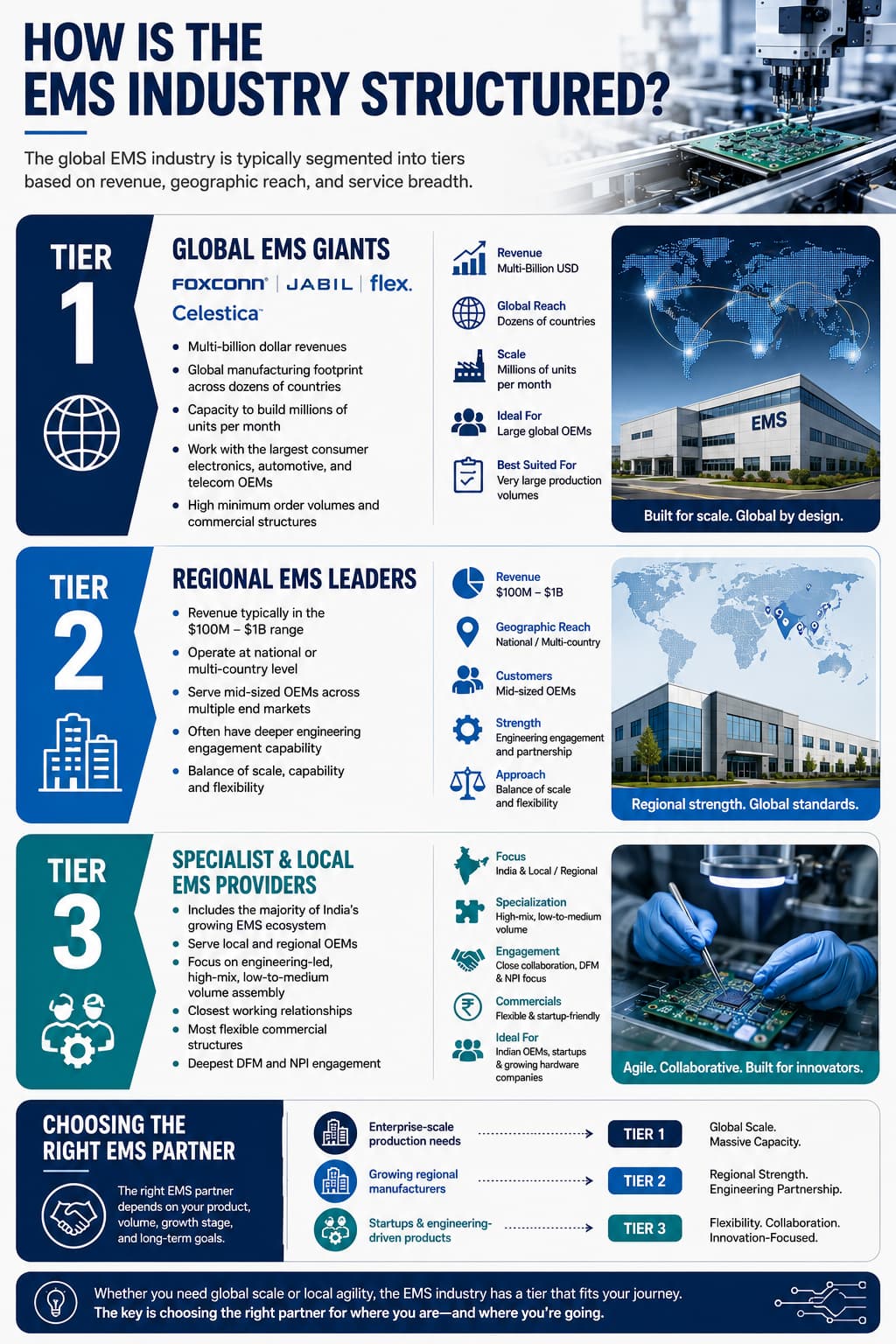
The global EMS industry is typically segmented into tiers based on revenue, geographic reach, and service breadth:
Tier 1 – Global EMS Giants
Companies like Foxconn, Jabil, Flex, and Celestica operate at massive scale, multi-billion dollar revenues, manufacturing facilities across dozens of countries, and the capacity to build millions of units per month. Tier 1 providers work with the largest consumer electronics, automotive, and telecom OEMs. Their minimum order volumes and commercial structures make them impractical for most small to mid-sized OEMs.
Tier 2 – Regional EMS Leaders
Regional EMS companies operate at a national or multi-country level, with revenues typically in the $100M–$1B range. They serve mid-sized OEMs across multiple end markets and often have deeper engineering engagement capability than Tier 1 providers who operate at higher automation levels.
Tier 3 – Specialist and Local EMS Providers
Tier 3 EMS companies which includes the majority of India’s growing EMS ecosystem serve local and regional OEMs with a focus on engineering-led, high-mix, low-to-medium volume assembly. These providers offer the closest working relationships, the most flexible commercial structures, and the deepest DFM and NPI engagement. For most Indian OEMs and hardware startups, a Tier 3 EMS partner is the most appropriate entry point.
Turnkey vs Consignment vs Partial Turnkey: What’s the difference?
One of the first commercial decisions in any EMS engagement is the supply model:
| Model | Who Sources Components | Best For |
|---|---|---|
| Turnkey | EMS partner sources everything | OEMs without procurement function; faster time to market |
| Consignment | OEM supplies all components | OEMs with existing supplier relationships; tighter BOM control |
| Partial Turnkey | Split: OEM supplies some, EMS sources rest | Most real-world engagements; balances control and convenience |
Turnkey is increasingly the preferred model for growing OEMs because it consolidates procurement, assembly, and quality accountability with a single partner. The risk of consignment where the OEM supplies components is that quality problems arising from component issues can create accountability disputes between the OEM and the EMS provider.
When should an OEM use an EMS partner?
Not every company needs an EMS partner, and not every EMS engagement makes commercial sense. Here are the scenarios where outsourcing to an EMS company creates clear value:
When Your Core Competency Is Not Manufacturing
If your value as a business is in product design, software, distribution, or customer relationships not in running a manufacturing operation, EMS allows you to access world-class assembly capability without building and managing a factory. Most successful hardware companies are fundamentally product and software businesses that use EMS partners for physical production.
When Volume Doesn’t Justify In-House Assembly
Building and maintaining an SMT line, training operators, managing component inventory, and maintaining quality certifications is expensive. Unless you are assembling thousands of boards per month consistently, in-house assembly is almost always more expensive per unit than an EMS partner who amortises those fixed costs across multiple customers.
When You Need to Scale Quickly
A capable EMS partner can scale output significantly faster than an OEM can expand in-house manufacturing. The equipment, operators, and processes are already in place, you are buying capacity, not building it.
When Regulatory or Quality Certification Is Required
If your product requires IPC Class 3 assembly, ISO 13485 (medical), IATF 16949 (automotive), or other regulated manufacturing standards, partnering with a certified EMS company is often faster and cheaper than achieving those certifications in-house.
When You Are Launching a New Product
NPI is where EMS companies add disproportionate value. Getting a new product from prototype to production in the shortest possible time, with the highest possible first-pass yield, requires process expertise and equipment that most OEMs don’t maintain in-house.
EMS in India: A Growing Opportunity
India’s Electronic Manufacturing Services sector has grown dramatically over the past decade, driven by government policy (Make in India, PLI schemes for electronics), rising domestic electronics consumption, and OEMs diversifying supply chains away from single-geography dependence on China.
Key characteristics of India’s EMS ecosystem today:
- Growing capability: Indian EMS companies particularly in hubs like Bengaluru, Pune, Chennai, and Ahmedabad have invested significantly in SMT equipment, quality infrastructure, and IPC-trained workforces
- Cost competitiveness: Labour and operating costs in India remain favourable compared to China and Southeast Asia, particularly for high-mix, low-to-medium volume assembly
- Proximity advantage: For OEMs selling into the Indian domestic market, local EMS partners offer logistics efficiency, easier oversight, and faster iteration cycles compared to offshore manufacturing
- PLI Scheme support: The Indian government’s Production Linked Incentive scheme for electronics manufacturing provides financial incentives that improve the economics of domestic EMS engagement
For OEMs operating in India or targeting the Indian market, the case for a domestic EMS partner has never been stronger, provided you identify the right partner with genuine technical capability.
What to look for when evaluating an EMS partner
Selecting the right EMS partner is one of the most consequential supply chain decisions an OEM will make. The wrong partner regardless of their quoted price will cost more in quality escapes, rework, delays, and management overhead than any unit price saving.
Evaluate every prospective EMS partner against these criteria:
Technical Capability
Does the partner have the equipment to build your specific product? Verify their SMT line’s minimum component size capability, X-ray availability for BGA products, and selective soldering for mixed-technology assemblies. Ask for the machine make and model, not just capability claims.
Quality Infrastructure
What inspection steps are in-line? SPI after paste printing, AOI after reflow, and X-ray for BGAs should be standard. Ask whether IPC-A-610 is applied consistently and what IPC class they build to as their standard. Verify that operators and inspectors hold individual IPC certifications, not just the company.
NPI Process
How do they handle new products? A structured NPI process: DFM review, first article inspection, process documentation, approval before volume build is a strong indicator of a mature EMS operation. An EMS company that starts building without DFM or first article sign-off is transferring risk directly to you.
Supply Chain Transparency
For turnkey engagements, can the partner provide Certificates of Conformance for all critical components? Do they source from authorised distributors? How do they handle component shortages or substitutions? These questions reveal whether the partner manages supply chain risk or transfers it to the OEM.
Communication and Engineering Engagement
The best EMS partners operate as an extension of your engineering team, proactively flagging design issues, providing process data, and solving problems collaboratively. Evaluate this during the quoting and DFM stage. If a prospective partner quotes without reviewing your Gerbers or BOM carefully, that is a signal about how they will operate in production.
References and Track Record
Ask for references from customers with similar product complexity and volume to yours. A partner who builds simple consumer boards at high volume may not be equipped for a complex industrial assembly at low-to-medium volume, even if their headline capabilities seem to match.
EMS vs ODM: What’s the difference?
A related term that is sometimes confused with EMS is ODM (Original Design Manufacturer). The distinction is important:
- EMS companies manufacture to the OEM’s design. The OEM owns the product design, and the EMS partner builds it.
- ODM companies design and manufacture products that OEMs then brand as their own. The ODM owns the underlying design.
For most OEMs with proprietary products, EMS is the correct model, the product design stays with the OEM, and the EMS partner provides manufacturing capability. ODM is appropriate when an OEM wants to sell a product but does not have the engineering capability to design it.
How Alica Technologies approaches EMS
At Alica Technologies, our EMS operation in Ahmedabad is built around the needs of mid-sized OEMs, product companies, and startups who need a technically capable, engineering-led manufacturing partner, not just a box-assembly facility.
Our service model covers the full EMS lifecycle:
- DFM review on every new product before the first build
- SMT and THT assembly with SPI, AOI, and X-ray inspection inline
- Rapid prototyping with 5–10 day NPI turnaround for new designs
- Partial and full turnkey component sourcing from authorised distributors
- IPC-A-610 quality standards applied consistently across all production
- Functional and flying probe testing before shipment
- Scalable production from prototype quantities to volume runs
If you are evaluating EMS partners for a new or existing product, we would welcome a technical conversation about your requirements.
Get a Quote |
View Our Services |
Call us: +91 97271 78787
Frequently Asked Questions about EMS
What does EMS stand for in electronics?
EMS stands for Electronic Manufacturing Services. It refers to companies that manufacture electronic assemblies including PCBs, sub-assemblies, and complete box-build products on behalf of OEMs (Original Equipment Manufacturers) who design and brand the products.
What is the difference between EMS and OEM?
An OEM (Original Equipment Manufacturer) is the company that designs and sells the electronic product under its own brand. An EMS company manufactures that product on behalf of the OEM. The OEM owns the design and brand; the EMS company provides the manufacturing capability and capacity.
What is the difference between EMS and ODM?
An EMS company manufactures products to the OEM’s design, the OEM retains ownership of the product design. An ODM (Original Design Manufacturer) both designs and manufactures the product, which the OEM then brands and sells. EMS is appropriate when the OEM has a proprietary design; ODM is appropriate when the OEM needs both design and manufacturing.
What is turnkey EMS?
Turnkey EMS is an engagement model where the EMS company sources all components, assembles, tests, and delivers the finished product. The OEM provides the design files (Gerbers, BOM, assembly drawings) and receives complete, tested assemblies. It is contrasted with consignment, where the OEM supplies all components themselves.
Why do OEMs use EMS companies?
OEMs use EMS companies to access manufacturing capability without the capital and operational cost of building and running their own factory. EMS partners offer economies of scale, specialised equipment, trained workforces, quality certifications, and established supply chains that most OEMs cannot replicate cost-effectively in-house.
What is NPI in EMS?
NPI stands for New Product Introduction. It is the structured process of taking a new product from engineering prototype to repeatable, quality-controlled volume production. NPI includes DFM review, prototype builds, first article inspection, process documentation, and production tooling creating the stable baseline from which volume manufacturing scales.
How do I choose an EMS company in India?
Evaluate Indian EMS companies on: SMT and THT equipment capability, IPC-A-610 certification (operators, not just the company), formal DFM review process, component traceability and supply chain transparency, NPI process maturity, and references from customers with similar product complexity. Price should be evaluated last, the cheapest EMS partner is rarely the lowest total cost.
What is the EMS industry worth in India?
India’s EMS sector has been growing rapidly, driven by Make in India policy, PLI scheme incentives, and OEM supply chain diversification. The sector was valued at approximately $20 billion and is projected to grow significantly through the decade as domestic electronics production scales.
What industries use EMS companies?
EMS companies serve virtually every industry that produces electronic products, consumer electronics, industrial automation, automotive electronics, medical devices, telecommunications, aerospace, defence, IoT, and renewable energy. Any OEM that produces an electronic product is a potential EMS customer.
What is the difference between EMS and CEM?
EMS (Electronic Manufacturing Services) and CEM (Contract Electronics Manufacturing) refer to the same industry. EMS is the more widely used term globally today, while CEM was more common historically. Both describe companies that manufacture electronic assemblies on a contract basis for OEM customers.
Alica Technologies LLP is an Electronics Manufacturing Services (EMS) company based in Ahmedabad, Gujarat, providing PCB assembly, SMT & THT production, DFM review, NPI support, AOI & X-ray inspection, and turnkey electronic manufacturing for OEMs across India.