
Smart Water Meter PCB Assembly: Building Low-Power Boards for Utility Rollouts
 Utsav
•
Nov 21, 2026

A smart water meter spends its life underground, in a chamber that floods, or on a wall outside a building, running on one battery that is expected to last for years. When a board fails in the field, nobody swaps it on a bench. A technician has to find the meter, dig it out or open the chamber, and replace the whole unit, while the utility loses billing data for that connection. That is why smart water meter PCB assembly is judged less by how the board looks on day one and more by how it behaves after a long time in damp, cold and unattended conditions.
For the hardware lead at a meter OEM, the difficulty is that most of the risk is invisible at final test. A marginal solder joint on a battery contact, flux residue near a sensing circuit, or a radio module that drifts with temperature can all pass a quick functional check and still cause a failure months later. Getting these boards right depends on decisions made at design review, at component sourcing and on the assembly line, not on any single test at the end.
Why smart water meter electronics are hard to build
Water meter boards look simple compared with a gateway or a controller. The complexity sits in the constraints rather than the component count.
Power budgets measured in microamps
Most smart water meters run from a primary lithium cell with no mains supply. The board spends almost all of its time in deep sleep and wakes briefly to measure flow, log data and transmit. Any leakage path on the assembled board, such as flux residue between fine-pitch pins, a partially bridged joint or a wrong-value resistor, raises the sleep current and shortens battery life. A unit that should last years in the field can be dead much earlier, and that does not show up on a two-minute test.
Measurement electronics that must stay stable
Ultrasonic water meters measure the time a sound pulse takes to travel with and against the flow, which needs precise timing circuits and well-matched transducer connections. Electromagnetic meters need clean, low-noise analogue front ends. Mechanical meters with electronic registers use reed switches, Hall sensors or other pickups to count rotations. In each case, the accuracy the OEM designed for depends on the assembly reproducing the design faithfully on every board.
Moisture, condensation and sealed housings
The enclosure, gaskets and any sealing process are design decisions owned by the OEM. On the board side, what matters is cleanliness, solid joints on connectors and battery tabs, and correct orientation of parts that sit close to the housing wall. A board that is assembled cleanly gives the sealing design the best chance of working.
Radio modules and antennas in a small space
Whether the meter uses NB-IoT, LoRaWAN, a sub-GHz RF link or a walk-by AMR protocol, the radio sits a few millimetres from the battery, the sensor and the housing. Module placement, solder quality on castellated pads and the antenna feed all affect range, and range decides whether the meter reports at all once it is installed in a pit.
What R&D teams should expect from smart water meter PCB assembly
For the hardware lead, the useful question is not whether a partner can place components but whether the partner understands where these boards fail. A capable EMS partner should bring the following to the build.
DFM review before tooling
An early design for manufacturability review catches issues while they are still cheap: pads that are too small for the battery connector, test points that cannot be reached once the board is in its carrier, sensing traces routed too close to areas that collect flux, or a radio module footprint that differs from the datasheet. Alica Technologies carries out DFM review before stencils and fixtures are made, and the same logic is set out in the smart meter PCB DFM checklist written for electricity meter boards.
Inline inspection matched to the parts on the board
Water meter boards often combine fine-pitch microcontrollers, QFN timing or analogue front-end ICs and a radio module with pads hidden underneath. Solder paste inspection checks the deposit before placement, AOI checks placement, polarity and visible joints after reflow, and 3D X-ray is the only practical way to see voids and bridges under QFN and BGA packages. Alica runs SPI, AOI and 3D X-ray inspection, and its testing and inspection process explains how each stage feeds the next.
Functional testing that looks at current, not only function
A functional test for a water meter board should go beyond “it powers on and the radio joins”. The OEM and the EMS partner should agree on a test that measures sleep current against a limit, checks the sensor interface with a known input, confirms the radio transmits at the expected level and writes the serial number and calibration data. Alica builds functional and burn-in testing to the customer’s specification, so the OEM’s own limits decide pass or fail.
Assembly to IPC-recommended procedures
Consistent stencil printing, controlled reflow profiles and clean handling matter more on low-power boards than on most others. Alica follows IPC-recommended procedures for SMT and through-hole PCB assembly, which covers mixed boards where battery connectors or terminal blocks are through-hole and the rest is surface mount.
For procurement: sourcing for a long-life product
Utility contracts can run for years, and the bill of materials has to stay buildable for that whole period. The main sourcing risks on a water meter are the metering or timing IC, the microcontroller, the radio module and the lithium cell, each of which can go on allocation or reach end of life. Turnkey sourcing with full BOM management lets the EMS partner track these parts, flag long-lead items at quotation and propose approved alternates before a shortage stops the line. The same approach is covered for electricity meters in the guide to smart meter component sourcing. Batteries in particular need handling and storage rules agreed in writing, because a cell that sits too long on a shelf arrives in the field with less capacity than the design assumed.
For operations: traceability and field returns
When a utility reports a cluster of failed meters, the OEM needs to know quickly whether it is a batch problem or a site problem. That depends on traceability: which component lots, which paste and which reflow run went into each serial number. Alica keeps component traceability on every build, so a return can be traced back to a date, a line setup and a set of parts. Operations teams also benefit when the same partner handles turnkey project delivery, from parts to tested, packed units, because there is one record and one point of contact for every unit shipped.
Common board types in a smart water meter
| Board or module | Typical content | Main assembly risk | Inspection and test focus |
|---|---|---|---|
| Main metering board | Low-power MCU, timing or analogue front end, memory, power management | Leakage from residue or bridges, raising sleep current | SPI, AOI, X-ray on QFN parts, sleep current test |
| Ultrasonic transducer interface | Driver and receiver circuits, transducer connections | Joint quality on connectors, matching between channels | AOI, functional test with a known signal |
| Communication section or module | NB-IoT, LoRaWAN or sub-GHz radio, antenna feed | Hidden pads under modules, antenna path damage | X-ray on module pads, RF output check |
| Register or pickup board (mechanical meters) | Reed switch or Hall sensor, display driver | Sensor orientation and position | AOI, pulse count test |
| Battery and power path | Lithium cell tabs or connector, protection parts | Weak joints on tabs, cell storage and handling | Visual and X-ray on joints, voltage and current checks |
Standards the meter is designed to
Smart water meters are designed to metrology standards such as ISO 4064 and OIML R 49, which are aligned and cover electronic meters as well as mechanical ones. In India, IS 779 covers domestic water meters and is referred to in many tenders. These are standards the OEM’s product is designed and type-tested to. The EMS partner’s role is to build every unit exactly to that approved design, with change control on parts and process, so that production meters match the meters that were tested.
Checklist before you release a water meter build
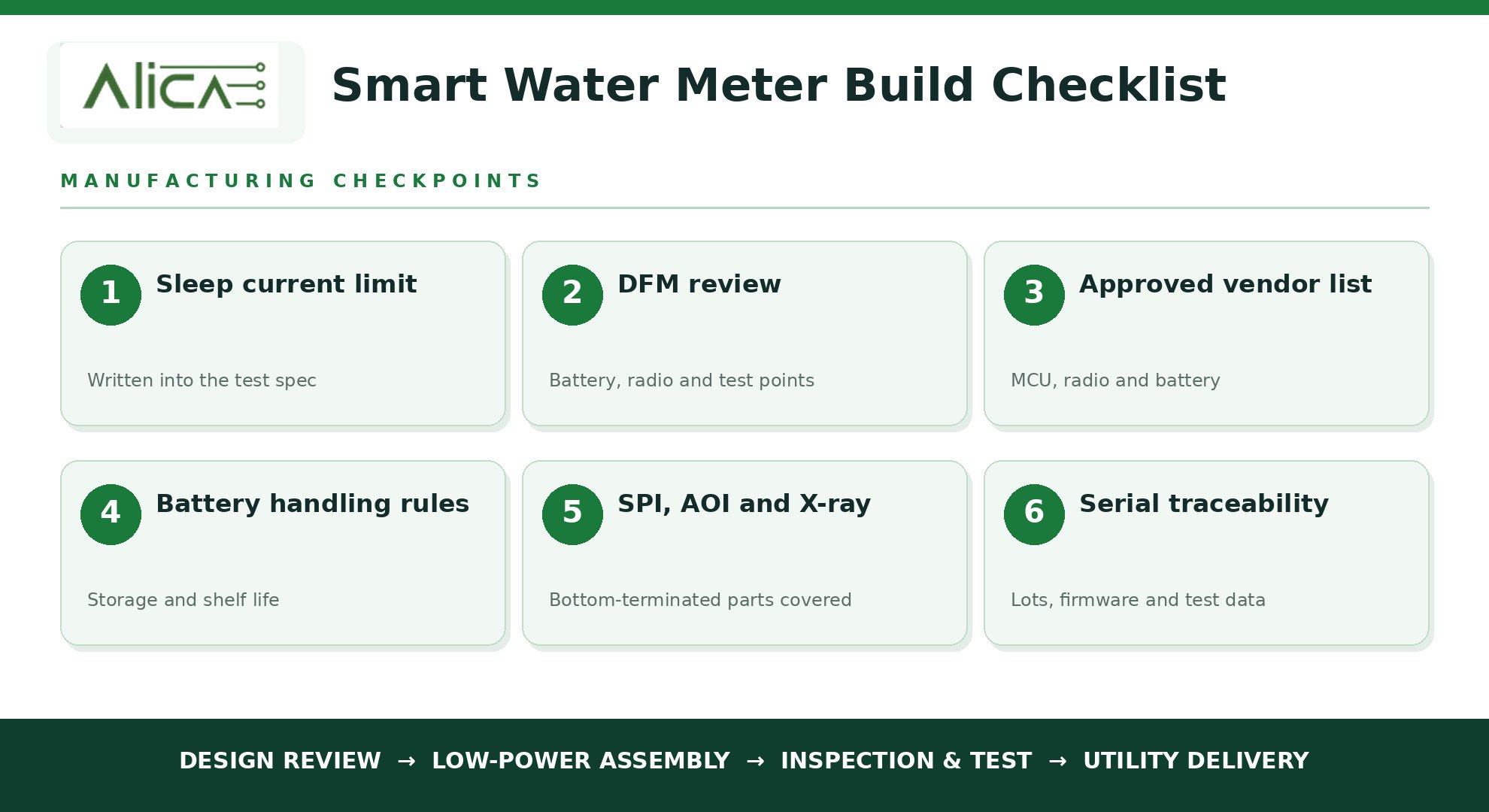
- Sleep current limit agreed and written into the functional test specification.
- DFM review completed, with battery connector, test point and radio module footprints signed off.
- Approved vendor list for the MCU, metering or timing IC, radio module and battery, with named alternates.
- Battery storage, handling and shelf-life rules agreed in writing.
- Inspection plan covering SPI, AOI and X-ray on all bottom-terminated packages.
- Functional test covering sensor input, radio output, serial number and calibration data write.
- Burn-in or extended test requirement decided for the first production batches.
- Traceability fields defined per serial number: component lots, build date, test results.
- Change control process agreed for any part or process change after type approval.
- Packing and labelling rules for utility delivery agreed with operations.
Water meters share many building blocks with electricity meters and the wider AMI network. For the full picture, see the guide to smart meter PCB assembly and box build in India.
Frequently Asked Questions
What makes smart water meter PCB assembly different from other metering boards?
Most smart water meters run on a single battery for years and sit in damp, unattended locations. That makes sleep current, board cleanliness and joint quality on the battery and radio more important than on mains-powered meters, and the functional test should measure current as well as function.
Does the EMS partner certify the water meter to ISO 4064 or IS 779?
No. The OEM designs the meter to the relevant metrology standard and arranges type approval. The EMS partner builds every unit to the approved design, keeps change control on parts and process, and maintains traceability records that support the OEM’s approval.
Which inspection steps matter most for water meter boards?
Solder paste inspection and AOI catch most placement and print problems, while 3D X-ray is needed for QFN, BGA and module pads that cannot be seen. A functional test that checks sleep current, the sensor interface and radio output then confirms the board will behave in the field.
Plan your smart water meter build with Alica
If you are moving a smart water meter from prototype to production, Alica Technologies can review the design, source the BOM, assemble and inspect the boards and run functional tests from its facility in Changodar, Ahmedabad. Share your design files with the Alica team or look through the full list of manufacturing capabilities first.
Tagged in
Looking for a reliable EMS partner?
Get a quote for PCB assembly, turnkey manufacturing, or prototype builds.
Get in Touch