
LoRaWAN Gateway Manufacturing: Assembling Networking Hardware for IoT Rollouts
 Utsav
•
Nov 27, 2026

A LoRaWAN gateway sits at the top of a long-range IoT network and quietly carries the data from hundreds or thousands of sensors, meters and trackers to the network server. When one gateway drops packets, overheats in a rooftop enclosure or loses its backhaul link, every device behind it goes silent. For hardware teams building these products, LoRaWAN gateway manufacturing is where a good reference design either becomes a dependable field product or turns into a stream of returns, site visits and firmware workarounds for what are really assembly faults.
The difficulty is that a gateway is several products in one box: a radio concentrator, a host processor, a backhaul module, a power stage and often an outdoor enclosure with surge protection and antenna feeds. Prototypes built by hand on a lab bench rarely expose the problems that appear at 500 or 5,000 units. This guide explains what makes LoRaWAN gateway hardware hard to build, what R&D teams should agree with their EMS partner before the first production batch, and what procurement and operations teams should check alongside them.
What sits inside a LoRaWAN gateway
Most indoor and outdoor gateways share the same building blocks, even when the industrial design differs:
- LoRa concentrator section: a multi-channel baseband IC with one or more RF front ends, filters, a low-noise amplifier path for receive and a power amplifier path for transmit.
- Host processor: an application processor or MCU running the packet forwarder, with DDR or flash memory, often in BGA or fine-pitch packages.
- Backhaul: Ethernet, Wi-Fi or a cellular module, sometimes all three, so the gateway can reach the network server.
- GNSS receiver: used for timing and location on many designs, with its own antenna feed.
- Power: Power over Ethernet, a DC input or a mains supply, plus protection against surges and reverse polarity.
- Mechanicals: RF shields, connectors for antennas, an enclosure, glands, mounting brackets and labels.
The broader family of connected hardware, including cellular and Wi-Fi gateways, is covered in the guide to IoT gateway PCB assembly for connected hardware. This article stays with the LoRaWAN case, where sub-GHz radio performance and outdoor reliability dominate.
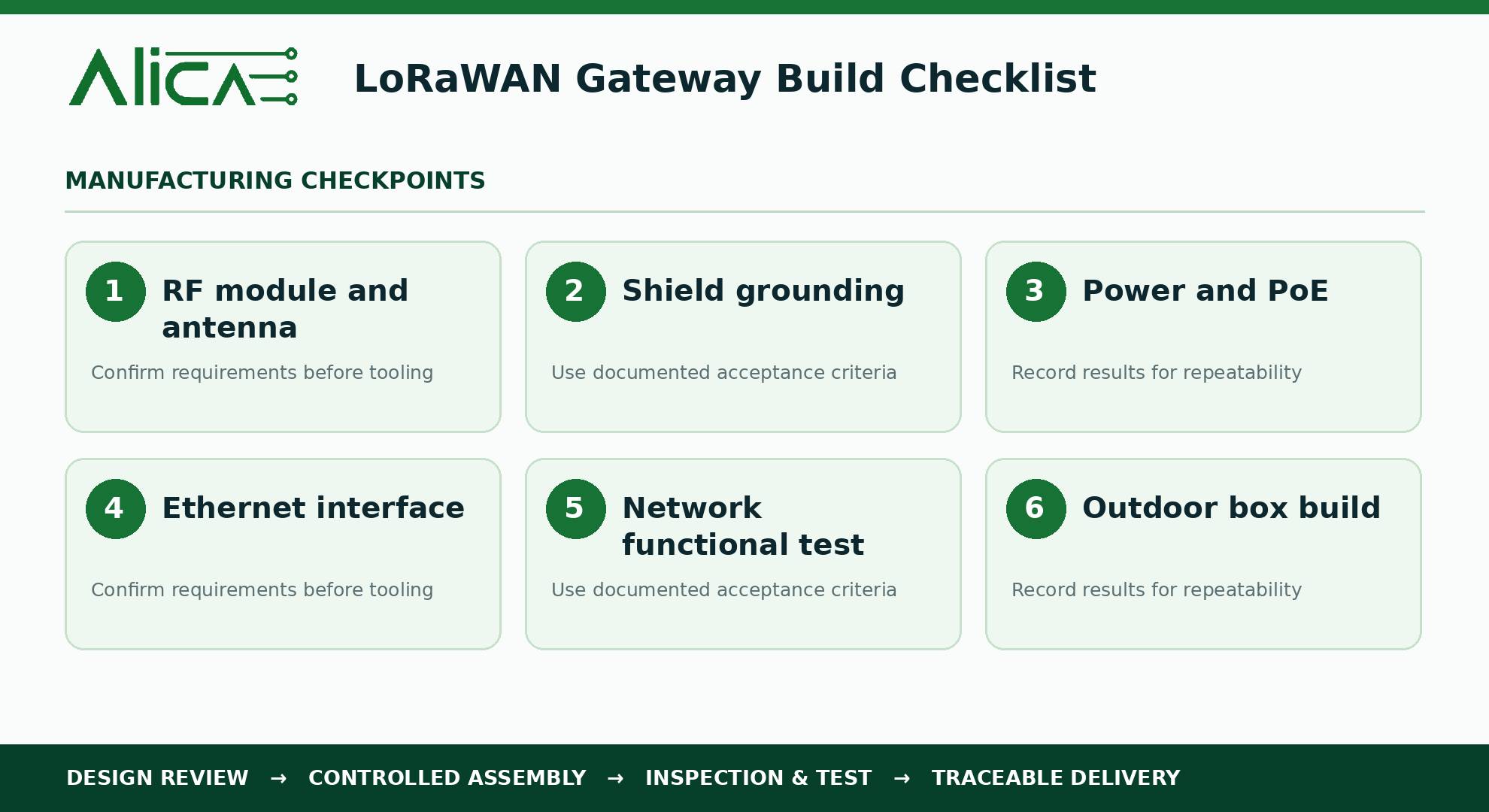
Why LoRaWAN gateway hardware is hard to build
The radio is sensitive to small assembly variation
A gateway earns its value by hearing weak signals from far-away devices. Receive sensitivity depends on the matching networks, filters and the low-noise path being built exactly as designed. A tombstoned matching capacitor, a solder bridge under an RF shield or excess solder on a coaxial connector footprint can cost range without causing an obvious failure. The unit still powers up and passes a basic check, but coverage in the field is worse than the design promised.
Mixed packages on one dense board
The host processor and memory are often BGA parts, the concentrator and front-end parts are QFN or fine-pitch packages, and the power and connector section carries larger through-hole parts. Building all of this on one multi-layer board calls for well-controlled solder paste printing, accurate placement and a reflow profile that suits both small and heavy parts. The choice between surface mount and through-hole for connectors and power parts is explained in the technical guide to SMT and THT assembly.
Hidden joints need X-ray, not just optical checks
Ground pads under QFN radio parts and the balls under BGA processors cannot be seen by optical inspection. Voids or opens in these joints affect RF grounding, heat flow and long-term reliability. 3D X-ray inspection is the practical way to confirm them on early builds and on sampled production lots.
Outdoor units face heat, moisture and lightning
Rooftop and pole-mounted gateways sit in direct sun, monsoon rain and coastal humidity. Surge protection parts must be fitted and earthed correctly, glands and gaskets seated fully and antenna connectors tightened as specified. The enclosure’s rating belongs to the OEM’s design and testing, but every production unit has to be built the same way as the unit that was tested.
Regional radio settings must match the market
LoRaWAN uses different frequency plans by region. India uses the IN865 plan in the 865 to 867 MHz band, while Europe and the USA use other plans. The OEM is responsible for the radio design, frequency plan and any regulatory approvals for each market. On the production floor, what matters is that the right hardware variant, firmware image and configuration go onto the right units, and that the records show it.
What R&D teams should agree before LoRaWAN gateway manufacturing starts
Hardware leads can prevent most early production problems by settling a few points with the EMS partner during the prototype and pilot stage.
DFM review focused on the RF section
An early design for manufacturability review should look at pad design for QFN ground paddles, stencil apertures for fine-pitch parts, clearance around RF shield frames, fiducials and panel layout. Questions found at this stage cost a stencil change; the same questions found after tooling cost a board respin. Alica Technologies carries out early DFM review before tooling as part of its SMT and THT PCB assembly service.
A clear test strategy for each build stage
Agree what is tested at board level and what is tested on the finished unit. A typical split is SPI and AOI on every board, X-ray on BGA and QFN joints, a functional test that powers the board, checks the host boots, confirms backhaul links and exercises the concentrator, then a final test of the boxed unit through its own connectors. If the OEM needs conducted RF measurements, the OEM usually supplies or specifies the fixture and limits.
Firmware and configuration control
Decide who loads which image, how serial numbers and gateway identifiers are assigned, and how each unit’s configuration is recorded. Mixing an IN865 configuration with a different regional build is an easy mistake on a busy line, and an expensive one to fix after shipment.
Build stages and what each one catches
| Build stage | Main purpose | Typical faults caught |
|---|---|---|
| Solder paste inspection (SPI) | Check paste volume and position before placement | Insufficient paste on QFN ground pads, bridging risk on fine-pitch parts |
| Automated optical inspection (AOI) | Check visible joints, polarity and part presence after reflow | Missing or tombstoned matching parts, wrong polarity, lifted leads |
| 3D X-ray inspection | Check hidden joints under BGA and QFN packages | Voids, opens and bridges under processors, memory and radio ICs |
| Board functional test | Confirm the board works as a circuit | Boot failures, dead backhaul ports, power rail faults, concentrator not responding |
| Box build and unit test | Confirm the finished gateway works through its own connectors | Loose antenna feeds, missing earth links, wrong firmware or configuration |
| Burn-in (where specified) | Run units under power for a set period | Early-life failures in power stages, memory and connectors |
Each of these steps is described on the testing and inspection services page.
What procurement teams should check
Gateways depend on a handful of parts that can go on allocation: concentrator ICs, RF front ends, cellular modules and memory. A sourcing manager should ask how the EMS partner handles turnkey sourcing, alternates and last-time buys, and whether the bill of materials is costed transparently line by line. Alica offers turnkey sourcing with full BOM management and transparent cost breakdowns through its turnkey project delivery service. Domestic manufacturing in Ahmedabad also helps teams that sell into Indian rollouts avoid shipping finished gateways across borders.
What operations teams should check
For plant and operations heads, the concern is consistency across batches and a complete product at the end of the line. Ask whether the partner can take the build through box build, unit test and burn-in, and whether each unit’s serial number links to its board serials, component lots and test results. That traceability shortens root-cause work when a site reports a fault. Teams that also build vehicle and asset trackers will see the same logic in the guide to GPS tracker and telematics PCB manufacturing.
Checklist before your first production batch
- Released Gerber or ODB++ data, assembly drawing, centroid file and BOM at one revision.
- DFM review closed, including RF shield clearances and QFN ground pad stencil design.
- Approved alternates listed for concentrator, front-end, memory and backhaul parts, or marked as no substitution.
- X-ray sampling plan agreed for BGA and QFN parts.
- Board functional test procedure, limits and fixture agreed.
- Firmware images, regional configuration and identifier assignment documented per variant.
- Enclosure assembly instructions covering glands, gaskets, surge parts, earthing and antenna connector torque.
- Unit test and burn-in conditions written down where the product needs them.
- Traceability format agreed: unit serial linked to board serials, lots and test data.
- First article inspection planned for the first units of every new revision.
Frequently Asked Questions
What does LoRaWAN gateway manufacturing involve?
LoRaWAN gateway manufacturing covers assembling the concentrator, host processor, backhaul and power sections on the PCB, inspecting them with SPI, AOI and X-ray, running functional tests, and then completing box build, unit testing and burn-in where needed, with records that link each unit to its boards and parts.
Why do LoRaWAN gateway boards need X-ray inspection?
Processors, memory and many radio ICs use BGA or QFN packages whose joints are hidden under the part. Optical inspection cannot see them, so X-ray is used to check for voids, opens and bridges that could affect RF grounding, heat flow and reliability.
Who is responsible for the gateway’s frequency plan and radio approvals?
The OEM is responsible for the radio design, the regional frequency plan such as IN865 for India, and any approvals for each market. The EMS partner builds to the approved design and makes sure the right hardware variant, firmware and configuration go onto each unit.
Plan your LoRaWAN gateway build with Alica
Alica Technologies builds dense multi-layer boards and complete units for IoT and networking OEMs from its facility in Changodar, Ahmedabad, following IPC-recommended procedures, with inline SPI, AOI, 3D X-ray inspection, functional and burn-in testing, and component traceability. Review the full list of electronics manufacturing capabilities, or send your gateway design files to the Alica team to discuss a prototype or pilot build.
Tagged in
Looking for a reliable EMS partner?
Get a quote for PCB assembly, turnkey manufacturing, or prototype builds.
Get in Touch