
Choosing a contract manufacturer for IP camera PCB assembly

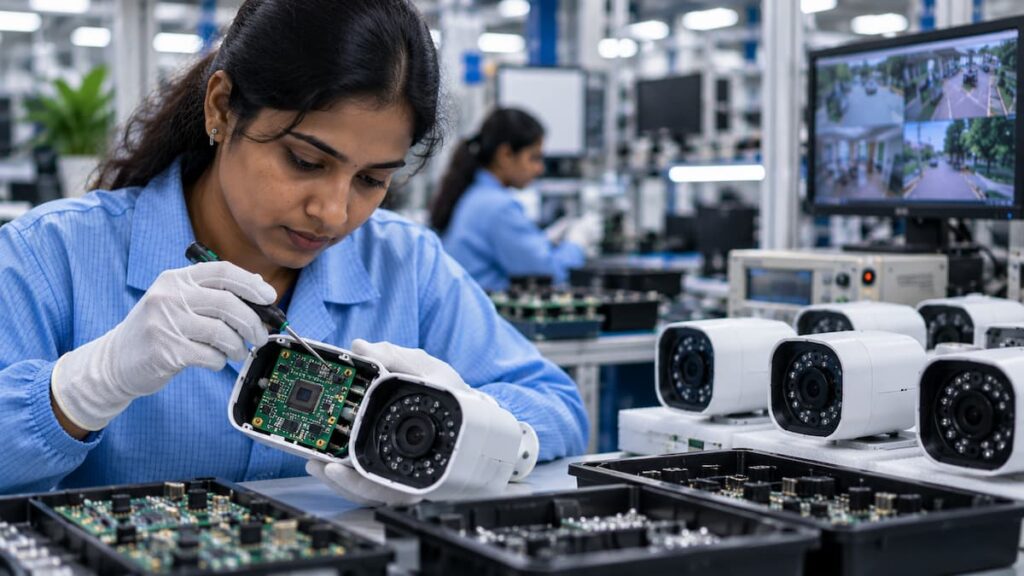
IP cameras have basically taken over the surveillance market at this point. Analog CCTV still has its place, but if you’re building anything new, chances are it’s a network camera with an onboard processor, some kind of edge analytics, and a chipset that needs to talk to the cloud or a local NVR. That shift has quietly changed what manufacturers need from their PCB assembly partner too.
A contract manufacturer who’s fine with basic analog camera boards isn’t automatically equipped to handle IP camera assembly. There’s more going on inside these boards, and the margin for error is smaller. So if you’re looking for a contract manufacturer for IP camera PCB assembly, here’s what actually matters.
Why IP camera boards ask more of your manufacturer
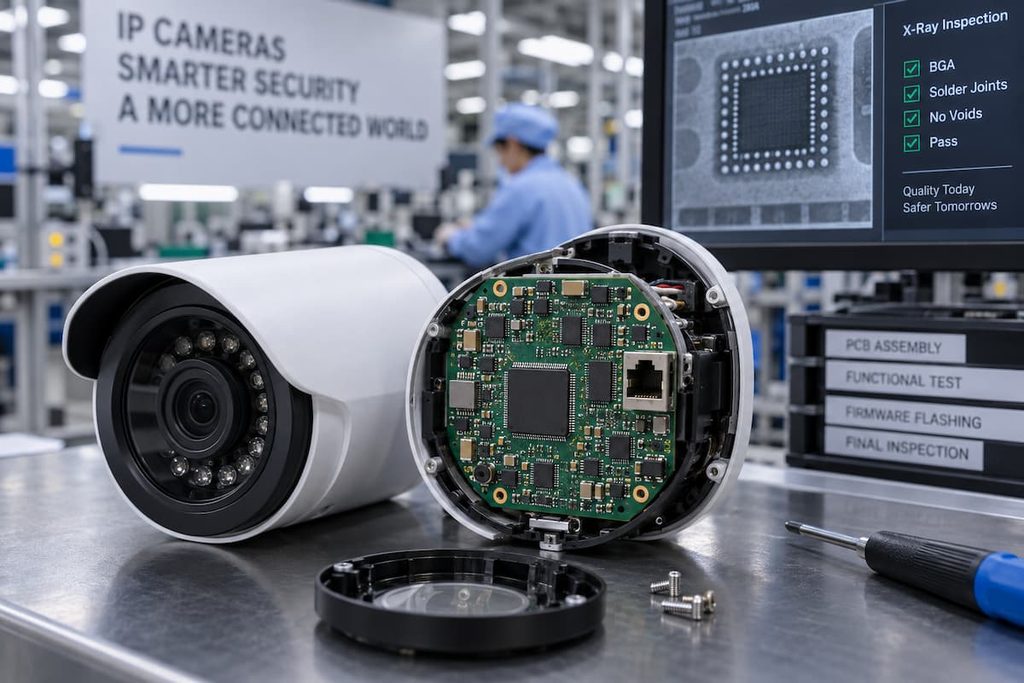
An IP camera isn’t just a sensor and a lens anymore. You’ve usually got a system-on-chip handling video encoding, a network interface for Ethernet or Wi-Fi, onboard storage or a microSD controller, sometimes an NPU for AI-based analytics, plus the usual image sensor, ISP, and IR components you’d find on any camera board.
That’s a lot of high-speed digital circuitry sitting close together, which brings its own set of assembly challenges. Signal integrity becomes a bigger deal, since you’ve got Ethernet lines and high-speed data buses running near sensitive analog components. Get the layout or assembly slightly wrong and you start seeing intermittent connectivity issues or noise creeping into the video feed, the kind of thing that’s a nightmare to debug after the fact.
PoE, power over Ethernet, is common on IP cameras too, and that adds another layer of power management circuitry that needs to be assembled and tested properly, since a fault there can take out the whole unit or, worse, damage whatever’s on the other end of that Ethernet cable.
Then there’s the processor itself. A lot of IP camera SoCs come in BGA packages, and getting solid, void-free solder joints on those isn’t something every contract manufacturer does well. This is exactly the kind of thing that only shows up under X-ray inspection, not a visual check.
What to look for in a contract manufacturer for IP camera PCB assembly
If you’re comparing contract manufacturers for an IP camera product, a few things separate the ones worth working with from the ones who’ll just get you through one production run before problems start showing up.
Experience with networked, processor-heavy boards matters more here than with basic analog cameras. You want someone who’s dealt with BGA rework, high-speed signal considerations, and PoE circuitry before, not someone learning on your product.
Testing needs to go beyond “does it power on.” A proper contract manufacturer should be running functional tests that check network connectivity, video output quality, and PoE behaviour under load, catching the kind of intermittent fault that a quick visual inspection would completely miss.
Firmware and software integration support is worth asking about too. A lot of IP cameras need firmware flashed at the assembly stage, and a manufacturer who can handle that step in-house saves you a separate logistics headache.
Component sourcing is its own challenge with IP cameras specifically, since network chipsets and camera SoCs have been through some rough supply chain years. A contract manufacturer with strong distributor relationships and the ability to flag long lead times early is worth a lot more than one who just tells you “we’ll try.”
And obviously, everything that matters for analog CCTV boards still applies here too. Proper handling of the image sensor, conformal coating for outdoor units, thermal management for IR arrays, the works. IP cameras don’t get a pass on any of that just because they’re smarter.
Questions to ask before signing on
A few good ones to run through with any contract manufacturer you’re considering. Have you assembled boards with networking chipsets or PoE circuitry before, and can you show examples? What’s your process for X-ray inspection on BGA packages specifically? Can your team handle firmware flashing during assembly, or is that on us? How do you manage component shortages for camera SoCs and network chipsets? And what does your functional test cover beyond basic power-on checks?
If a manufacturer struggles to answer these with any specificity, that’s usually a sign they haven’t done much of this kind of work before.
Why this choice matters more than it seems
It’s tempting to treat contract manufacturer selection as a cost decision, get a few quotes, pick whoever’s cheapest, move on. But with IP camera products specifically, a manufacturer who doesn’t fully understand what they’re building tends to show it later, not in the first batch, but a few months down the line when connectivity issues start showing up in the field or a whole run gets flagged for BGA solder defects that never got caught.
The right contract manufacturer doesn’t just save you from that headache, they also tend to catch design issues before production even starts, manage your component risk proactively instead of reactively, and give you the flexibility to scale up as your product line grows without having to switch vendors and start the qualification process all over again.
Wrapping up
IP cameras have raised the bar for what “PCB assembly” actually means, and treating them the same as a basic analog camera board is how a lot of manufacturers end up with quality problems they didn’t see coming. Whether you’re launching your first network camera or scaling an existing line, the manufacturer you choose needs to genuinely understand networked, processor-driven hardware, not just claim to.
Looking for a reliable EMS partner?
Get a quote for PCB assembly, turnkey manufacturing, or prototype builds.
Get in Touch