
10 applications of PCB in Electronics and Technology

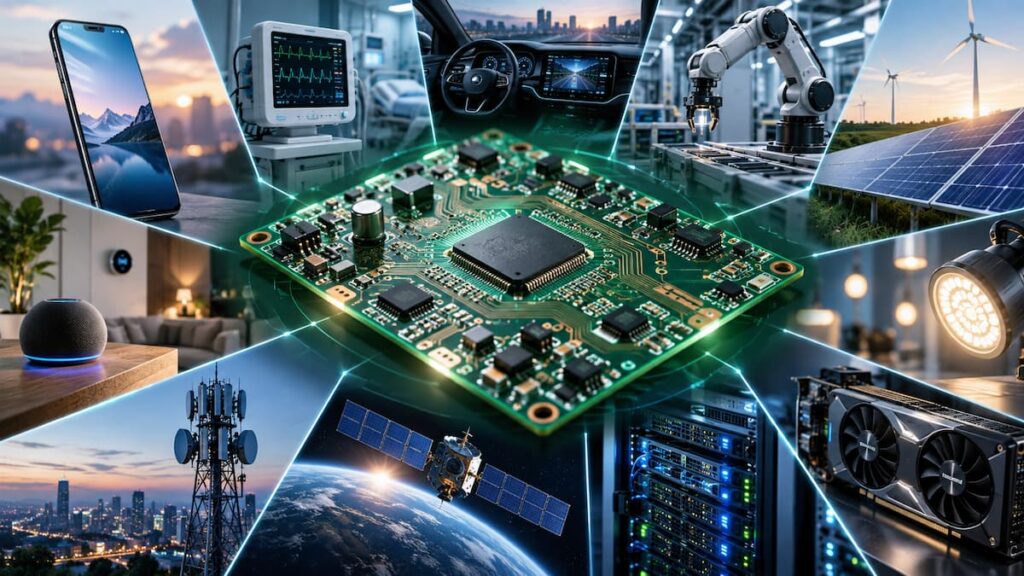
Printed circuit boards are present in almost every electronic product manufactured today. They connect components, carry power, and transmit signals through copper pathways printed onto an insulating base. Without them, modern electronics would not be compact, affordable, or reliable enough for everyday use.
This article explains ten major applications of PCBs across different industries and outlines what makes each application distinct.
Table of Contents
- What a PCB Does?
- 1. Smartphones and Mobile Devices
- 2. Medical Devices
- 3. Automotive Electronics
- 4. Industrial Automation and Sensors
- 5. Renewable Energy Systems
- 6. Smart Home and Consumer IoT Products
- 7. Telecommunications Equipment
- 8. Aerospace and Defence Systems
- 9. Computing and Graphics Hardware
- 10. LED and Lighting Systems
- Trends Shaping PCB Design
- Choosing a Board for an Application
- Author Opinion
- Frequently Asked Questions
What a PCB Does?
A printed circuit board is a flat board made of insulating material, usually fiberglass, with thin copper tracks printed on its surface. These tracks replace individual wires and connect components such as resistors, capacitors, and processors.
The main advantages of PCB technology are:
- Smaller product sizes, because circuits are printed rather than wired by hand
- Consistent quality, because boards are produced by automated processes
- Lower cost at volume, because assembly can be machine driven
- Better signal performance, because trace layout can be controlled precisely
Applications of PCB
1. Smartphones and Mobile Devices
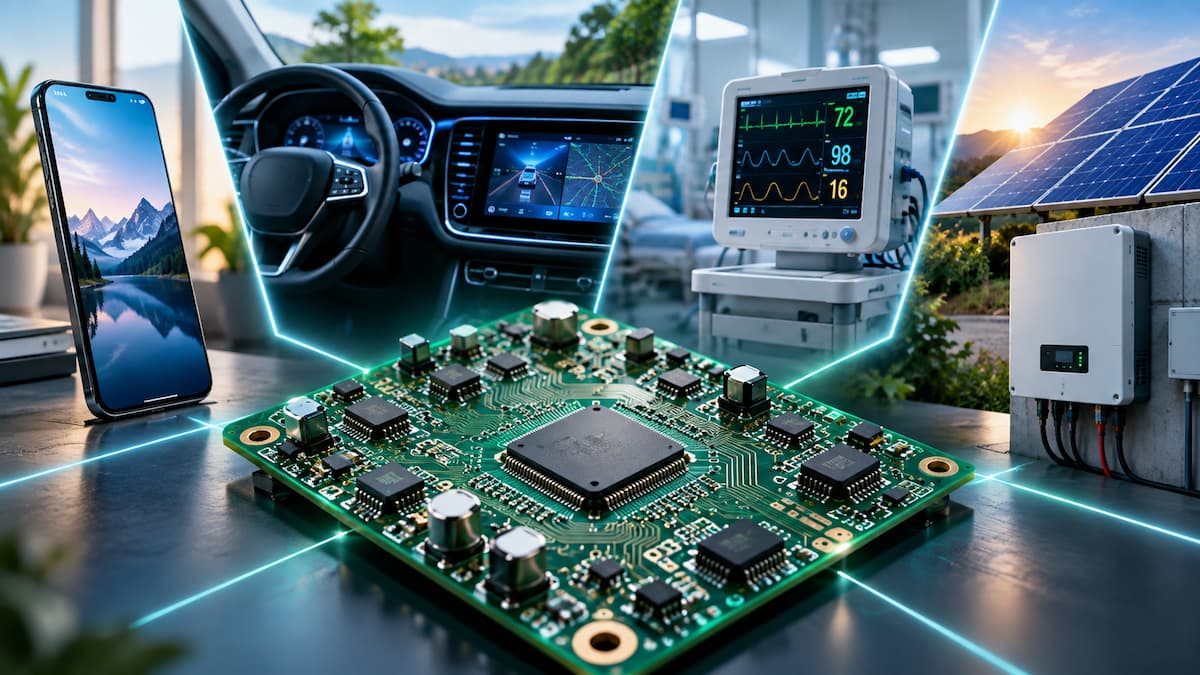
A typical smartphone contains several printed circuit boards. The main board holds the processor, memory, power management circuits, and wireless modules within a very small area.
These boards use high density interconnect construction, where trace widths measure less than one tenth of a millimetre and eight or more layers are stacked to save space. Flexible boards made from polyimide are used near cameras and displays, where the board must bend to fit the shape of the device.
2. Medical Devices
Medical equipment depends on boards that operate reliably over long periods. Manufacturers of these boards work under quality standards such as ISO 13485 and, in many markets, under additional regulatory approval.
Common examples include pacemakers, which must function for several years without service, blood glucose monitors, patient monitoring systems, ventilators, and portable diagnostic equipment. In each case, the board handles sensing, signal processing, and power management.
3. Automotive Electronics
A modern vehicle contains dozens of printed circuit boards. These boards must tolerate temperature changes, constant vibration, and electrical interference over the life of the vehicle.
Typical automotive applications include engine control units, battery management systems in electric vehicles, driver assistance systems that process camera and radar data, and infotainment units. Electric vehicles have increased demand further, since charging systems and motor controllers both require boards rated for high current and high temperature.
4. Industrial Automation and Sensors
Factory equipment uses printed circuit boards in controllers, sensors, and communication gateways. These boards are built to withstand dust, moisture, and vibration in production environments.
Applications include programmable logic controllers, wireless sensor units that measure temperature or pressure, motion control boards, and smart meters used in energy monitoring. Many of these boards also carry wireless modules so that equipment can report data to a central system.
5. Renewable Energy Systems
Solar and wind installations rely on power electronics, and every power electronic system is built around one or more printed circuit boards.
In solar systems, boards are used in inverters that convert direct current from panels into alternating current for the grid, and in microinverters mounted behind individual panels. Wind installations use control boards that manage turbine operation in outdoor conditions. Battery storage systems use boards that regulate charging and discharging to protect cell life.
6. Smart Home and Consumer IoT Products
Smart speakers, thermostats, cameras, door locks, and lighting controls are all built on compact boards that combine a processor, a wireless module, and sensors.
The design priority for these products is low power consumption, since many are battery operated and expected to run for months without replacement. Wearable devices such as fitness trackers and smartwatches use the same approach, often with flexible or very small rigid boards.
7. Telecommunications Equipment
Network infrastructure depends on boards designed for high frequency signals. Base stations, routers, switches, and optical transceivers all fall into this category.
At these frequencies, trace geometry directly affects performance, so the boards use controlled impedance design and specialised materials that limit signal loss. Layer counts are high, and manufacturing tolerances are tighter than in consumer products. Power supply boards in telecom sites form a separate category, handling higher currents at lower frequencies.
8. Aerospace and Defence Systems
Boards used in aircraft, satellites, and defence equipment are built to the strictest reliability requirements in the industry. Manufacturers typically operate under AS9100 certification and maintain full traceability of materials.
Applications include flight control systems, navigation and communication units, cockpit displays, radar systems, and satellite electronics. Satellite boards may also require radiation resistant materials. Because of testing and qualification requirements, these boards cost considerably more than commercial equivalents.
9. Computing and Graphics Hardware
Computers, servers, and graphics cards use some of the most complex boards produced. These designs must route very high speed signals between the processor and memory while also delivering large amounts of power.
Heat management is a central concern, since a single graphics processor can draw two hundred watts or more. Boards in this category commonly use twelve or more layers, with dedicated power planes and carefully planned component placement to keep thermal performance within limits.
10. LED and Lighting Systems
LED lighting products use boards that hold the LEDs themselves along with driver circuits that regulate current. Many of these boards use an aluminium base rather than fiberglass, because metal draws heat away from the LEDs and extends their working life.
Applications include commercial and street lighting, display backlighting, automotive headlamps and indicators, and horticultural lighting used in controlled growing environments.
Trends shaping PCB design
Several developments are changing how boards are designed and manufactured:
| Trend | Reason It Matters |
|---|---|
| Flexible boards | Allow curved and folded assemblies in wearables and phones |
| Metal core and ceramic boards | Handle higher temperatures and power levels |
| High frequency materials | Required for 5G and radar applications |
| Embedded components | Place passive parts inside the board to save surface area |
| Lead free and recyclable materials | Meet environmental regulations in most markets |
Choosing a board for an application
- When specifying a printed circuit board, the following factors usually determine the design:
- Operating environment, including temperature range, humidity, and vibration
- Signal speed, which affects layer count, trace width, and material choice
- Power requirements, including current levels and heat dissipation
- Applicable standards for the industry, such as automotive, medical, or aerospace
- Production volume, since prototype and mass production designs differ in cost structure
- Required lead time and the capability of the chosen manufacturer
Author Opinion
As devices continue to become smaller and more connected, board design remains one of the main constraints on what a product can achieve. Understanding these applications is a practical starting point for anyone specifying, sourcing, or designing electronic hardware.
Frequently Asked Questions
What is the difference between single sided, double sided, and multilayer boards?
Single sided boards carry copper on one face and suit simple circuits. Double sided boards use both faces and handle moderate complexity. Multilayer boards stack four or more copper layers and are used where circuit density is high, such as in phones and computers.
Can printed circuit boards be recycled?
Yes. Boards contain copper, and connectors often contain small quantities of gold. Certified electronic waste recyclers recover these materials and process the remaining substrate safely.
What is an HDI board?
HDI stands for high density interconnect. These boards use very small vias and narrow traces to fit more circuitry into a smaller area. They are standard in smartphones, medical implants, and compact aerospace equipment.
How long does PCB manufacturing take?
Prototype boards are commonly delivered within three to seven days. Small production runs take one to two weeks. Larger volumes typically require two to four weeks, excluding design and tooling time.
What does controlled impedance mean?
Controlled impedance means the board is manufactured so that trace width, spacing, and layer thickness stay within tight limits. This keeps the electrical impedance of high speed signal paths consistent and prevents data errors caused by signal reflections.
Looking for a reliable EMS partner?
Get a quote for PCB assembly, turnkey manufacturing, or prototype builds.
Get in Touch