
AMI Hardware Manufacturing: What meter OEMs and utilities need
 Utsav
•
Nov 16, 2026
For a meter OEM or a supplier to an AMI service provider, winning a utility order is only half the battle. The other half is delivering hundreds of thousands of meters, communication modules and data concentrators on schedule, at the agreed cost, with every unit behaving the same way in the field. A single component shortage can stall a rollout. A single bad batch can trigger replacements across a whole circle. That is why AMI hardware manufacturing has become a supply chain question as much as an engineering one.
Procurement and sourcing teams sit at the centre of that pressure. They juggle metering ICs, MCUs, RF and cellular modules, relays, current sensors, enclosures and batteries from many vendors, while utilities expect firm delivery commitments and complete documentation. This guide explains what AMI hardware includes, why it is demanding to build at volume, and what procurement, R&D and operations teams should look for in a manufacturing partner.
What AMI hardware actually includes
Advanced metering infrastructure is a system, not a single product. India’s Central Electricity Authority describes its core building blocks as smart meters, communication infrastructure, a Head End System (HES) and Meter Data Management (MDM). The HES and MDM are software platforms. The hardware that has to be manufactured is everything that sits in the field:
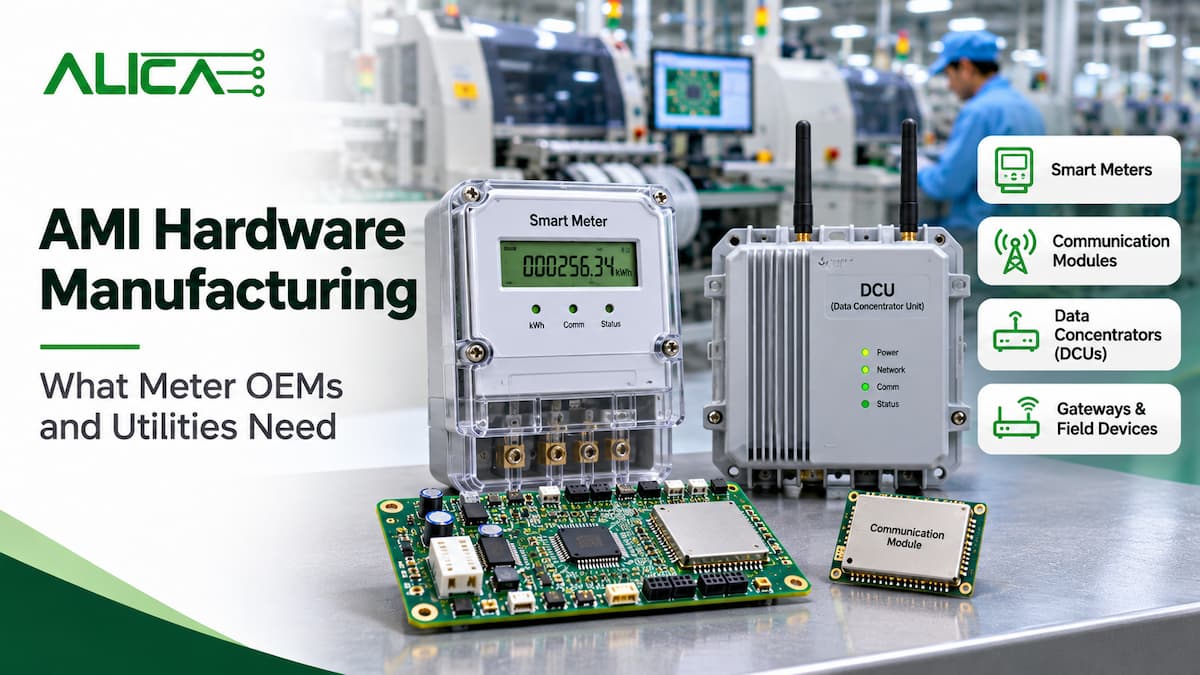
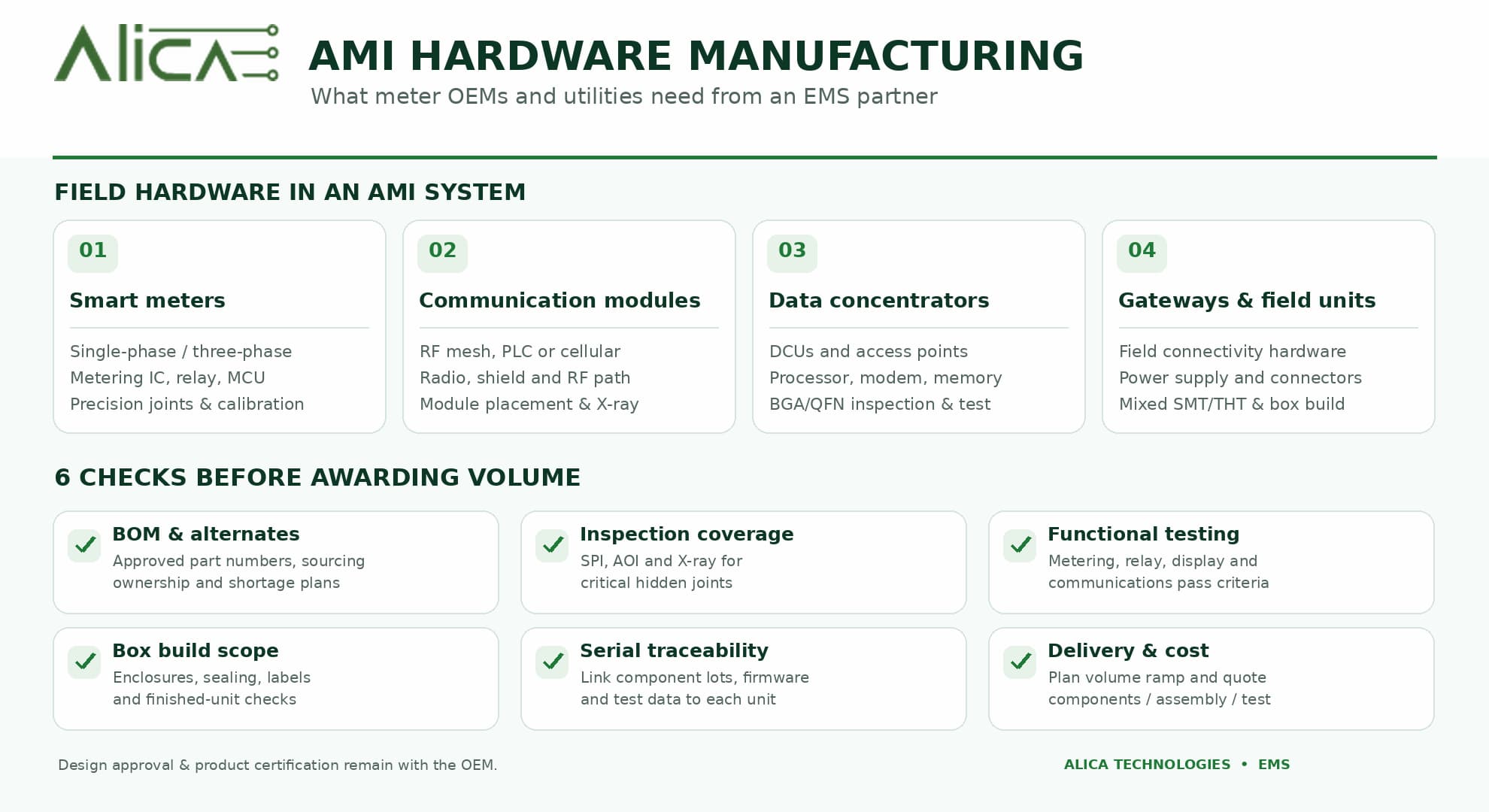
- Smart meters: single-phase and three-phase electricity meters with a metering front end, MCU, display, load switching relay and a communication interface
- Communication modules: plug-in or embedded RF mesh, PLC or cellular modules that carry meter data
- Data concentrator units (DCUs) and access points: devices that collect data from RF mesh or PLC meters and pass it to the HES, while cellular meters usually connect to the HES directly
- Gateways and field devices: feeder and distribution transformer meters, modems and related units
Each of these is a printed circuit board assembly and, in most cases, a finished box build. A meter OEM may make some of them in-house and buy others, so the manufacturing partner often handles more than one product line for the same programme. The guide to smart meter PCB assembly and box build covers the meter itself in more detail.
Why AMI hardware manufacturing is demanding at volume
Long field life and no second chances
Meters are installed for many years, often in hot, dusty or humid locations, and replacing one means a truck roll. Failures that would be tolerable in consumer electronics, such as a few percent of units with weak joints, become expensive across a large rollout. Hidden joints under metering ICs, QFN MCUs and communication modules need to be confirmed, not assumed.
Product standards and utility specifications
Smart meters in India are designed to IS 16444, and utilities and AMI service providers add their own technical specifications on communication, data and security. These standards apply to the OEM’s product and its type tests. The manufacturing partner’s job is to build every unit to the approved design and BOM, with no unapproved substitutions, and to keep records that show it.
Programme scale and delivery pressure
Large utility rollouts in India, including those under the Revamped Distribution Sector Scheme (RDSS), are commonly delivered through AMI service providers that buy hardware from meter OEMs and their suppliers. Delivery schedules are tied to installation targets, so a late batch has knock-on effects for everyone down the chain.
For procurement teams: what to check in an AMI manufacturing partner
Procurement is the primary reader of this guide because most AMI programme risk shows up first as a sourcing or delivery problem. These are the areas to examine closely.
Turnkey sourcing and full BOM management
A meter BOM can run to well over a hundred lines, and a DCU adds processors, memory, cellular modems and power supplies. Turnkey sourcing, where the EMS partner buys and manages every component, cuts the number of suppliers the OEM has to manage and gives one point of accountability for shortages. Alica Technologies offers turnkey project delivery with full BOM management and transparent cost breakdowns, so procurement teams can see what each line costs and where the risk sits.
Approved alternates and change control
Because the product standard and utility approvals are tied to a specific design, alternates must be approved before they are used. Agree upfront which parts have qualified alternates, who approves a change, and how the change is recorded against serial numbers. Design choices that make alternates easier to approve are covered in the smart meter PCB design for manufacturability checklist.
Domestic manufacturing and logistics
Building in India shortens the path from factory to utility warehouse and avoids import paperwork on finished goods. Alica builds from its facility in Changodar, Ahmedabad, and serves OEMs across India, including Delhi-NCR, Pune, Bengaluru, Hyderabad and Chennai.
Cost transparency at quote stage
Ask for quotes that separate component cost, assembly, testing and box build. That makes it easier to compare suppliers on a like-for-like basis and to see the effect of a BOM change. The questions that matter most when choosing a partner for metering are set out in the article on choosing a smart meter contract manufacturer in India.
AMI hardware types and manufacturing focus
| AMI device | Main board content | Assembly focus | Sourcing watch points |
|---|---|---|---|
| Single-phase smart meter | Metering IC, MCU, display, relay, comms interface | Fine-pitch SMT, relay and terminal THT joints, X-ray on QFNs | Metering IC and MCU allocation, relay lead times |
| Three-phase smart meter | Multi-channel metering, CTs or sensors, MCU, comms | Mixed SMT and THT, current path joints | Current sensors, enclosures, terminal blocks |
| Communication module | RF, PLC or cellular radio, MCU | Module and shield placement, hidden joints | Radio modules and chipsets, firmware versions |
| Data concentrator unit | Processor, memory, modem, RF or PLC interface, power supply | BGA and QFN inspection, power stage joints, box build | Processors, memory, cellular modems |
For R&D teams: inspection and test that protect the design
For the engineering team, the concern is that the units in volume behave like the samples that passed type testing. Inline SPI and AOI catch paste and placement defects early. 3D X-ray inspection confirms joints under metering ICs, QFN MCUs and BGA processors in DCUs. Functional testing to the OEM’s test plan checks measurement, display, relay switching and communication on every unit. Alica runs these stages with 100% inspection coverage, following IPC-recommended procedures. The stages are described on the testing and inspection services page.
For operations teams: box build and traceability
Utilities receive finished products, not boards. Bringing PCB assembly, testing, enclosure fitting, labelling and packing together removes handovers between suppliers and keeps the record for each unit in one place. Component traceability linked to each meter or DCU serial number lets an OEM answer the utility’s questions quickly if a batch issue appears. Alica’s end-to-end electronic manufacturing covers this full path, including functional and burn-in testing before dispatch.
AMI hardware sourcing checklist
Before you place an AMI hardware order with a manufacturing partner, confirm:
- Every device in scope: meter variants, communication modules, DCUs and gateways
- BOMs with approved alternates and a written change approval process
- Who buys each component, and which items are consigned by the OEM
- Stock plans for long lead parts such as metering ICs, MCUs and radio modules
- Inspection stages: SPI, AOI and X-ray, and which parts get X-ray coverage
- Functional and burn-in test plans, with pass limits from the OEM
- Serial number, label and traceability format required by the utility or AMI service provider
- Box build scope: enclosure, sealing, labels, packing and dispatch documents
- Delivery schedule tied to installation phases, with a plan for ramp-up
- Quote broken down into components, assembly, testing and box build
Frequently Asked Questions
What does AMI hardware manufacturing cover?
AMI hardware manufacturing covers the field devices in an advanced metering system: smart meters, communication modules, data concentrator units, access points and gateways. It includes PCB assembly, inspection, functional testing and box build. The Head End System and Meter Data Management are software platforms and are not part of the hardware build.
Is the EMS partner responsible for IS 16444 compliance?
No. IS 16444 applies to the meter OEM’s product design and type testing. The EMS partner’s role is to build every unit to the approved design and bill of materials, avoid unapproved part changes and keep traceability records that show each meter matches the approved version.
How can procurement reduce shortage risk on AMI programmes?
Procurement can reduce shortage risk by agreeing approved alternates early, planning stock for long lead parts such as metering ICs and radio modules, and using a turnkey sourcing partner that manages the full BOM and reports risk lines before they affect delivery.
Plan your AMI hardware build with Alica Technologies
Alica Technologies supports meter OEMs and AMI suppliers from Changodar, Ahmedabad, with turnkey sourcing, high-density SMT and THT assembly, SPI, AOI and 3D X-ray inspection, functional and burn-in testing, and box build. Send your BOM and programme volumes through the Alica Technologies contact page, or call +91 97271 78787. You can also review the full list of manufacturing capabilities before you start.
Tagged in
Looking for a reliable EMS partner?
Get a quote for PCB assembly, turnkey manufacturing, or prototype builds.
Get in Touch