
Industrial Box Build Assembly: Building ruggedised units for harsh sites
 Utsav
•
Nov 15, 2026
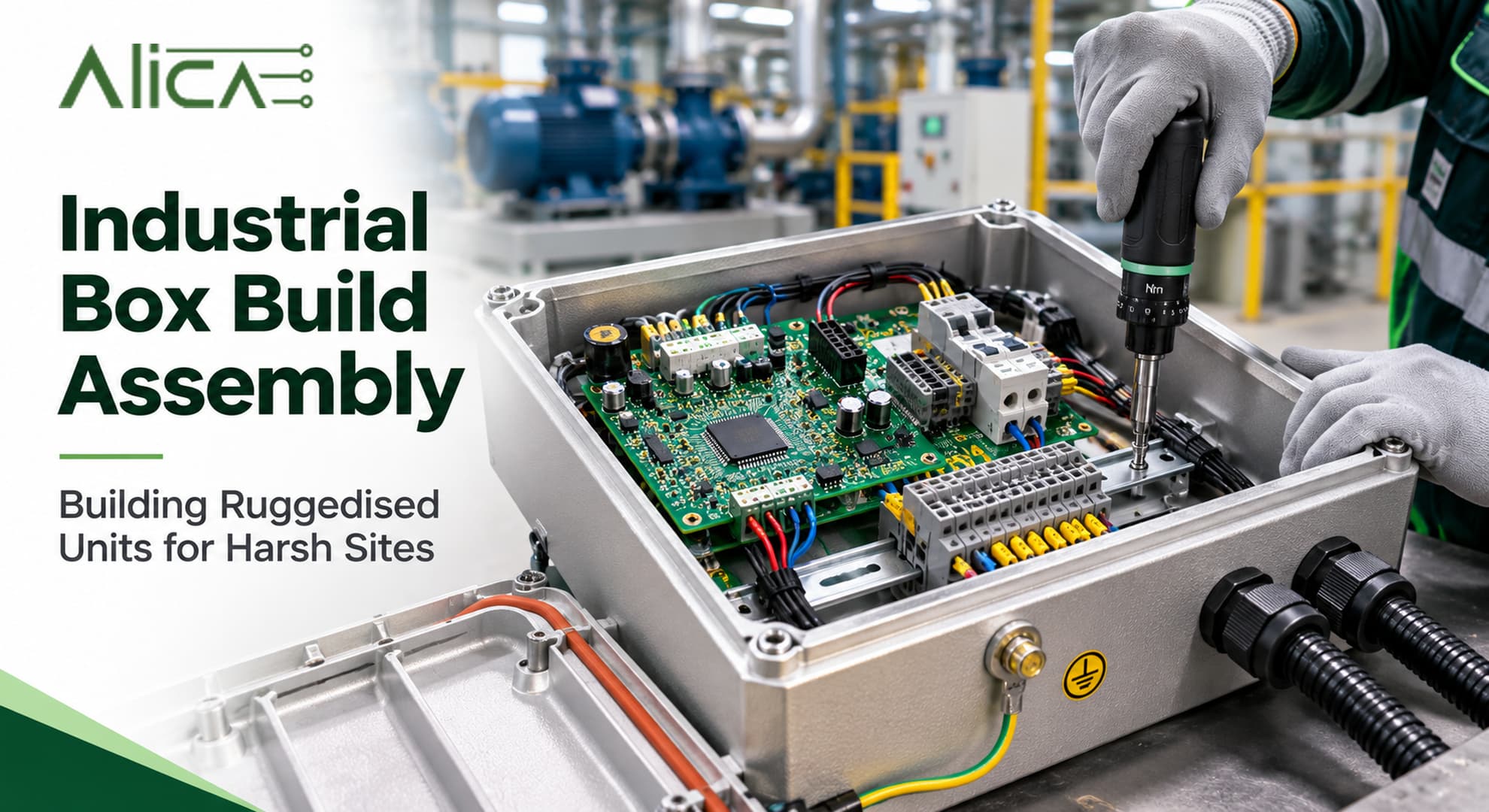
An industrial controller that passes every test on the bench can still fail in its first monsoon on a pump station, a cement plant or a packaging line, and the cause is often the industrial box build assembly rather than the electronics. The board is often fine. What lets the unit down is everything around it: a cable gland tightened by feel rather than to a torque value, a gasket seated unevenly, a harness routed across a sharp edge, an earth lug that was never checked, or a connector that works loose after a few weeks of vibration. For a plant head or operations manager at an industrial OEM, these are the faults that turn into site visits, warranty claims and awkward calls with customers.
That is why industrial box build assembly deserves as much attention as the PCB assembly inside it. When one partner builds the boards, fits them into the enclosure, wires the unit, tests it as a finished product and records what went into it, there are fewer hand-offs where quality can slip. This guide explains what makes ruggedised box build hard, what operations teams should ask for, and what procurement and R&D teams should check alongside them.
What industrial box build assembly covers
Box build is the step that turns a tested circuit board into a product that can be shipped, installed and powered up on site. For industrial equipment it usually includes:
- Fitting one or more PCB assemblies into a metal or plastic enclosure, with standoffs, brackets, DIN rail clips or heat sinks as drawn.
- Building and routing internal wiring and harnesses between boards, terminals, displays and power supplies.
- Mounting front panels, keypads, indicators, fans, filters and labels.
- Fitting seals, gaskets and cable glands to the OEM’s drawing and work instructions.
- Final functional testing of the complete unit, often followed by burn-in.
- Packing, serial labelling and the build records that go with each unit.
A general introduction to the process is in the guide to box build assembly from bare PCB to finished product. This article focuses on what changes when the product has to survive an industrial site rather than an office.
Why ruggedised units are hard to build well
Mechanical stress does not forgive small errors
Motors, compressors, presses and conveyors shake everything bolted near them. In a ruggedised unit, every fastener, standoff and connector is a possible failure point. A screw that is under-torqued backs out. One that is over-torqued cracks a plastic boss or stresses the board. Heavy parts such as transformers, relays and large capacitors need secure mounting and good solder joints, which is why industrial boards often combine surface mount and through-hole parts. The trade-offs are covered in the technical guide to SMT vs THT assembly.
Sealing depends on the build, not only the design
Many industrial enclosures are designed to an IP rating defined in IEC 60529. The first digit describes protection against solid objects and dust, and the second describes protection against water. An IP65 enclosure, for example, is designed to be dust tight and protected against water jets. The rating belongs to the OEM’s product and is proven by the OEM’s testing, but it only holds if every unit is built the same way: gaskets seated fully, glands tightened correctly, covers closed in the right sequence and no cables pinching a seal.
Wiring is where many field faults start
Loose crimps, wrong wire colours, harnesses resting on hot components or sharp metal edges, and missing strain relief are common causes of intermittent faults. They are also hard to diagnose on site, because the unit may work for days before a vibration or temperature swing exposes the problem.
Heat and long service life
Industrial units often sit in closed panels or outdoor cabinets. Heat sinks, thermal pads and airflow paths only work if they are fitted exactly as designed. Products also stay in production for years, so the build has to stay consistent across many batches, revisions and operators.
What operations teams should expect from a box build partner
For a plant or operations head, the aim is simple: every unit that leaves the line should behave like the one that passed qualification. That depends on process discipline more than on any single machine.
Documented work instructions for every step
Each assembly step, from fitting the board to closing the cover, should follow a written, revision-controlled work instruction with pictures, torque values and the sequence to follow. When the OEM changes the design, the instruction changes with it, and the old one is withdrawn from the line.
Board quality before the box is closed
Problems found after the enclosure is sealed cost far more to fix. Boards going into a ruggedised unit should already have passed solder paste inspection, AOI and, where there are hidden joints under BGAs, QFNs or power pads, X-ray inspection. Alica Technologies follows IPC-recommended procedures for assembly and inspection. The defects these steps catch are explained in the guide to common PCB assembly defects and how inspection catches them.
Testing the finished unit, not just the board
A board-level test cannot see a reversed connector, a missing earth link or a display cable that is not fully seated. Finished-unit functional testing should exercise inputs, outputs, communication ports and power-up behaviour through the unit’s own connectors. For products that must run continuously, burn-in under power helps expose early-life failures before they reach a customer. More on the test options is on Alica’s testing and inspection services page.
Records you can trace back
Every unit should carry a serial number that links to its board serials, component lots, test results and the operator or station that built it. When a field return arrives, that record shows whether the issue is limited to one batch or wider, which keeps a small problem from becoming a large recall.
Board-level build vs complete box build
| Area | Board-level build only | Complete industrial box build |
|---|---|---|
| Who fits the enclosure | The OEM, in its own plant or through another vendor | The EMS partner, to the OEM’s drawing and work instructions |
| Wiring and harnesses | Separate supplier or OEM line | Built and fitted in the same flow as the boards |
| Final test | Board test only; unit test done later by the OEM | Functional test of the finished unit, plus burn-in where specified |
| Hand-offs between suppliers | Several, each with its own packaging and inspection | One, at dispatch of the finished unit |
| Traceability | Split across board and unit records | One record linking unit, boards, lots and test data |
| Accountability for a field fault | Often disputed between suppliers | Held by one partner for the build |
What procurement teams should check
For purchasing and supply chain teams, box build adds parts that are easy to overlook in a quote: enclosures, glands, gaskets, fasteners, harness materials, labels and packaging. Ask for a quote that lists these separately, so cost changes are visible. Agree who sources each mechanical part, and how long-lead items such as custom enclosures are planned. A partner that handles turnkey sourcing and full BOM management for both electronic and mechanical parts reduces the number of vendors to manage. Alica’s end-to-end electronic manufacturing service covers this flow from sourcing to a finished unit, with domestic manufacturing in Ahmedabad.
What R&D teams should settle before the first build
Hardware engineers can make box build far easier by settling a few things early. Give the partner a full mechanical drawing set with torque values, gasket and gland details, and an exploded view. Specify which connectors need locking features. Define the finished-unit test: what is measured, what the limits are and how long burn-in runs. Request a design for manufacturability review that covers the mechanical assembly as well as the board, so issues such as poor screwdriver access or a harness that cannot be routed without stress are fixed before tooling. The guide to industrial automation PCB assembly covers the board-level side of these decisions.
Industrial box build checklist
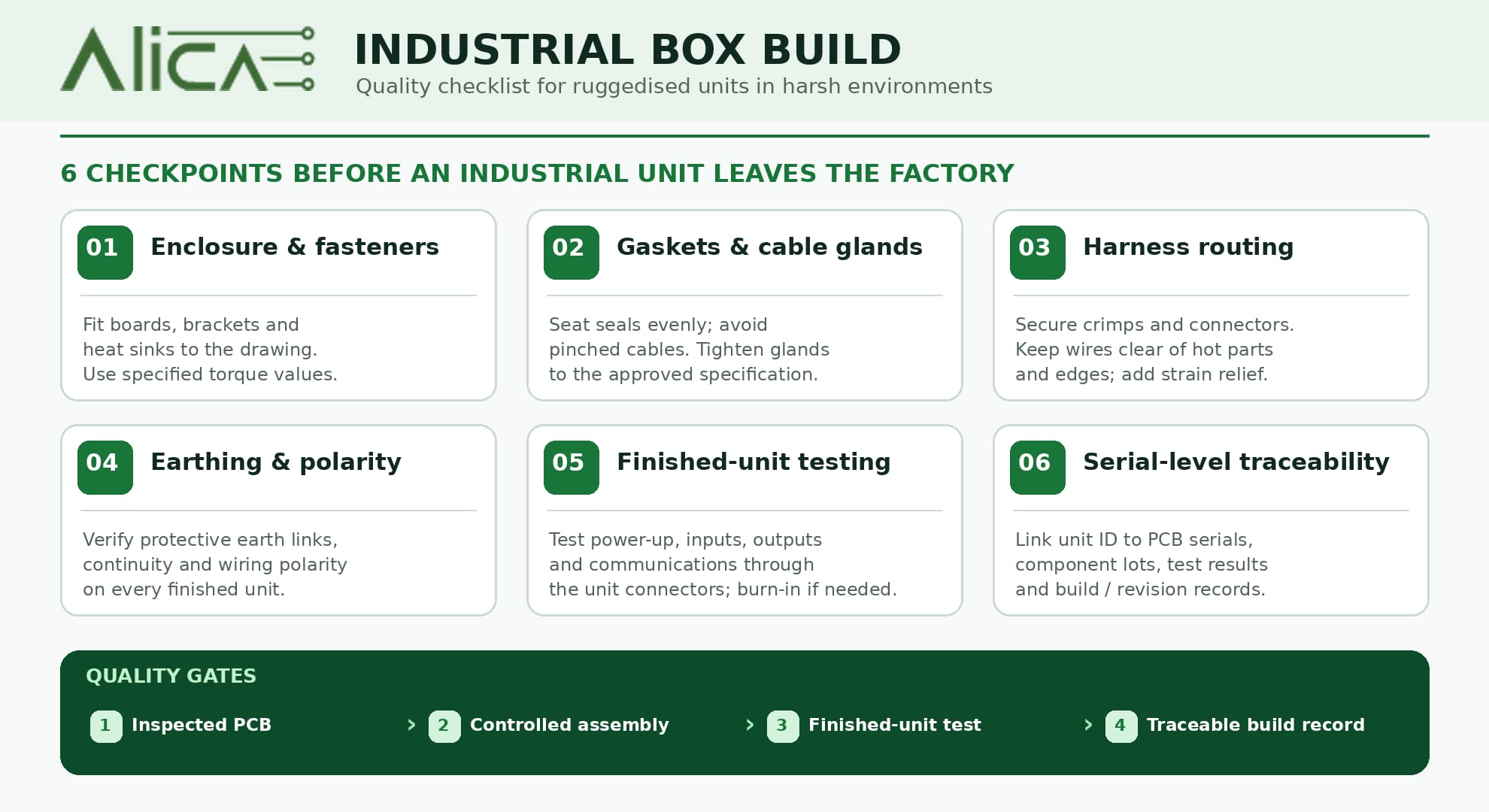
- Revision-controlled work instructions with pictures, sequence and torque values for every fastener and gland.
- SPI, AOI and X-ray inspection on boards before they go into the enclosure.
- Agreed handling for gaskets and seals, including how they are stored and fitted.
- Harness routing defined away from sharp edges and hot parts, with strain relief at every exit.
- Earth continuity and polarity checks on every unit.
- Functional test of the finished unit through its own connectors, with recorded results.
- Burn-in duration and conditions written down where the product needs it.
- Unit serial numbers linked to board serials, component lots and test data.
- A first article inspection on the first units of every new build or revision.
- A clear process for engineering changes, so old and new builds never mix.
Frequently Asked Questions
What is industrial box build assembly?
Industrial box build assembly is the process of turning tested PCB assemblies into finished industrial units. It covers fitting boards into the enclosure, wiring and harnesses, panels, seals and glands, final functional testing, burn-in where needed, labelling and the build records for each unit.
Does the box build partner certify the IP rating of my enclosure?
No. The IP rating is part of the OEM’s product design and is proven by the OEM’s own type testing. The box build partner’s job is to build every unit to the approved drawing and work instructions, so that production units are sealed the same way as the unit that was tested.
Why test the finished unit if the boards were already tested?
Board tests cannot detect faults introduced during box build, such as a reversed connector, a loose harness, a missing earth link or a display cable that is not fully seated. A functional test through the unit’s own connectors confirms the complete product works before it is shipped.
Plan your next industrial box build with Alica
Alica Technologies builds PCB assemblies and complete box build units for industrial OEMs from its facility in Changodar, Ahmedabad, with mixed SMT and THT assembly, SPI, AOI and 3D X-ray inspection, functional and burn-in testing, and component traceability. Review the full list of manufacturing capabilities, or share your drawings and test requirements with the Alica team to start the discussion.
Tagged in
Looking for a reliable EMS partner?
Get a quote for PCB assembly, turnkey manufacturing, or prototype builds.
Get in Touch