
Medical Device Contract Manufacturer in India: How to Choose a Partner
 Utsav
•
Nov 28, 2026
For a sourcing manager at a medical device company, choosing a medical device contract manufacturer in India is not like buying a commodity part. The partner will hold your BOM, touch every board that goes into a monitor, analyser or wearable, and produce the records your quality team will rely on during an audit or a field investigation. A low quote that comes with weak documentation or a shaky supply chain is not a saving. It is a risk that shows up later, usually at the worst time.
The difficulty is that most quotes look similar on paper. Every supplier says it inspects, tests and traces. The differences appear in the detail: how components are bought, how changes are controlled, what is recorded per unit and how problems are escalated. This guide sets out what procurement and supply chain teams should check, with shorter notes for operations and R&D colleagues who will sit in the same evaluation.
Why medical electronics are harder to outsource
Medical devices combine several demanding traits. The boards are often dense, with fine-pitch BGAs, QFNs and small passives. Measurement front ends handle very small signals, so a marginal joint or the wrong tolerance part can change a reading. Volumes are usually low to medium with many variants, which makes setup discipline important. And because the product is regulated, the OEM must be able to show how each unit was built.
In India, medical devices are regulated by CDSCO under the Medical Devices Rules, 2017. The manufacturer that holds the licence carries the regulatory responsibility, and the Fifth Schedule of the rules sets out the quality management system it must run. A contract manufacturer builds to your design and your requirements, so its records and controls have to feed cleanly into your quality system. The medical device PCB assembly in India guide covers the technical side of these builds in more depth.
What procurement should check in a medical device contract manufacturer in India
Turnkey sourcing from authorised channels
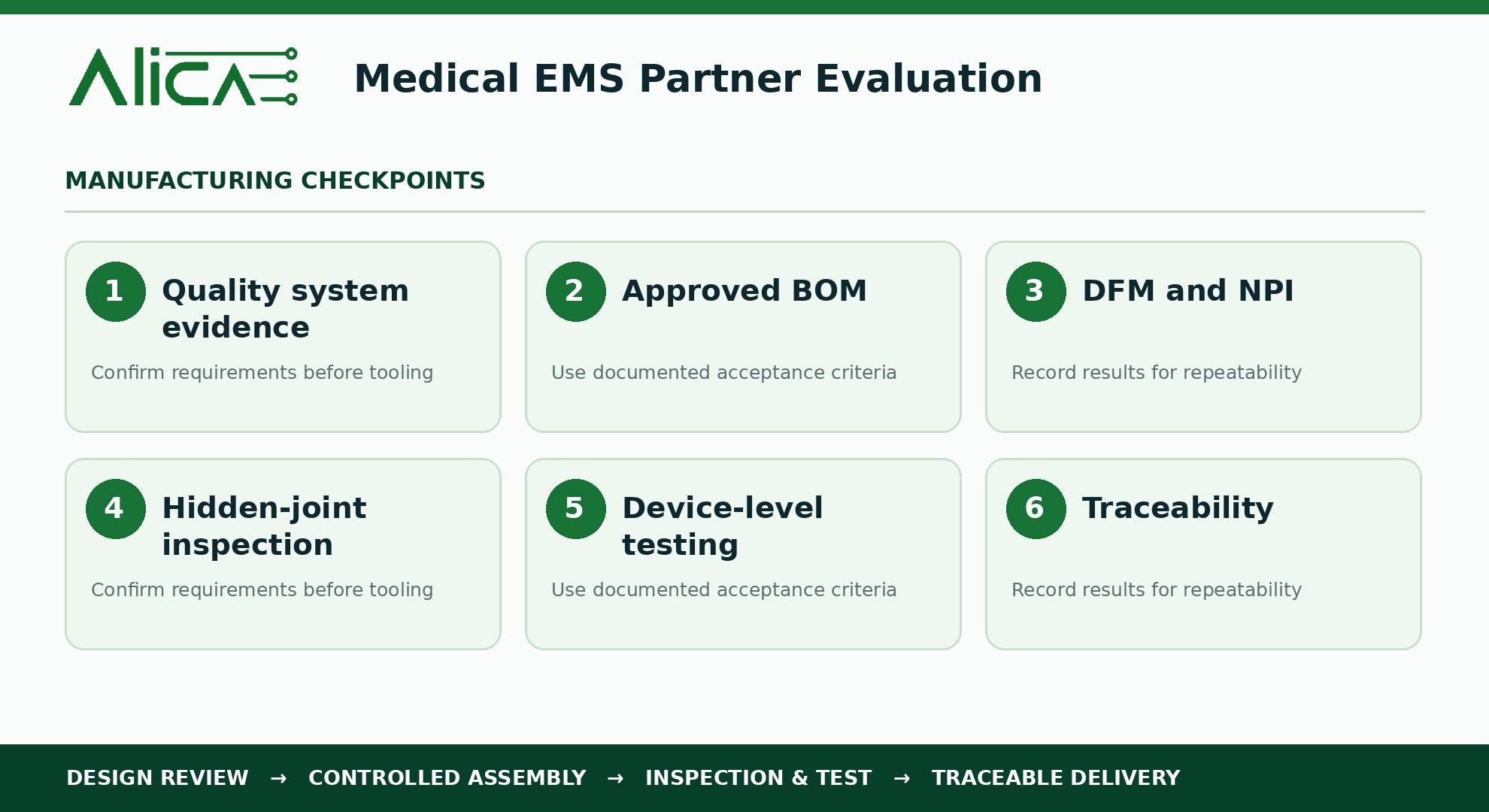
Counterfeit or poorly stored components are a serious risk in any electronics build and a much larger one in medical devices. Ask where the partner buys parts, how it handles moisture-sensitive devices and what happens when a part is short. A partner that offers turnkey sourcing and full BOM management takes on the work of buying, tracking lead times and proposing alternates. The important rule for medical products is that no alternate is fitted without your written approval. Alica’s model for this is described on its turnkey project delivery page.
Component traceability per unit
Traceability means being able to take a serial number from a returned device and find the component lots, the build date and the inspection results for that board. Ask to see a sample trace record. If the answer is a spreadsheet assembled after the fact, the system will not hold up when you need it.
Change control
Medical OEMs need to know about any change that could affect the product: a new component source, a revised stencil, a different reflow profile or a process step moved. Ask how the partner notifies customers of changes and whether it waits for approval before applying them.
Transparent cost breakdowns
A clear quote separates component cost, assembly cost, testing, box build and any one-time charges such as stencils and fixtures. This lets purchasing compare suppliers fairly and see where cost moves when volumes or parts change. The broader principles of picking a partner are covered in how to choose a PCB assembly partner.
Certifications and their scope
Ask every shortlisted supplier which certifications it holds, and check the certificate itself: the issuing body, the expiry date and, most importantly, the scope. A certificate that covers a different site or a different activity does not cover your build. Your regulatory team should decide which supplier credentials your own licence and quality system require.
Comparing contract manufacturing models
| Model | Who buys components | Best suited to | Procurement watch-outs |
|---|---|---|---|
| Consigned (kitted) assembly | The OEM | Teams with strong in-house purchasing and approved vendor lists | Kit shortages stop the line; OEM carries storage and handling risk |
| Turnkey PCB assembly | The contract manufacturer | OEMs that want one supplier for parts and assembly | Agree approved sources and alternate rules in writing |
| Turnkey with box build | The contract manufacturer | OEMs that want tested, assembled units ready for final release | Define test coverage, labelling and packaging records up front |
The difference between a basic contract manufacturer and a full EMS partner is explained in contract manufacturing vs EMS.
For operations and quality teams
Operations colleagues will want to know how defects are caught before units ship. Look for inline solder paste inspection after printing, automated optical inspection after reflow and 3D X-ray inspection for BGA and QFN joints. Functional testing should check that each board does what the design intends, and burn-in testing can expose early-life failures before dispatch. Written procedures that follow IPC-recommended practice, with records for each batch, give the quality team something concrete to audit. Alica’s approach is set out on its testing and inspection page.
If the device needs to arrive as a finished unit, with boards fitted into enclosures, cables dressed and labels applied, ask whether the partner offers box build and how that stage is inspected. The guide to box build assembly explained shows what that work involves.
For R&D and hardware teams
Engineering teams care most about the first builds. An early DFM review before tooling can catch pad, spacing and test access issues while the design can still change cheaply. Rapid prototyping lets the team validate the design on boards built with production processes, so there are fewer surprises at the pilot stage. Ask the partner how DFM findings are reported and who signs them off.
Supplier evaluation checklist
Use this list during supplier visits or RFQ reviews:
- Where are components bought, and are they from authorised channels?
- How are moisture-sensitive parts stored and tracked?
- Is any alternate part fitted only after your written approval?
- Can the partner trace a serial number to component lots and inspection results?
- How are process and source changes notified, and are they held for approval?
- Is SPI inline, is AOI run on every board, and is X-ray available for hidden joints?
- Will functional and burn-in tests follow a test plan you have approved?
- Does the quote separate components, assembly, testing and one-time costs?
- Which certifications are held, and does each certificate cover this site and activity?
- Can the partner move from prototypes to production and box build without a change of supplier?
Frequently Asked Questions
What does a medical device contract manufacturer do?
A medical device contract manufacturer builds electronics or finished devices to the design supplied by the OEM. Depending on the agreement, this can include component sourcing, PCB assembly, inspection, functional testing, box build and the build records the OEM needs for its quality system.
Who holds the regulatory responsibility when manufacturing is outsourced?
In India, the manufacturer that holds the CDSCO licence under the Medical Devices Rules, 2017 carries the regulatory responsibility for the device. The contract manufacturer builds to the requirements of that manufacturer, so its records and change control must support the quality system of the licence holder.
Is turnkey or consigned assembly better for medical devices?
It depends on your purchasing strength. Consigned assembly suits teams that already buy and control parts well. Turnkey assembly moves sourcing to the partner and reduces supplier count, but the approved sources and the rules for alternates should be agreed in writing first.
Talk to Alica about your medical electronics build
Alica Technologies builds medical and other regulated electronics in Changodar, Ahmedabad, with turnkey sourcing, full BOM management, component traceability, inline SPI, AOI, 3D X-ray, functional and burn-in testing, and box build. Review the full list of Alica’s capabilities, or request a quote for your medical device build.
Tagged in
Looking for a reliable EMS partner?
Get a quote for PCB assembly, turnkey manufacturing, or prototype builds.
Get in Touch