
Contract manufacturing vs EMS: Is there a real difference?
 Utsav
•
Aug 22, 2026
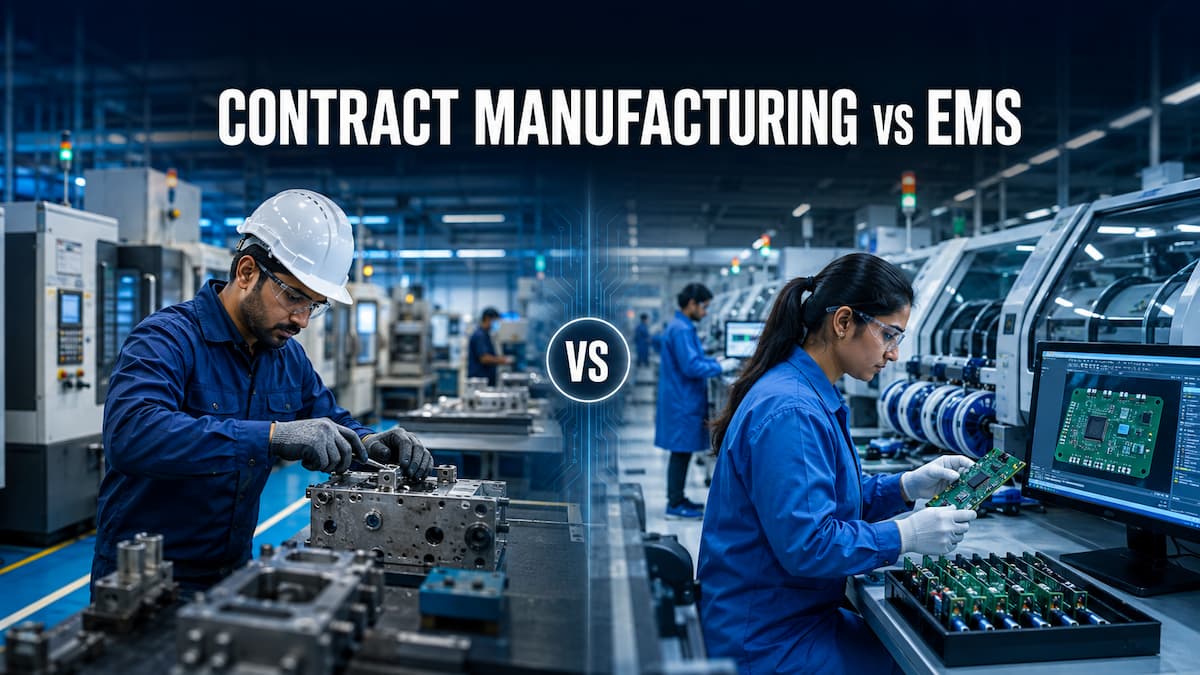
A procurement lead sourcing a manufacturing partner will hit both terms fast: “contract manufacturer” and “EMS provider.” Some vendors use them interchangeably. Others treat them as completely different categories. Neither approach is fully accurate and the confusion can cost you if it shapes how you write an RFQ or shortlist a vendor.
This guide breaks down exactly what separates contract manufacturing from EMS, where they overlap, what each term signals in practice, and how to evaluate any vendor regardless of how they label themselves.
Table of Contents
What Is Contract Manufacturing?
Contract manufacturing is any arrangement where a business pays an outside company to produce a product on its behalf under contract rather than building it in-house.
The term is industry-agnostic. It applies equally to furniture, pharmaceuticals, textiles, automotive components, and electronics. A company that sews garments for a fashion brand is a contract manufacturer. So is a company that builds circuit boards for a medical device company.
The core idea: you own the product design and brand; they own the production process.
Contract manufacturing relationships typically cover:
- Physical production of goods to the buyer’s specification
- Use of the buyer’s design files, materials, or formulations
- White-label or OEM production where the buyer’s brand is on the final product
- Sometimes logistics, warehousing, or fulfillment depending on the arrangement
What Is an EMS Provider?
EMS stands for Electronic Manufacturing Services. It describes contract manufacturing specifically for electronic assemblies PCBs, box builds, cable assemblies, and the inspection, testing, and component sourcing that supports them.
Every EMS provider is a contract manufacturer. But not every contract manufacturer is an EMS provider.
EMS emerged as a distinct category because electronics manufacturing has its own infrastructure requirements that a general fabrication shop doesn’t necessarily have:
- SMT and THT assembly lines for populating PCBs
- Automated optical inspection (AOI) and solder paste inspection (SPI) to catch defects early
- X-ray inspection for hidden solder joints under BGAs and similar packages
- Component sourcing and traceability knowing exactly which batch a part came from
- DFM review capability reviewing Gerber files and BOMs before production starts
- IPC standards knowledge IPC-A-610 for assembled boards, IPC-7711/7721 for rework
A general contract manufacturer who adds PCB assembly as a side service rarely builds all of that infrastructure. An EMS provider’s entire operation is built around it.
Contract Manufacturing vs EMS: Side-by-Side
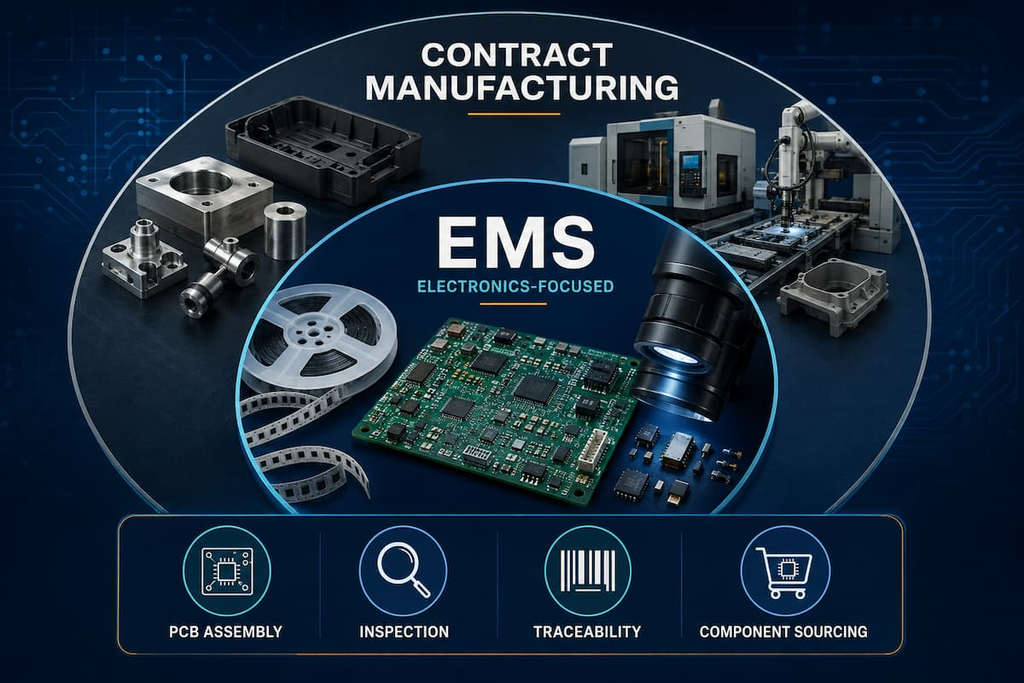
Contract Manufacturing EMS Provider Scope Any industry Electronics only Products Furniture, textiles, pharma, metal parts, electronics PCBs, box builds, cable assemblies, electronic sub-assemblies Inspection Varies widely by industry SPI, AOI, X-ray built into standard process Component sourcing Often handled by buyer Usually handled in-house, with traceability Quality standards Industry-specific IPC-A-610, ISO 9001, and often IATF or IOSEC depending on sector DFM review Rarely standard Standard step at quoting stage Who uses them Brands across all verticals Electronics OEMs, hardware startups, defense, medical, industrial Where the Confusion Comes From
The terms overlap because EMS is a subset of contract manufacturing and many EMS providers market themselves as “contract manufacturers” to cast a wider net in search results.
The confusion becomes a problem when you’re evaluating vendors. A search for “contract manufacturer India” will return both large, electronics-only EMS operations and smaller general fabrication shops that handle PCBs as one service among many. On their websites, both might say “contract manufacturing.”
The difference only shows up when you look deeper: their equipment list, their inspection process, their case studies, and what percentage of their production volume is actually electronic assemblies.
Why This Matters More in India Right Now
India’s electronics manufacturing sector is growing fast. Government incentives under the Production Linked Incentive (PLI) scheme have pushed new investment into the space, and more vendors are entering the market.
That growth creates a wider spread between top-tier EMS providers and general fabricators who have recently added PCB assembly capability. Both will show up in the same search results. Both may quote the same product.
The differences that matter:
- Inspection discipline — Does SPI and AOI run on every job, or only when a customer requests it?
- Component traceability — Can they tell you exactly which batch a component came from, months after delivery?
- DFM capability — Do they flag design issues before procurement, or after they’ve already bought parts?
- IPC familiarity — Do their technicians work to IPC-A-610 by default, or is it a term they’ve heard of?
These aren’t things you can assess from a vendor’s homepage. They show up in their process, their documentation, and how they answer specific questions.
Questions to Ask Any Vendor EMS or Contract Manufacturer
Don’t filter by label. Filter by answers.
On production mix:
- What percentage of your production volume is electronic assemblies specifically?
- What industries do you serve, and what share is electronics vs. other product types?
On inspection:
- Do you run SPI, AOI, and X-ray as standard steps, or only on request?
- At what production volumes do you run full inspection vs. sampling?
- Can you share an inspection report from a comparable past project?
On components:
- Do you handle component sourcing in-house, or does the buyer supply parts?
- How do you manage component traceability can you pull batch records post-delivery?
- What’s your process if a specified component goes obsolete mid-production?
On design review:
- Do you review Gerber files and BOMs before procurement starts?
- What DFM issues do you flag most often, and how are they communicated?
On quality and standards:
- What certifications do you hold? (ISO 9001, IATF 16949, ISO 13485)
- Which IPC standards do your technicians work to?
- Can you provide a Certificate of Conformance per batch?
A vendor whose answers are specific and process-driven is a different partner than one whose answers are vague and assurance-heavy. The label on their website tells you almost nothing.
Where Alica Technologies Sits
Alica Technologies is an EMS provider in the strict sense electronics only, built around electronic assemblies from the ground up.
Our facility in Ahmedabad handles SMT assembly, THT assembly, and box builds. Every job runs through SPI, AOI, and X-ray inspection as standard steps, not add-ons. DFM review starts at the quoting stage, before any components are procured or production is scheduled.
What that looks like in practice:
- Gerber files and BOMs reviewed for manufacturability before procurement begins common DFM issues flagged in writing before production is locked in
- SPI, AOI, and X-ray inspection run on every job, regardless of order size
- Component sourcing handled in-house, with Certificate of Conformance documentation maintained per batch and traceable post-delivery
- IPC-A-610 as the working standard for assembled boards across all product categories
Our focus is narrow by design. We don’t manufacture furniture, metal parts, or plastic housings. Every process on our floor exists to support electronic assembly. That focus shows up in the quality of the output and in the depth of the documentation we can provide.
If you’re evaluating EMS partners in India, our EMS partner selection checklist walks through the full set of questions to ask with notes on what good answers look like vs. what to be cautious about.
Frequently Asked Questions
Is EMS a type of contract manufacturing?
Yes. EMS describes contract manufacturing specifically for electronic products. Every EMS provider is a contract manufacturer, but not every contract manufacturer is an EMS provider. The distinction is about scope and specialization, not a different type of business relationship.
Should I avoid vendors that call themselves general contract manufacturers?
Not automatically. But it’s worth checking whether electronics assembly is a core part of their business or one service among several. Ask what share of their production volume is PCB assembly, and whether inspection stages like SPI and AOI run by default. Those answers tell you more than the label does.
Does the terminology affect the contract?
No. What matters in any manufacturing contract is scope of work, quality standards, inspection requirements, IP ownership, liability terms, and delivery milestones regardless of whether the vendor calls themselves a contract manufacturer or an EMS provider.
Why do some EMS providers avoid the term “contract manufacturer”?
Many EMS providers use “EMS” specifically to signal electronics focus and distinguish themselves from general fabrication shops. Even though the terms overlap in meaning, “EMS” carries a more specific implication of PCB assembly capability, inspection infrastructure, and electronics-specific quality standards.
What’s the fastest way to tell if a vendor is genuinely electronics-focused?
Ask what share of their production volume is PCB assembly. Ask whether SPI and AOI run as standard on every job. Ask to see inspection documentation or first-article reports from a comparable past project. If those answers are specific and come with documentation, you’re dealing with a vendor whose business is actually built around electronics.
What does DFM review mean, and why does it matter?
DFM stands for Design for Manufacturability. It’s a review of your design files Gerber files, BOM, assembly drawings before production starts, to catch issues that would cause defects, delays, or cost overruns. A vendor who runs DFM review as a standard step is a different partner than one who starts assembly and flags problems after parts are already on order.
What certifications should an EMS provider hold?
At minimum, ISO 9001 for quality management. Depending on your product category: IATF 16949 for automotive, ISO 13485 for medical devices. IPC-A-610 is the relevant quality standard for assembled electronic boards. Ask which certifications a vendor holds and request documentation certifications should be current and verifiable.
Alica Technologies provides electronic manufacturing services for OEMs and hardware companies across industrial, commercial, and emerging technology sectors. Our facility is in Ahmedabad, India.
Looking for a reliable EMS partner?
Get a quote for PCB assembly, turnkey manufacturing, or prototype builds.
Get in Touch