
EMS vs OEM vs ODM: What’s the difference (and which do you actually need)?
 Utsav
•
Aug 18, 2026
Utsav
•
Aug 18, 2026
“Do we need an EMS partner?” “Should we work with an ODM?” “Are you an OEM or ODM?” These questions are common in electronics manufacturing, but the terms EMS, OEM, and ODM do not mean the same thing.
Each model describes a different role in product development and manufacturing. The main differences involve product design, intellectual property, engineering responsibility, manufacturing, and supply chain management.
Understanding these differences before choosing a manufacturing partner can help you avoid unexpected costs and unclear ownership of your product design or IP.
In this guide, we explain what EMS, OEM, and ODM mean, how each manufacturing model works, and what to consider when choosing the right option for your electronics product.
The three models, defined
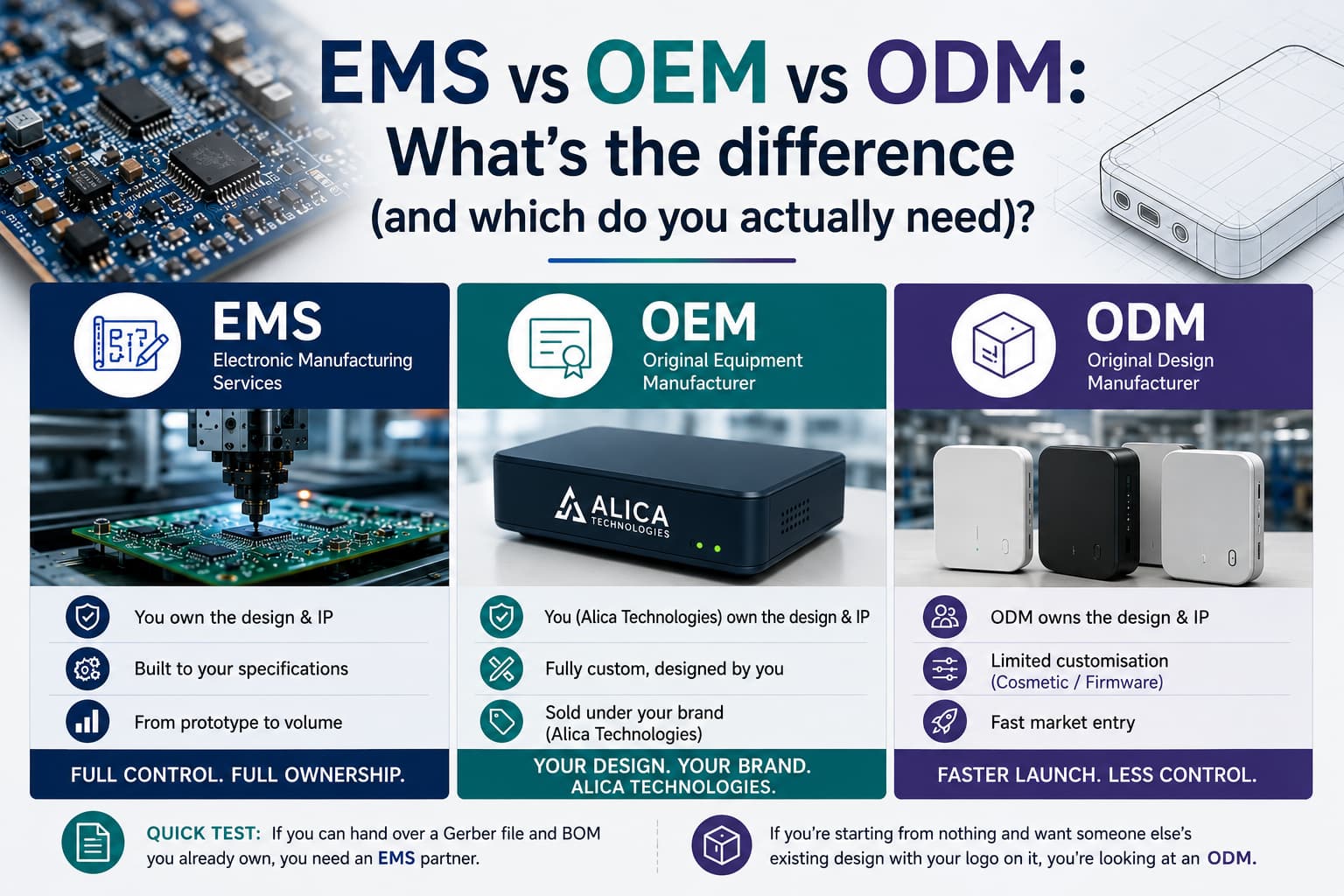
EMS: Electronic Manufacturing Services
An EMS provider manufactures a product to your design. You (or your engineering team) own the PCB layout, the BOM, and the intellectual property. The EMS partner sources components, assembles, tests, and often packages the product but the design itself is yours from start to finish. Alica Technologies operates as an EMS provider: we build to your specifications; we don’t own or sell the design.
OEM: Original Equipment Manufacturer
This term causes the most confusion because its meaning shifted over time. In its original sense, an OEM is the company whose brand the final product carries, the company that designed it and sells it under their own name, even if someone else manufactures it. In casual industry use today, “OEM manufacturer” often gets used to mean the same thing as an EMS or contract manufacturer. When you hear the term, it’s worth clarifying which sense is meant.
ODM: Original Design Manufacturer
An ODM designs the product itself, typically as a semi-generic or fully generic product, and then manufactures it for multiple brands who each put their own label on it. The ODM owns the base design and IP; the brand customises packaging, minor features, or firmware and sells it as their own. This is common for consumer electronics like power banks, routers, or generic IoT devices.
EMS vs OEM vs ODM side-by-side comparison
| Factor | EMS | OEM (brand owner sense) | ODM |
|---|---|---|---|
| Who owns the design/IP | You | You (the brand) | The ODM |
| Who does the engineering | You (partner may assist via DFM) | You, in-house or outsourced | The ODM, largely pre-built |
| Customisation level | Fully custom, built to your spec | Fully custom | Limited: cosmetic/firmware tweaks only |
| Typical use case | Custom hardware products, any volume | Any branded product | Fast market entry with a generic product |
| IP risk | Low: your design stays yours | Low: your design stays yours | Higher: you don’t own the underlying design |
Which one does your product actually need?
Choose EMS When…
- You have a proprietary or custom PCB design you want built exactly as specified
- Protecting your IP and design ownership matters to your business
- You need a manufacturing partner who can scale from prototype to volume without owning your product
Choose ODM When…
- You want to enter a market quickly with a proven, generic product design
- Deep hardware differentiation isn’t your competitive edge: branding, software, or go-to-market is
- You’re comfortable with limited control over the underlying design and shared access to that design across other brands
Why EMS vs OEM vs ODM distinction matters before you sign anything
Contracts, IP terms, and exclusivity clauses look completely different across these three models. Signing an ODM agreement thinking you’re getting a fully custom EMS build or vice versa, creates problems that surface much later, often after you’ve already invested in tooling or marketing around a product you don’t fully own.
How Alica Technologies fits in
Alica Technologies operates purely as an EMS partner. We manufacture to your design, your IP stays yours, from the first prototype through volume production. This means:
- You retain full ownership of your PCB design, BOM, and any proprietary IP
- Our role is manufacturing execution: SMT, THT, mixed-technology assembly, inspection and testing, and turnkey component sourcing not designing or owning your product
- Our team supports your design through DFM review at the NPI stage, without ever claiming ownership of what we help you refine
If you’re evaluating manufacturing partners and want to understand what a genuine EMS relationship looks like in practice, see our EMS partner selection checklist or read about our turnkey project delivery model.
Frequently Asked Questions
Is an EMS provider the same as a contract manufacturer?
Yes, in electronics the terms are typically used interchangeably. Both describe a partner who manufactures a product to your design without owning the underlying IP.
Can I switch from an ODM to an EMS model later?
It’s possible, but it usually requires redesigning the product from scratch since you don’t own the ODM’s original design. This is one of the key risks worth weighing before choosing an ODM for a long-term product line.
Does using an EMS partner mean I need my own engineering team?
Not necessarily in-house, but you (or a design partner you hire) need to own and provide the PCB design and BOM. A good EMS partner will review it for manufacturability but won’t create the design for you.
Why do people use “OEM” to mean different things?
The term originated to describe the brand owner of a finished product, but common industry usage has drifted to sometimes mean the manufacturer itself, especially in casual conversation. Always clarify which meaning is intended in a given context.
Is ODM cheaper than EMS?
Often yes for initial cost, since the design work is already done and shared across multiple customers. But the trade-off is limited differentiation and no ownership of the underlying design.
Looking for a reliable EMS partner?
Get a quote for PCB assembly, turnkey manufacturing, or prototype builds.
Get in Touch