
Design House to Production Handoff: From Schematic to an EMS Partner
 Utsav
•
Nov 15, 2026
For an embedded design house, the schematic and layout are rarely the hardest part of a client project. The hard part comes after: the client approves the prototype, wants a few hundred units within weeks, and the design team has to hand the product to a manufacturer it may never have worked with. Files go out in a hurry, the BOM still lists a part that is out of stock, the test procedure lives in one engineer’s head, and the first build comes back with questions nobody has time to answer.
A clean design house to production handoff avoids most of that pain. It is not a single email with a zip file. It is a short, structured process in which the design house, its client and the EMS partner agree on data, parts, tests and responsibilities before the first board is built. This guide walks a lead hardware architect through that process, and then covers what the client’s purchasing and operations teams will want to see.
Why handoffs go wrong
Most production problems on a new design trace back to gaps at the handoff, not to the design itself. The usual causes are familiar to anyone who has shipped hardware:
Incomplete or conflicting data
Gerber files from one revision and a BOM from another. A pick-and-place file that does not match the reference designators. Assembly notes that say “see schematic” for polarity. Each gap forces the manufacturer to ask a question or, worse, make an assumption.
A BOM written for prototypes, not production
Prototype BOMs often name parts that were on hand, in short supply or close to end of life. Without approved alternates, a single shortage can hold up the whole build.
No agreed definition of a good board
If the test procedure, the limits and the inspection standard are not written down, the design house, the client and the manufacturer may each judge the same board differently.
Unclear ownership
When a client’s product is built by a third party, it must be clear who approves changes, who answers technical questions and who owns the files. Without that, simple queries bounce between three companies.
The design house to production handoff, step by step
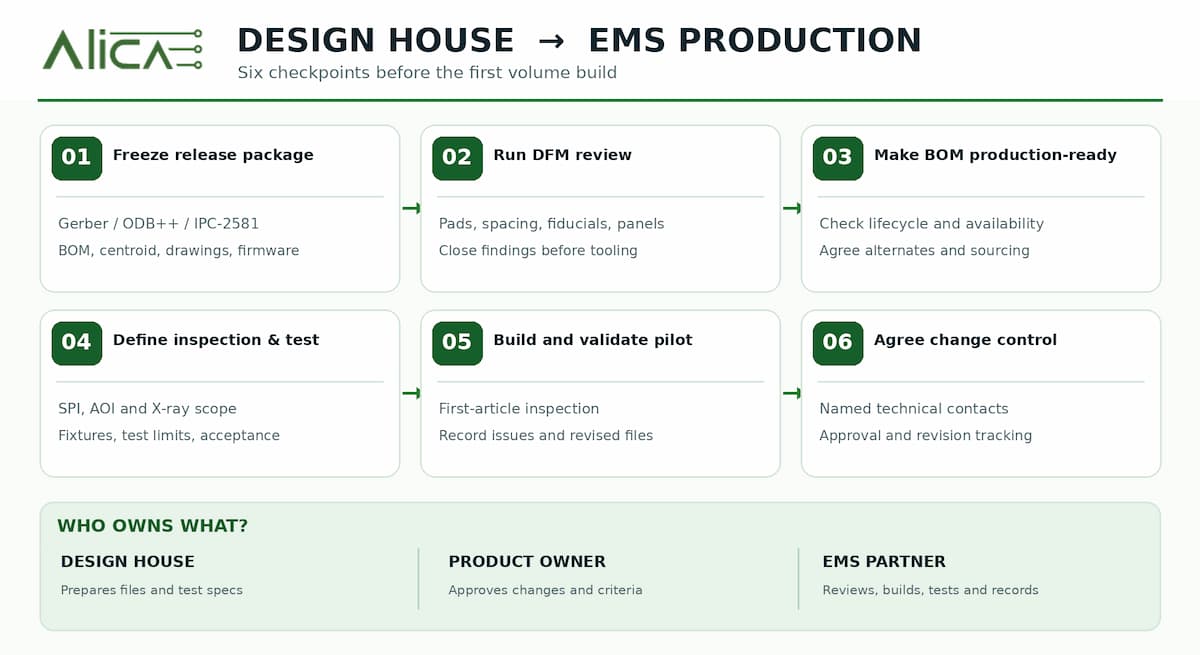
1. Freeze the release package
Create a single, revision-labelled release that contains everything needed to build the product. Most assembly partners work from a set like this:
- Fabrication data in the format the partner accepts, such as Gerber, ODB++ or IPC-2581, with drill files and a stack-up drawing.
- A pick-and-place (centroid) file that matches the board revision.
- An assembly drawing showing polarity, orientation, do-not-fit parts and any special instructions.
- The BOM with manufacturer part numbers, approved alternates and reference designators.
- Mechanical drawings if the build includes an enclosure or box build.
- Programming files and instructions for firmware loading.
Formats such as ODB++ and IPC-2581 carry more of the design intent in one package than classic Gerber, which can reduce mismatches. Ask the partner which format it prefers before you export.
2. Run a DFM review before tooling
A design for manufacturability review by the assembly partner checks pad sizes, component spacing, fiducials, panelisation, thermal relief and test access against how the board will actually be built. Issues found here cost a footprint edit. The same issues found after a stencil is cut, or after a batch is built, cost much more. The principles behind this are covered in the guide on designing PCBs for high-yield assembly.
3. Make the BOM production-ready
Review lifecycle status and availability for every line. Add approved alternates for passives and common parts, and flag single-source items early so long lead times are planned. If the partner offers turnkey sourcing and BOM management, agree which parts it buys and which the client supplies. The trade-offs between these models are explained in the guide to turnkey PCB assembly and how the process works.
4. Define test and inspection in writing
Write a test specification that says what is measured, the pass limits, the fixtures or equipment needed and who supplies them. State which inspection steps apply, such as SPI, AOI and X-ray for BGA or QFN parts, and the workmanship standard the build should follow. Alica Technologies follows IPC-recommended procedures, and the design house should say if the client needs anything beyond that.
5. Build a pilot batch
A small pilot build proves the data, the process and the test before volume. Review the first article together: placement, solder quality, X-ray images of hidden joints, test results and any assembly queries. Record every change as a formal revision, so the volume build matches what was approved.
6. Agree change control and communication
Name one technical contact at the design house and one at the client, and agree how engineering changes are requested, approved and rolled into production. This keeps the manufacturer from receiving conflicting instructions.
Who owns what at the handoff
| Item | Design house | Client (product owner) | EMS partner |
|---|---|---|---|
| Release package and revisions | Prepares and controls | Approves | Builds to the approved revision |
| DFM feedback | Reviews and updates the design | Approves changes that affect cost or function | Raises findings before tooling |
| BOM and alternates | Specifies parts and alternates | Approves sourcing model and cost | Sources turnkey parts and manages the BOM |
| Test specification | Writes procedure and limits | Signs off acceptance criteria | Runs tests and records results |
| Product standards and compliance | Designs to the required standards | Arranges certification testing | Builds consistently to the released design |
| Engineering changes | Proposes | Approves | Implements and records by revision |
What the client’s procurement team will look for
Purchasing teams on the client side want a clear cost breakdown, predictable lead times and as few vendors as possible. A transparent quote that separates components, assembly, testing and any box build makes approvals faster. The guide to calculating PCB assembly cost for your build explains what drives each line. Domestic manufacturing in India also removes some import and logistics friction for Indian clients, which matters when the first batch is on a tight schedule.
What the client’s operations team will look for
Operations teams care about consistency once the product ships in volume. They will ask how batches are inspected, what happens when a test fails, and whether each unit can be traced to its component lots and test results. If the product needs a finished unit rather than bare boards, they will also want to know whether the same partner can handle box build and final testing. Alica’s turnkey project delivery covers that path from sourcing to a tested, packed product.
Handoff checklist for design houses
- One revision-labelled release package, with every file from the same revision.
- Fabrication data in the partner’s preferred format, plus drill files and stack-up.
- Pick-and-place file checked against reference designators.
- Assembly drawing with polarity, orientation and do-not-fit parts marked.
- BOM with manufacturer part numbers, approved alternates and lifecycle checks.
- DFM review completed and findings closed before the stencil is ordered.
- Written test specification with limits, fixtures and firmware loading steps.
- Inspection requirements stated, including X-ray for hidden joints.
- Pilot batch planned, with a first article review meeting booked.
- Named contacts and a written change control process agreed by all three parties.
Frequently Asked Questions
What files does an EMS partner need from a design house?
An EMS partner usually needs fabrication data such as Gerber, ODB++ or IPC-2581 with drill files, a pick-and-place file, an assembly drawing, a BOM with manufacturer part numbers and alternates, programming files and a test specification. Mechanical drawings are needed if the build includes box build.
When should a design house involve the EMS partner?
As early as possible, ideally before layout is frozen. A DFM review before tooling lets the partner flag footprint, spacing, panelisation and test access issues while they are still cheap to fix, and gives time to plan long-lead components.
Who is responsible for product compliance after the handoff?
The design house designs the product to the standards it needs, and the client, as product owner, arranges certification testing. The EMS partner builds every unit consistently to the released, approved design and keeps the build and test records.
Plan your next client handoff with Alica
Alica Technologies works with design houses as a manufacturing partner for their client builds, from DFM review and turnkey sourcing to SMT and THT assembly, SPI, AOI and 3D X-ray inspection, functional testing and box build, from its facility in Changodar, Ahmedabad. Explore Alica’s assembly and testing capabilities, or send your release package for a DFM review and quote.
Tagged in
Looking for a reliable EMS partner?
Get a quote for PCB assembly, turnkey manufacturing, or prototype builds.
Get in Touch