
EMS Partner for Design Houses: Your manufacturing arm for client builds
 Utsav
•
Nov 17, 2026
An embedded design house sells engineering: schematics, layout, firmware and a working prototype. But the client is buying a product, and the moment the prototype works, the next question is always the same: who will build the first 200 units, and then the next 5,000? Without a reliable EMS partner for design houses, that question lands on the design team, who end up chasing component quotes, couriering parts to an assembler and debugging boards that failed because of a solder defect rather than a design error.
That work is unpaid, slow and risky for the relationship. If the first production batch has problems, the client rarely separates the design from the build. This guide explains what a manufacturing arm should do for a design house, how to set up the working model, and what the client’s purchasing and operations teams will expect to see.
Why design houses struggle to get boards built well
Design houses work across many products for many clients. Each project brings a different BOM, a different volume and a different level of client maturity. That creates a few recurring problems:
- Small, irregular volumes. Prototype and pilot quantities are too small for many assemblers to prioritise, so lead times stretch and feedback is thin.
- Dense, modern designs. Wireless modules, fine-pitch BGAs, QFNs and 0402 or smaller passives need good stencil design, controlled reflow and X-ray inspection. A low-cost prototype shop may not have these.
- Files that make sense to the designer but not the line. Missing fiducials, unclear polarity marks, panel outlines that do not suit the line, and BOMs without manufacturer part numbers all slow the first build.
- Component sourcing. The design house picked the parts, but buying them in small quantities from authorised channels, and finding alternates when one goes out of stock, is a full-time job.
- Hand-off to the client. When volumes grow, the client may want its own purchasing team to take over. If the build was never documented properly, the move is painful.
What an EMS partner for design houses should provide
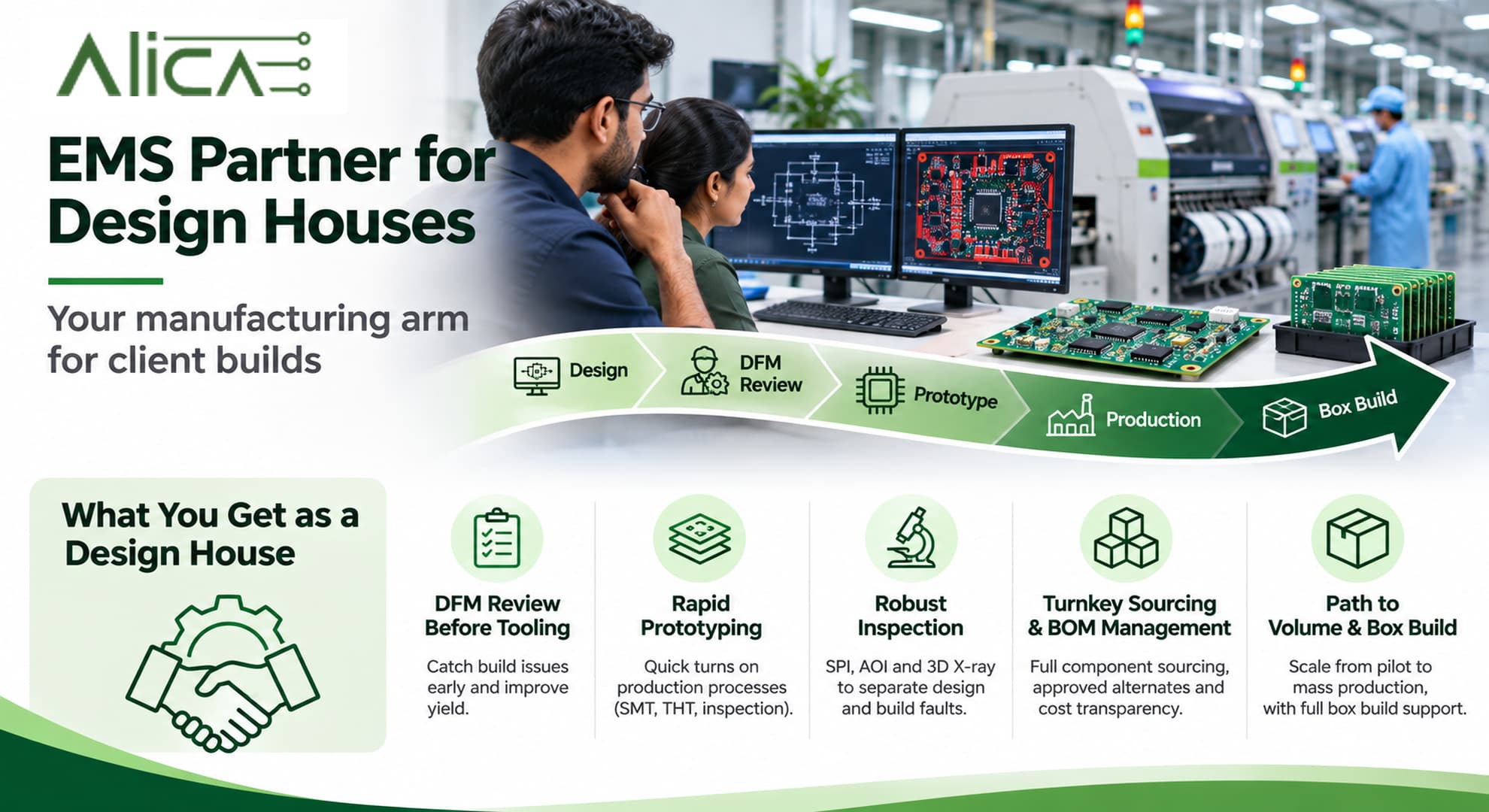
A good manufacturing arm fills the gap between a working prototype and a product that can be built repeatedly. In practice, that means five things.
Early DFM review before tooling
The partner should review the Gerbers, BOM and assembly drawings before stencils are cut and before parts are bought. A useful review points to specific issues: pads that will cause tombstoning, components too close to the board edge, missing test points, thermal imbalance on large pads, or parts that are near end of life. The design house can then fix these while the design is still fresh. The principles behind this are covered in the guide on designing PCBs for high-yield assembly.
Rapid prototyping on production processes
Prototypes built on the same SMT and THT lines and inspection steps that will later be used for production give much better information. A prototype that passes because it was hand-soldered tells the team little about the production yield. Alica Technologies offers rapid prototyping as well as volume production through its SMT and THT assembly services in Changodar, Ahmedabad, so a design can move from first build to volume with the same partner and the same inspection steps.
Inspection that separates design faults from build faults
When a prototype does not work, the design team needs to know quickly whether the cause is the design or the assembly. Inline solder paste inspection, AOI and 3D X-ray for BGA and QFN joints remove much of that doubt. If the build data shows clean joints and correct placement, the engineers can focus on firmware and circuit issues. Alica’s testing and inspection services cover these steps along with functional testing and burn-in.
Turnkey sourcing and BOM management
The partner should be able to buy the full BOM, propose alternates for approval, and share a transparent cost breakdown per line. This removes a large task from the design house and gives the client a clear view of where cost sits.
A path to volume and box build
The same partner should be able to move from prototype to pilot to volume, and to end-to-end electronic manufacturing including box build, so the client receives finished, tested units rather than loose boards.
Three working models for design houses
Design houses use EMS partners in different ways depending on their client contracts. The right model decides who holds the purchase order, who talks to the factory and who owns the build documents.
| Model | How it works | Best suited to |
|---|---|---|
| Design house manages the build | The design house places orders with the EMS partner and delivers boards to the client | Prototypes and pilots, or clients with no manufacturing team |
| Introduced, then client-managed | The design house introduces the partner and supports the first builds; the client then orders directly | Clients with a purchasing team who want a direct supply relationship |
| Shared | The design house stays the technical contact for changes; the client handles orders and payments | Long-term products with regular engineering changes |
Whichever model is chosen, agree early on how engineering change requests are handled, who signs off first articles, and who keeps the master BOM. These three points cause most disputes later. The difference between a simple assembler and a full partner is explained in contract manufacturing vs an EMS partner.
Setting up the partnership: practical steps
For the CTO or founder of a design house, these steps make the first projects run smoothly:
- Send one real project as a pilot, with the full data pack: Gerbers, BOM with manufacturer part numbers, pick and place file, assembly drawing and test notes.
- Judge the partner on the quality of the DFM feedback, not only the quote.
- Agree a standard file checklist so every future project arrives in the same format.
- Agree the sourcing model for each project: turnkey, consigned or mixed.
- Define who approves alternate parts and how changes are recorded.
- Agree the first article process and what build and test data will be shared.
- Put confidentiality terms in writing before sharing client designs.
- Plan the move to volume early, including box build and functional test fixtures if needed.
What the client’s procurement team will look for
When the client’s purchasing team gets involved, its questions change from “does it work” to “can we buy it reliably”. They will want a clear cost breakdown, authorised sourcing of key parts, a plan for long lead time items and a supplier that can scale. A design house that brings a partner with turnkey sourcing and project delivery already in place makes that conversation much easier, and domestic manufacturing in Ahmedabad avoids import steps for assembled boards.
What the client’s operations team will look for
Operations and plant teams focus on consistency. They will ask how each batch is controlled, whether every board is inspected, how test results are recorded and whether component lots can be traced if a field issue appears. IPC-recommended procedures, 100% inspection coverage, functional and burn-in testing and component traceability give them those answers.
Frequently Asked Questions
What does an EMS partner for design houses do?
An EMS partner for design houses builds the boards and products that the design house has designed for its clients. It reviews the design for manufacturability, sources components, assembles and inspects prototypes and production boards, runs functional tests and can deliver finished box build units, so the design house can focus on engineering.
Should a design house or its client place orders with the EMS partner?
Either can work. Many design houses manage prototype and pilot builds themselves, then hand ordering to the client once volumes grow. The important part is to agree in advance who approves engineering changes, who signs off first articles and who owns the master BOM.
Why should prototypes be built on production lines?
Prototypes built on the same lines and inspection steps as production show how the design will behave in volume. Hand-built prototypes can hide assembly issues that only appear later, while a production-process prototype gives real data on solder joints, placement and test results.
Make Alica your manufacturing arm
Alica Technologies works with design houses and product engineering firms as their manufacturing arm, offering early DFM review, rapid prototyping, turnkey sourcing, SMT and THT assembly, inspection, testing and box build from Changodar, Ahmedabad. Review Alica’s manufacturing capabilities for design houses, or share your next client project for a DFM review and quote.
Looking for a reliable EMS partner?
Get a quote for PCB assembly, turnkey manufacturing, or prototype builds.
Get in Touch