
How to choose a BMS Manufacturer in India: 8 criteria every battery OEM should check
 Utsav
•
Oct 6, 2026
Utsav
•
Oct 6, 2026
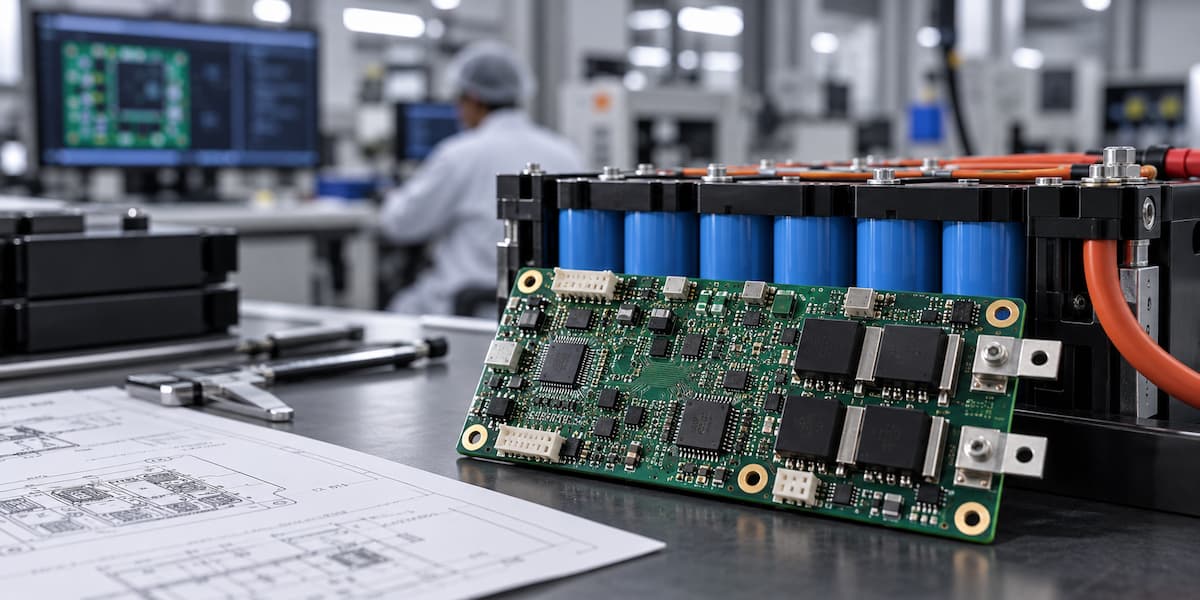
Picking a manufacturing partner for a battery management system is a different decision from picking one for a typical control board. The BMS is the safety layer of the pack. If it reads a cell voltage wrongly or fails to disconnect on a fault, the consequences reach well beyond a warranty claim. Yet many OEMs still choose their BMS manufacturer in India on quotation price and lead time alone, and only discover the gaps after the first field return.
This guide sets out eight criteria that separate a partner who can build your BMS reliably from one who can only assemble it. It is written for hardware leads, procurement managers, and operations heads at EV, energy storage, and industrial battery companies. If you want the background on what a BMS board involves, start with our overview of BMS PCB assembly and battery management system manufacturing.
BMS manufacturer India – checklist
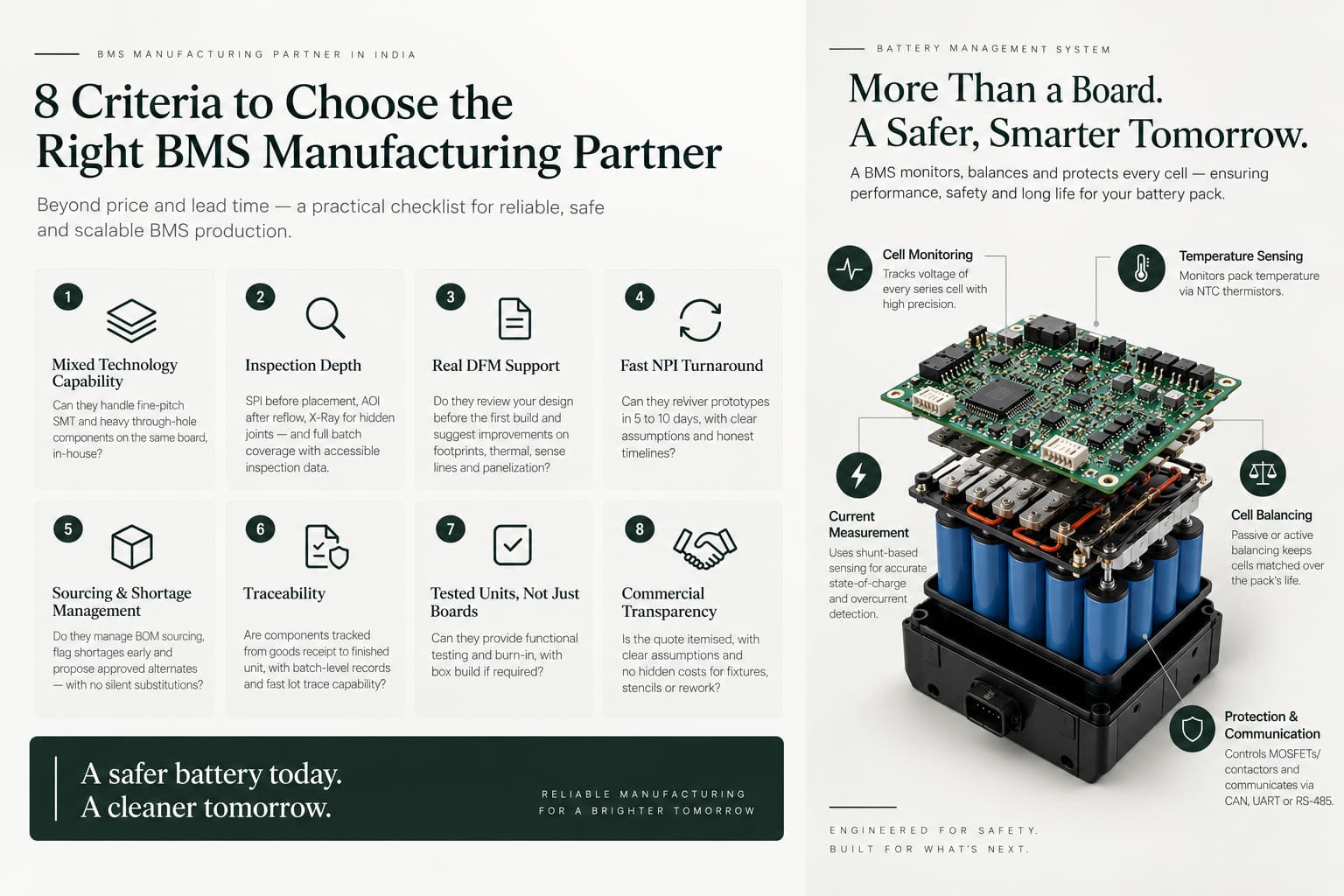
1. Can they handle mixed technology on one board?
A BMS board rarely stays purely SMT. Monitoring ICs, microcontrollers, and precision resistors are fine-pitch surface-mount parts, while terminals, fuses, and high-current connectors are often through-hole. A partner that outsources one of those processes adds a handoff, and every handoff is a chance for inconsistency. Ask whether SMT and THT assembly are done in-house, and how inspection is applied between stages.
2. How deep is their inspection?
Every EMS company claims quality control. What you want to know is where inspection sits in the process and how much of each batch it covers:
- Is solder paste inspection (SPI) run before placement, or only AOI after reflow?
- Is AOI applied to every board, or sampled?
- Is X-Ray available for hidden joints on BGA and QFN packages?
- What happens to inspection data: is it available to you if there is a problem?
For a safety-relevant board, full coverage matters more than a low unit price. See how this works in practice on our testing and inspection page.
3. Do they offer real DFM support before the first build?
The cheapest time to fix a BMS layout problem is before assembly. A good partner reviews your files for footprint issues, thermal relief on power paths, shunt and sense-line placement, and panelization, and tells you what to change. Ask for a sample DFM report from a previous job, with confidential details removed. If a partner only says “send files and we will quote”, you will learn about design issues the expensive way.
4. How fast can you iterate through NPI?
BMS hardware and firmware are tuned together, so expect several board revisions. A partner with 5 to 10 day rapid NPI turnaround lets your team validate a revision in about a week instead of a month. Ask what the turnaround assumes: parts in stock, files complete, and no open DFM queries. Honest partners will tell you where the timeline can slip.
5. Who owns sourcing and shortages?
Analog front-end ICs, precision shunts, and automotive-grade MOSFETs are the parts most likely to be allocation-constrained. If your partner leaves sourcing entirely to you, shortages become your problem. Under a turnkey project delivery model, the partner manages BOM sourcing, flags shortages early, and proposes approved alternates for your sign-off. Be clear up front about how substitutions are handled on a safety-relevant board: no part should change without your written approval. For more on what turnkey should include, read what turnkey electronics manufacturing covers beyond PCB assembly.
6. Is traceability built into the process?
If a pack in the field misbehaves, you need to know which batch, which reels, and which process settings produced that board. Ask how components are tracked from goods receipt to finished unit, how long records are retained, and how fast a lot-level trace can be produced. Combined with IPC-compliant SOPs, traceability turns a field complaint into a solvable problem rather than a guessing exercise.
7. Can they deliver a tested unit, not just a board?
A BMS that powers up once on a bench has not been proven. Functional testing against your procedure, and burn-in under representative conditions, catch early failures before the board reaches your pack line. A partner offering end-to-end electronic manufacturing with box build and burn-in can hand you a unit that has already been exercised. Ask what tests they can run, what fixtures are needed, and who writes the test procedure.
8. Do you trust the commercial transparency?
Procurement teams should look for a clear cost breakdown across components, assembly, testing, and logistics, with no surprise charges for stencils, fixtures, or rework. Domestic manufacturing also changes the commercial picture: shorter lead times, easier visits and audits, and less import and logistics friction than overseas builds. Judge the partner on how clearly it explains its quote, not just how low it is.
Good signs and red flags at a glance
| Area | Good Sign | Red Flag |
|---|---|---|
| Inspection | SPI, AOI and X-Ray with clear coverage | “We do visual checks” |
| DFM | Written feedback before the first build | Quote only, no file review |
| Sourcing | Early shortage alerts, approved alternates only | Silent substitutions |
| Traceability | Batch-level records, fast lot trace | Records “available on request” with no process |
| Testing | Functional and burn-in options | Power-on check only |
| Quote | Itemised, assumptions stated | Single lump sum, vague exclusions |
What to include in your BMS RFQ
The quality of your quote depends on the quality of your data. Send:
- Gerber files and fabrication notes
- A complete BOM with manufacturer part numbers and approved alternates
- Pick-and-place data and assembly drawings
- Test procedure and any firmware loading steps
- Expected batch size and annual volume
- Required inspection level and documentation
Validate before you commit
Whatever a partner’s brochure says, the most reliable test is a pilot. Build a small batch, review the inspection data and DFM feedback, and watch how the team handles questions, shortages, and defects. If possible, visit the facility. How a partner behaves during a pilot is the best predictor of how it will behave in production.
Frequently Asked Questions
What should I send an EMS partner to get an accurate BMS assembly quote?
Gerber files, a complete BOM with approved alternates, pick-and-place data, assembly drawings, test and firmware steps, expected volumes, and your inspection and documentation requirements.
Should a BMS board be built by a turnkey or consigned EMS partner?
Turnkey suits teams that want one accountable partner for sourcing, assembly, and testing, especially with long-lead parts. Consigned suits teams with strong supplier relationships or strict approved-vendor lists.
How can I validate a new BMS manufacturer before committing to volume?
Run a prototype or pilot batch, review the inspection data and DFM feedback, and visit the facility if you can. Pilot behavior predicts production behavior.
Talk to Alica about your BMS program
Alica Technologies supports battery OEMs from Ahmedabad with SMT and THT assembly, full inspection coverage, turnkey sourcing, and box build with burn-in testing. Review our manufacturing capabilities or contact us with your files for a DFM review and quote.
Tagged in
Looking for a reliable EMS partner?
Get a quote for PCB assembly, turnkey manufacturing, or prototype builds.
Get in Touch