
EV Startup Guide to Outsourcing Electronics Manufacturing in India
 Utsav
•
Nov 9, 2026
You have a working prototype on your bench. The motor controller runs, the BMS balances, the charger charges. Your investors are asking when you will ship. Your customers are asking for samples. And somewhere between the prototype that works and the product that ships, you need an electronics manufacturing partner who can build your boards at quality, at cost, and at a pace that keeps your programme on track.
This is the article that covers the practical side of that decision. Not the theory of EMS, not a glossary of acronyms, but the actual questions an EV startup founder or hardware lead faces when outsourcing electronics manufacturing in India for the first time: how to choose a partner, what to prepare, what to expect, what to watch for, and how to avoid the mistakes that cost startups time and money.
Alica Technologies in Changodar, Ahmedabad works with EV startups and established automotive companies across the automotive and EV electronics spectrum. This article draws on the patterns we see in those engagements, what works, what does not, and what the successful startups do differently.
When to Start Looking for an EMS Partner
The common mistake is to look for a manufacturing partner after the design is “done.” By then, the board layout is frozen, the BOM is locked, and any manufacturing issue that the DFM review finds requires a redesign. The better time to engage an EMS partner is during the design phase, specifically after the schematic is stable but before the board layout is finalised. At that point, the EMS partner’s DFM review can influence the layout in ways that improve manufacturability without changing the circuit.
Some specific timing triggers:
- When you have a stable schematic and a preliminary BOM. The EMS partner can review the BOM for sourcing risks (end-of-life components, single-source parts, long lead items) and suggest alternatives before you commit to the layout.
- When you are starting the PCB layout. Component placement guidance, panelisation constraints, and test point accessibility can be incorporated into the layout from the start rather than retrofitted.
- When you have a prototype that works and you are thinking about production. This is the latest useful point. The EMS partner can still review the design and flag issues, but any changes at this stage require a board respin.
What to Prepare Before the First Meeting
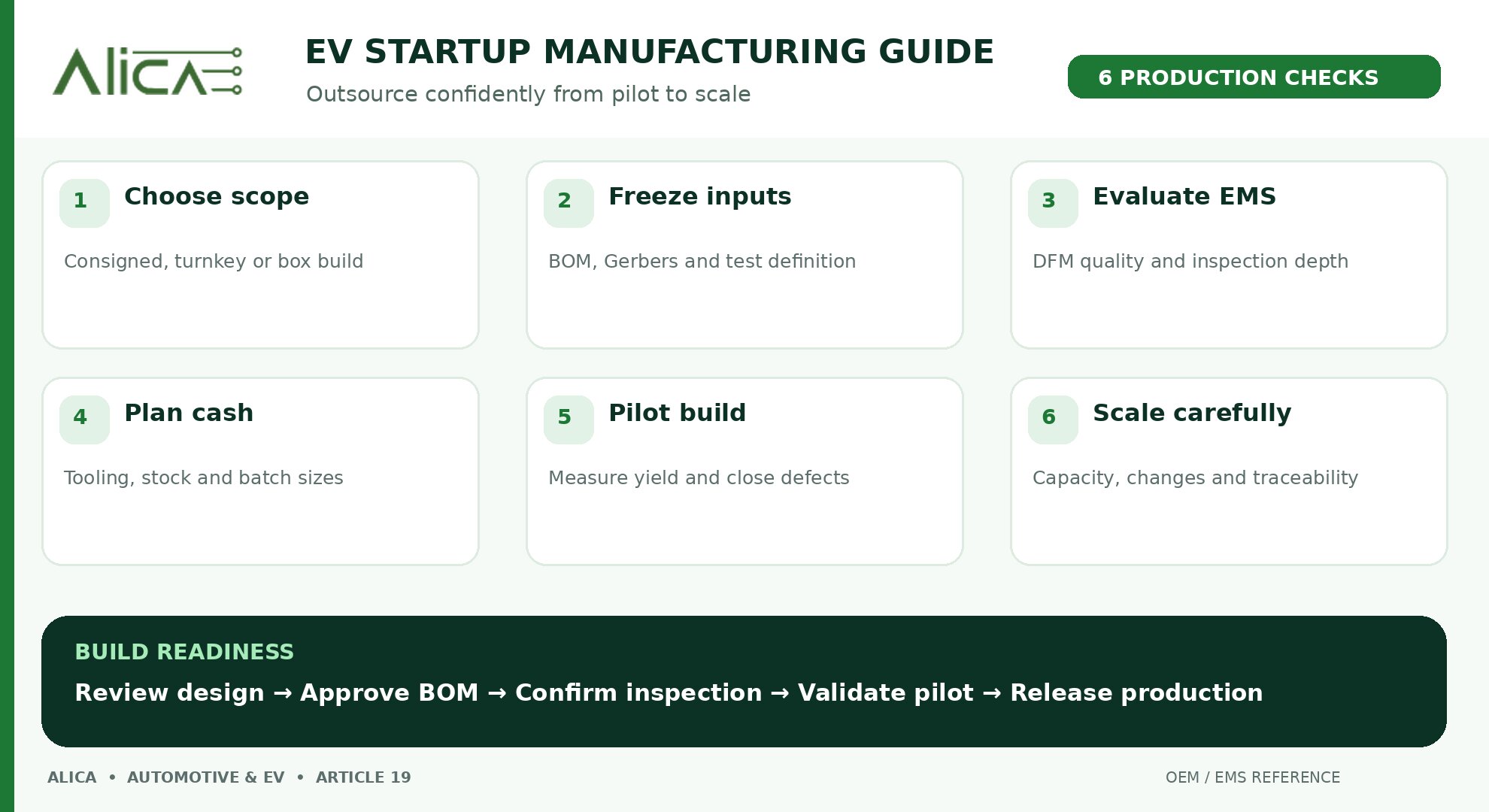
An EMS partner can only give you a useful response if you give them useful information. Here is what to bring to the first technical conversation:
- Gerber files and drill files for the latest board revision, or at minimum the board dimensions, layer count and technology (HDI, flex-rigid, heavy copper, RF, etc.).
- Bill of materials (BOM) with manufacturer part numbers, not just generic descriptions. “100nF 0402 capacitor” is not specific enough. “Murata GRM155R71C104KA88D” tells the EMS partner the exact component, its availability and its price.
- Assembly drawings showing component placement, orientation and any special assembly instructions (underfill, conformal coating, thermal interface material, press-fit connectors).
- Quantity forecast. How many boards do you need for the prototype? For the pilot run? What is your expected annual volume at steady state? The answers to these questions determine the manufacturing approach, the tooling investment and the pricing.
- Test requirements. What does “tested and working” mean for your board? A power-up check? A full functional test against a specification? Environmental screening? Burn-in? The clearer you are about what constitutes a “good” board, the better the EMS partner can design the test process.
- Target cost. If you have a target cost per board, share it. The EMS partner can tell you whether it is realistic, and if not, what changes would bring the cost into range.
Turnkey vs Consigned: Which Model Suits a Startup
In turnkey manufacturing, the EMS partner procures all the components. In consigned manufacturing, you buy the components and ship them to the EMS partner for assembly. In a hybrid model, you consign some components (usually the expensive or hard-to-source ones) and the EMS partner buys the rest.
For most EV startups, turnkey manufacturing is the right choice. Here is why:
- Procurement is a full-time job. A typical automotive BOM has 200 to 500 line items. Each one needs to be sourced, quoted, ordered, received, inspected and stored. If you have a procurement team, they can do this. If your team is four engineers, procurement will consume engineering time that should be spent on product development.
- The EMS partner buys better. An EMS partner with established distributor relationships gets better pricing, better lead times, and access to allocation that a small startup does not have. The difference can be significant, especially for automotive-grade components that are constrained.
- Component risk is shared. In a turnkey model, the EMS partner takes responsibility for component quality and authenticity. In a consigned model, if you buy a reel of counterfeit MOSFETs from an unauthorised distributor, the resulting field failure is your problem, not theirs.
- Logistics are simpler. One purchase order, one delivery, one invoice. No tracking of component shipments from multiple distributors to the EMS partner’s dock, no worrying about whether the parts arrived in time for the build, no managing partial shipments and backorders.
The main exceptions are components where you have a significantly better supply arrangement (a volume deal negotiated by your investor, for example), or components that are only available through a specific OEM channel. In those cases, a hybrid model makes sense: you consign those specific parts and the EMS partner procures the rest.
Evaluating an EMS Partner: What Actually Matters
Capability match, not capability excess
You do not need the biggest EMS company in the country. You need one whose capabilities match your product’s requirements. If your board is a four-layer, mixed-technology assembly with standard components, a mid-size EMS with well-maintained SMT and THT lines will serve you better than a large contract manufacturer whose minimum order quantities, pricing and attention are designed for high-volume consumer electronics. If your board has HDI, fine-pitch BGAs, or RF sections, you need a partner with the specific equipment and experience for those technologies.
Engineering engagement
An EMS partner who just builds what you send them is a build house. An EMS partner who reviews what you send, flags issues, suggests improvements, and helps you solve problems during bring-up is an engineering partner. For a startup, the engineering partner is worth more. Ask for examples of DFM feedback they have provided to other customers (redacted for confidentiality). Ask what happens when they find an issue during the build. Ask who you will talk to when you have a technical question: the sales team, or the process engineer?
Prototype-to-production continuity
As covered in the automotive prototype assembly article, keeping the same EMS partner from prototype through production preserves the process knowledge, the test fixtures and the supply chain relationships. When evaluating a partner for prototyping, evaluate them for production at the same time. If they cannot scale to your production volume, you will need to switch partners later, which is expensive and risky.
Quality system
The quality system matters more than the quality certification. A well-run EMS company with a disciplined process, good traceability, and a culture of catching defects before shipment will produce better boards than a certified company with sloppy execution. That said, some customers and markets require specific certifications, and your EMS partner’s certification status determines which doors are open to you. Ask about the quality system: how they handle incoming component inspection, how they control the soldering process, how they handle nonconformances, and how they do root cause analysis when something goes wrong.
Communication and responsiveness
This is the factor that startups underweight in their evaluation and overweight in their complaints. When your pilot build has an issue, how quickly does the EMS partner respond? When you need a schedule update, can you get one the same day? When you have a design question during bring-up, is there an engineer who picks up the phone? For a startup operating on a tight timeline, a partner who responds in hours rather than days can make the difference between hitting a milestone and missing it.
Managing the NPI Process as a Startup
Define “done” before you start
Before the first prototype build, agree with the EMS partner on what constitutes a successful build at each stage. For the prototype: how many boards, what test level (visual inspection only, power-up, full functional test), what documentation (inspection report, test data, photos). For the pilot run: the same, plus yield targets, cycle time targets and packaging requirements. Clear exit criteria at each stage prevent the scope from drifting and keep both sides aligned.
Own your BOM
Even in a turnkey model, the startup owns the BOM. This means keeping it current, managing the approved vendor list (AVL), approving any substitutions the EMS partner proposes, and tracking component lifecycle status. A BOM that is “somewhere in an email from three months ago” causes delays. A BOM in a version-controlled spreadsheet with part numbers, AVL, and revision history saves time for everyone.
Invest in the test specification
The test specification defines what a “good” board looks like. It is the contract between you and the EMS partner on quality. For an EV electronics board, the test specification should cover: the electrical functional test (what signals to stimulate, what responses to measure, what the pass/fail criteria are), the visual and X-ray inspection criteria, any environmental screening (hi-pot, thermal cycle, vibration), and the burn-in requirements if applicable. Writing the test specification is engineering work, and it is worth doing well because every board that ships will be judged against it.
Plan your component lead times
The single biggest cause of EV electronics schedule slips is not the assembly. It is the component lead times. Automotive-grade MOSFETs, gate drivers, microcontrollers and specialty connectors can have lead times of 12 to 26 weeks. If you finalise your BOM today and expect boards in four weeks, you will be disappointed unless every component on that BOM is in stock. Work with your EMS partner to identify long-lead items early and place advance orders or stock agreements.
Cost Structure: Where the Money Goes
Understanding the cost structure helps you make better decisions about where to invest and where to save.
- Components typically account for 60 to 75 percent of the total cost of a populated board. The component cost is driven by the design, not the manufacturing. A design change that eliminates one connector or replaces a specialty part with a standard one has more impact on the total cost than any negotiation on the assembly price.
- PCB fabrication accounts for 10 to 15 percent, depending on the layer count, material, and technology. A four-layer FR-4 board costs significantly less per square centimetre than an eight-layer board with controlled impedance, or a flex-rigid board.
- Assembly (the EMS partner’s value-add: solder paste printing, placement, reflow, selective soldering, inspection, test) accounts for 10 to 20 percent. This is the part that scales with volume: the per-board assembly cost drops as the quantity increases, because the fixed setup costs are spread over more boards.
- Test is included in the assembly cost or billed separately, depending on the partner. Custom test fixture development is a one-time NRE cost. The per-board test cost depends on the test time and the fixture complexity.
- Box build, if applicable (assembly into an enclosure, cable harness, thermal interface material, conformal coating, final test, packaging) adds to the assembly cost and is proportional to the labour and material involved.
The takeaway for startups: optimise the design for cost before negotiating the assembly price. A design review focused on component cost reduction, BOM consolidation (reducing the number of unique part numbers), and standard component selection will save more money than any procurement negotiation.
Scaling from Pilot to Production
The transition from pilot to production is where many startups stumble. The pilot run worked, the customer has accepted the samples, the order is placed, and now the pressure is on to deliver volume. Here is what changes at production scale:
- Component procurement becomes critical path. At pilot quantities, components can be sourced from distributors’ stock. At production quantities, components need to be ordered from the manufacturer, with lead times and minimum order quantities that the pilot did not encounter. Plan the production BOM procurement as a separate workstream with its own timeline.
- Process stability matters more than process flexibility. At pilot scale, the process can be tuned between batches. At production scale, the process needs to be stable and repeatable. Any process variability that was tolerable at pilot quantities becomes a yield issue at production quantities.
- Inventory management becomes a real problem. At pilot scale, you buy what you need for one build. At production scale, you need to manage raw material inventory, work-in-progress inventory, and finished goods inventory. The EMS partner’s inventory management and planning systems need to be able to handle this, and you need to provide them with a production forecast that is realistic.
- Quality metrics become meaningful. At pilot scale, the sample size is too small for statistical process control. At production scale, yield data, defect Pareto charts, and SPC on critical process parameters become meaningful and actionable. Work with the EMS partner to define the quality metrics and reporting cadence before the first production batch.
The India Advantage for EV Electronics Manufacturing
India’s EV electronics manufacturing ecosystem is maturing rapidly. The combination of government incentives (PLI scheme for electronics, PM E-DRIVE scheme for EV adoption, state-level EV manufacturing incentives), a growing pool of hardware engineering talent, and an increasingly capable EMS industry makes India a competitive destination for EV electronics manufacturing, both for domestic OEMs and for companies looking to diversify their supply chain beyond East Asia.
For EV startups, the practical advantages include: proximity to the domestic market (no import duties, no shipping delays, no customs clearance), access to engineering talent for collaborative product development, a cost structure that is competitive with Southeast Asian alternatives, and the “Make in India” positioning that matters for government tenders and fleet procurement. Gujarat in particular has established itself as an EV manufacturing hub, and Alica’s location in the Changodar industrial area puts it in the middle of that ecosystem.
Frequently Asked Questions
What is the minimum order quantity for EV electronics manufacturing?
Minimum order quantities vary by EMS partner and by the complexity of the build. For prototypes, most EMS companies will build single boards or small batches. For production, the minimum is often driven by the component packaging (a reel of resistors is 5,000 pieces, so ordering 50 boards that use that resistor means buying a full reel anyway) rather than by the EMS company’s own minimums. A good EMS partner for startups will work with you to find practical minimums that balance cost and waste.
Should an EV startup choose turnkey or consigned manufacturing?
For most EV startups, turnkey manufacturing (where the EMS partner procures all components) is the better choice. It reduces the startup’s procurement workload, leverages the EMS partner’s buying power and distributor relationships, and simplifies the logistics. The main case for consigned manufacturing is when the startup has negotiated special pricing on specific components, or when a component is available only through a specific channel. A hybrid model, where the startup consigns a few critical or long-lead components and the EMS partner procures the rest, is common and practical.
How do I protect my IP when outsourcing to an EMS partner?
Start with a mutual NDA before sharing any design files. The NDA should cover the design data (Gerbers, schematics, BOM), the test procedures, and any proprietary processes. The EMS partner should have clear data handling procedures: who has access to your design files, how they are stored, and what happens to them when the engagement ends. Most established EMS companies handle multiple customers’ proprietary designs routinely and have these procedures in place. Ask about them before you share your files.
Start a Conversation with Alica
If you are an EV startup looking for an electronics manufacturing partner in India, or an established company exploring domestic sourcing, the next step is straightforward. Send your design package, your BOM, and your volume forecast through the contact page or call +91 97271 78787. The team will review what you have, give you honest feedback on the design and the timeline, and provide a quote. No minimum commitment needed. You can also look at the full manufacturing capabilities, the specific automotive and EV work, and the other industries Alica serves for context.
Looking for a reliable EMS partner?
Get a quote for PCB assembly, turnkey manufacturing, or prototype builds.
Get in Touch