
Automotive Prototype and NPI: First Board to Pilot Production
 Utsav
•
Nov 9, 2026
Every automotive electronic product, whether it is an ADAS camera module, an EV DC-DC converter, a two-wheeler motor controller or a telematics unit, starts as a design that has never been built. The transition from that design file to a working, tested, qualified board is not a single step. It is a sequence of builds, each with a different purpose and a different set of questions to answer.
The first build asks: does this design work at all? The second asks: can we build it reliably? The third asks: can we build it at rate, with consistent quality? Getting those builds right, quickly and without wasting money, is what determines whether a product reaches the market on time or slips by quarters. And the EMS partner who handles those early builds shapes the product’s manufacturability for its entire production life.
This article covers how automotive prototype PCB assembly and new product introduction (NPI) works, what each stage involves, what to look for in an EMS partner for this phase, and how Alica Technologies in Changodar, Ahmedabad approaches these builds as part of its automotive and EV electronics practice.
Why Prototype and NPI Deserve Separate Attention
In consumer electronics, prototype builds are fast and informal. A design engineer sends Gerbers to a quick-turn house, gets boards back in a few days, hand solders the tricky parts and tests the design on the bench. The process works because the volumes are high enough that any manufacturing issue will be found and fixed during the ramp.
Automotive electronics is different. The qualification process is longer, the regulatory requirements are more demanding, the temperature and vibration environment is harsher, and the production volumes for many products (especially in the EV startup and off-highway segments) are low enough that there is no extended ramp to catch issues. If the manufacturing process is not right by the pilot run, there is no second chance. The boards that come off the pilot line are often the ones that go into the vehicles for field testing, regulatory submission and early customer delivery.
This means the prototype and NPI phase is not just about validating the design. It is about validating the manufacturing process, the test coverage, the component supply chain, and the quality system, all at the same time and all to a standard that will hold when the product goes into production.
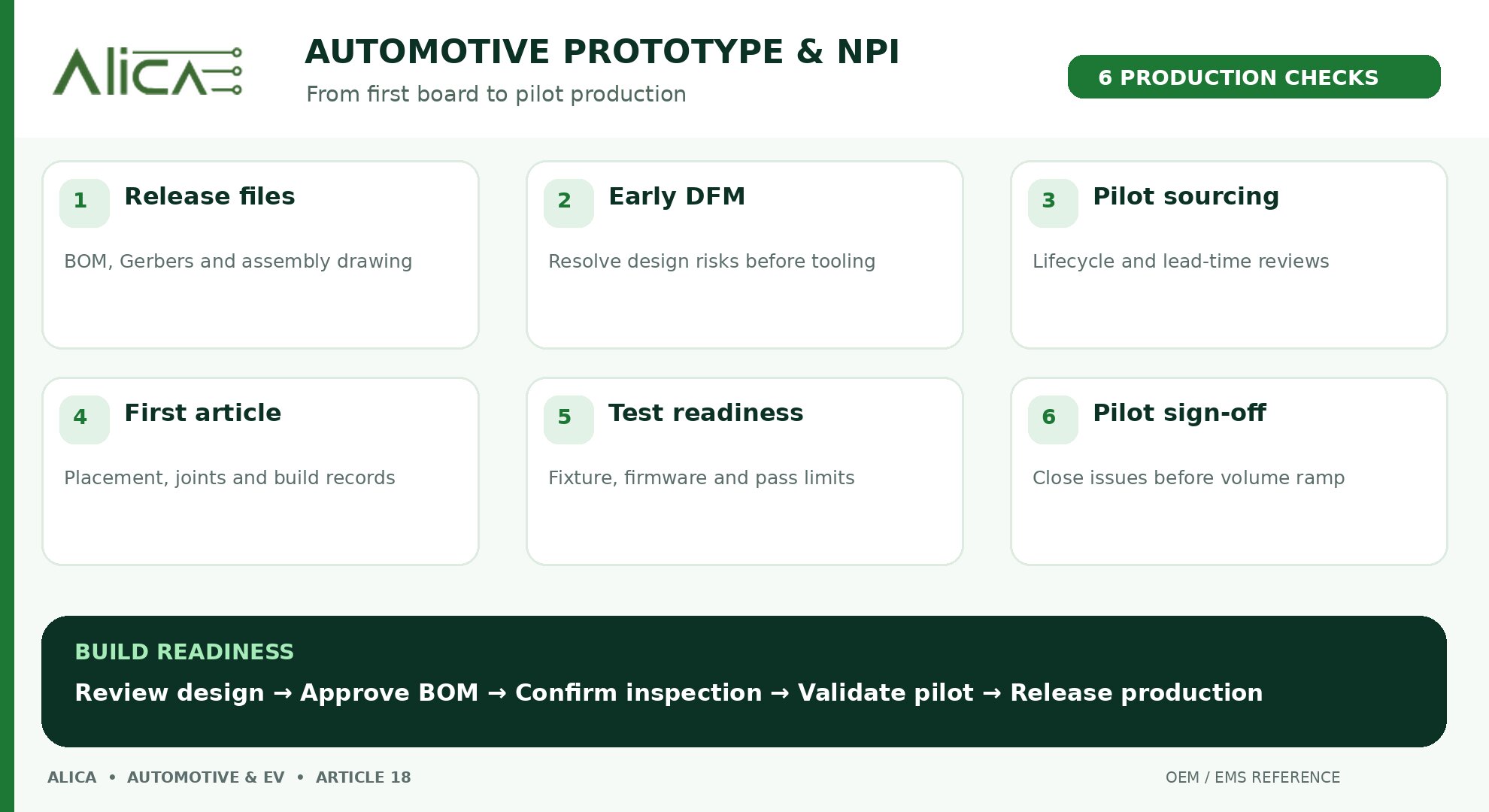
The Stages of Automotive NPI
Stage 1: DFM review before the first build
The DFM (design for manufacturability) review is the highest leverage activity in the entire NPI process. It costs almost nothing compared to a board spin, and it catches issues that would otherwise show up as yield losses, rework, or field failures.
A thorough DFM review for an automotive board covers:
- Footprint verification. Does every component footprint in the design match the actual component that will be placed? This catches the most common prototype failure: a component that does not fit its pads because the footprint was drawn from a different package variant or an older datasheet.
- Pad geometry for the reflow profile. Are the pads sized and shaped for the components and the reflow process? Undersized pads cause insufficient solder joints; oversized pads cause tombstoning on small passives. Thermal pads on QFN and power components need the right via pattern and solder paste coverage to avoid voiding.
- Component placement clearances. Are there components placed too close to each other for the pick and place nozzle to reach? Are there tall components that shadow shorter ones during reflow? Is there clearance for the selective soldering nozzle around through-hole components?
- Panelisation and tooling. Can the board be panelised efficiently? Are the board edges compatible with the conveyor rails? Are there fiducials for the vision system?
- BOM review. Are any components end-of-life, single-sourced with long lead times, or not available in the quantity needed for the prototype build? Are there components with moisture sensitivity levels that require special handling?
- Thermal considerations. Are there components with conflicting reflow profile requirements on the same board? Heavy thermal mass components next to temperature-sensitive ones can make profile optimisation difficult.
The DFM review should produce a marked-up design with specific, actionable recommendations, not a generic checklist. The design engineer needs to know exactly what to change and why, so the feedback can be incorporated before the bare boards are ordered.
Stage 2: First article build
The first article build is a small quantity, typically single units to a handful, built on the production SMT and THT line with hand-guided setup. The purpose is to validate that the design can be physically assembled and that the resulting board powers up and runs basic functions.
What matters at this stage:
- Stencil design. The solder paste stencil is cut based on the pad geometry in the Gerber files. For the first build, the stencil apertures may need adjustment based on the DFM review findings: modified apertures for thermal pads, reduced apertures for fine-pitch parts, home plate apertures for small passives to prevent tombstoning.
- Reflow profile development. The reflow profile is developed on the actual board with the actual components, using thermocouples on the critical components. For automotive boards with a mix of large thermal mass components and fine-pitch ICs, the profile is a compromise, and getting it right on the first build saves iterations later.
- Visual and X-ray inspection. Every joint on the first article is inspected. BGA and QFN joints are X-rayed to verify solder coverage, void percentage and alignment. Any anomaly at this stage is a data point for the process, not just a defect to rework.
- Bring-up support. The boards go back to the design engineer for functional testing. Any issue found during bring-up, whether it is a design issue or an assembly issue, is documented and fed back for the next iteration.
Stage 3: Design iteration
Automotive designs rarely work perfectly on the first spin. The first article build usually reveals issues that need design changes: a layout change to improve signal integrity, a component swap to meet a temperature rating, a footprint correction, a BOM change to address a sourcing issue, or a circuit modification based on the testing results.
The speed of this iteration cycle determines the overall NPI timeline. If the EMS partner can turn around a revised build in days, not weeks, the design can iterate quickly and the product reaches the pilot stage sooner. This is where having the prototype and production capability under one roof matters: the same line, the same stencil cutting capability, the same component inventory, and the same engineers who know the design from the DFM review.
Stage 4: Pilot production run
The pilot run is the dress rehearsal for production. It uses the finalised design, the production stencil, the production reflow profile, and the production test setup. The quantity is larger, typically tens to low hundreds, and the purpose is to:
- Validate the production process. Can the line build this board at rate with acceptable yield? Are there any steps that require manual intervention that should be automated?
- Validate the test coverage. Does the test fixture catch the defects that need catching? Are there failure modes that the test does not detect? Is the test time compatible with the target cycle time?
- Build units for downstream testing. The pilot boards go into enclosures for environmental testing (thermal cycling, vibration, humidity), into vehicles for field testing, and to the regulatory lab for type approval. These are the boards that must work, and they must be representative of what production will deliver.
- Train the production team. The operators, inspectors and test technicians who will build the product in volume need to learn it during the pilot run. Any special handling, tricky placements, or critical inspection points are documented and trained at this stage.
- Finalise the documentation. The work instructions, inspection criteria, test procedures and packaging specifications are finalised during the pilot run, not before it, because the pilot run reveals the details that the planning missed.
What to Look for in an NPI Partner for Automotive
Willingness to work at prototype quantities
Not every EMS company is willing to do single-board builds. The setup time for a prototype run, programming the pick-and-place machines, cutting a stencil, developing a reflow profile, is significant, and the revenue from a small build does not cover it on its own. An EMS partner who accepts prototype work does so because they understand that the prototype is the first step in a production relationship, not a one-off job.
Engineering engagement, not just manufacturing
At the prototype stage, the design is not frozen. The EMS partner needs to be an engineering partner, not just a build house. This means providing DFM feedback that is specific and constructive, suggesting component alternatives when sourcing is difficult, advising on design changes that improve yield or testability, and understanding the design intent well enough to flag issues that a purely mechanical DFM check would miss.
Traceability from day one
Automotive traceability requirements apply to the prototype and pilot boards as well as the production boards. The boards that go into test vehicles and regulatory submissions must be traceable to their component lots, assembly dates, test results and inspection records. Setting up traceability at the prototype stage means it is already working when production starts, and it means the data from the prototype and pilot builds can be used to support the qualification process.
Test fixture development capability
The test fixtures for an automotive board are usually custom built, and they need to be designed and validated during the NPI phase. An EMS partner who can develop test fixtures in house, or work closely with the design engineer to specify them, shortens the NPI timeline and produces better test coverage. A test fixture developed by people who understand both the design intent and the manufacturing process catches more defects than one developed in isolation.
Component sourcing for small quantities
Prototype BOMs include components that are hard to buy in small quantities: automotive-grade parts with high minimum order quantities, long-lead-time items that need to be ordered before the design is finalised, and specialty components from distributors who only sell in full reels. An EMS partner with established distributor relationships and a component inventory from other automotive builds can often source these parts faster and at better terms than a startup buying direct.
Common Mistakes in Automotive Prototyping
Using non-automotive components for the prototype
It is tempting to use commercial-grade components for the prototype and switch to automotive-grade for production. The problem is that the prototype is supposed to validate the design, and if the prototype uses components with different electrical characteristics, different package dimensions, or different thermal behaviour, the validation is incomplete. The functional test may pass, but the design may not work with the automotive-grade components that have different tolerances, different leakage currents, or different switching characteristics. Use the production-intent components from the first build whenever possible.
Skipping the DFM review to save time
The DFM review adds a few days to the front of the NPI timeline. Skipping it saves those days and often costs weeks on the back end when the first build reveals assembly issues that require a design respin. A footprint mismatch that the DFM review would have caught in an hour costs a full board revision cycle to fix.
Treating the pilot run as a large prototype build
The pilot run is not a bigger version of the prototype build. It is a smaller version of the production run. The setup, the process controls, the inspection criteria and the documentation should be production-grade, because the pilot run is proving that the production process works. Building the pilot run with prototype-stage informality means the transition to production requires another round of process development, which the schedule usually cannot accommodate.
Switching EMS partners between prototype and production
All the process knowledge developed during prototyping, the reflow profile, the stencil design, the test fixture, the component handling procedures, the inspection criteria, lives with the EMS partner. Switching partners between prototype and production means rebuilding that knowledge from scratch, and the new partner has no history with the design to draw on. Unless there is a compelling reason (capacity, capability, geography), keeping the same partner from prototype through production is usually the fastest and lowest-risk path.
The EV Startup Prototyping Challenge
India’s EV ecosystem includes a large number of startups developing new electronic products: motor controllers, battery management systems, charging electronics, telematics units, and vehicle control units. Many of these startups are hardware teams of a few engineers who need to move from concept to a working prototype quickly, with limited budgets and tight timelines.
For these teams, the NPI phase is where the product lives or dies. A slow prototype cycle burns through the development budget without producing results. A prototype that works but cannot be manufactured at the target cost leads to a redesign cycle that the timeline cannot absorb. An EMS partner who can provide fast prototype builds, honest DFM feedback, and a clear path from prototype to production is not just a vendor for these companies. They are a critical part of the development team.
Alica works with EV startups and established automotive companies at every stage of this process. The manufacturing capabilities that serve production, the SMT lines, the selective soldering, the inspection equipment, the testing and burn-in capability, are the same capabilities that build the prototypes. The engineering team that does the DFM review is the same team that will build the production boards. That continuity is the point.
Frequently Asked Questions
What is the difference between a prototype build and a pilot production run?
A prototype build produces a small number of boards (often single units or a handful) using the production line but with hand-guided setup, to validate the design, check fitment, test functionality and identify assembly issues. A pilot production run produces a larger batch (tens to low hundreds) using the finalised production setup, to validate the manufacturing process, build test fixtures, train operators and produce units for field testing, regulatory submission or customer evaluation. The pilot run is the dress rehearsal for volume production.
Does Alica provide DFM feedback before building the prototype?
Yes. Before the first board is built, Alica reviews the Gerber files, BOM and assembly drawings for manufacturability issues: component footprint mismatches, insufficient pad sizes, thermal relief problems, tight clearances that can cause solder bridging, and components that are difficult to source or have long lead times. The DFM review catches issues that are cheaper to fix in the design than to work around on the assembly line.
Can the same EMS partner handle both prototyping and volume production?
It is usually better to have the same partner handle both. The prototype and pilot builds develop the assembly process knowledge, the test procedures and the component sourcing relationships that carry directly into volume production. Switching EMS partners between prototype and production means rebuilding that knowledge from scratch, re-qualifying the process and re-validating the test coverage. Alica handles the full range from single prototype boards through pilot runs to series production.
Start Your Automotive Prototype with Alica
If you have an automotive or EV electronics design that is ready for its first build, or a design that needs DFM review before the board is ordered, the next step is a conversation. Send your Gerbers, BOM and design notes through the contact page or call +91 97271 78787. The team will review your package, flag any manufacturability concerns, and provide a timeline and quote for the prototype build. You can also review the full manufacturing capabilities and the industries Alica serves to see if the fit is right.
Looking for a reliable EMS partner?
Get a quote for PCB assembly, turnkey manufacturing, or prototype builds.
Get in Touch