
Automotive Aftermarket and Retrofit Electronics Manufacturing
 Utsav
•
Nov 8, 2026
The automotive aftermarket is not a single industry. It is a collection of hundreds of product categories, from dashcams to GPS trackers, from LED lighting upgrades to parking sensors, from performance tuning modules to EV retrofit kits. What unites them is that they are all installed on a vehicle after the vehicle leaves the factory, and they are all made by companies that are not the vehicle’s OEM.
For the companies designing and selling these products, the manufacturing decision is different from an OEM’s. OEM programmes run at high volumes with long qualification cycles and stable designs. Aftermarket products run at lower, more variable volumes with shorter development cycles and frequent design changes. An aftermarket company might launch a new dashcam model, sell 3,000 units in the first batch, refine the design based on customer feedback, build another 2,000 of the revised version, and have a completely new model in development by the time the second batch ships.
This pace requires a manufacturing partner who can handle prototype through production without the setup overhead and minimum order quantities that work for OEM programmes but kill aftermarket economics. It also requires a partner who understands that aftermarket does not mean low quality. A dashcam that fails after three months damages the brand. A GPS tracker that loses signal gets the product blacklisted by fleet operators. A poorly assembled EV retrofit kit can be a safety hazard.
This article covers what automotive aftermarket electronics manufacturing involves, what the common product categories need, and how Alica Technologies in Changodar, Ahmedabad supports aftermarket companies as part of its automotive electronics manufacturing work.
What Makes Aftermarket Manufacturing Different
Lower volumes, more SKUs
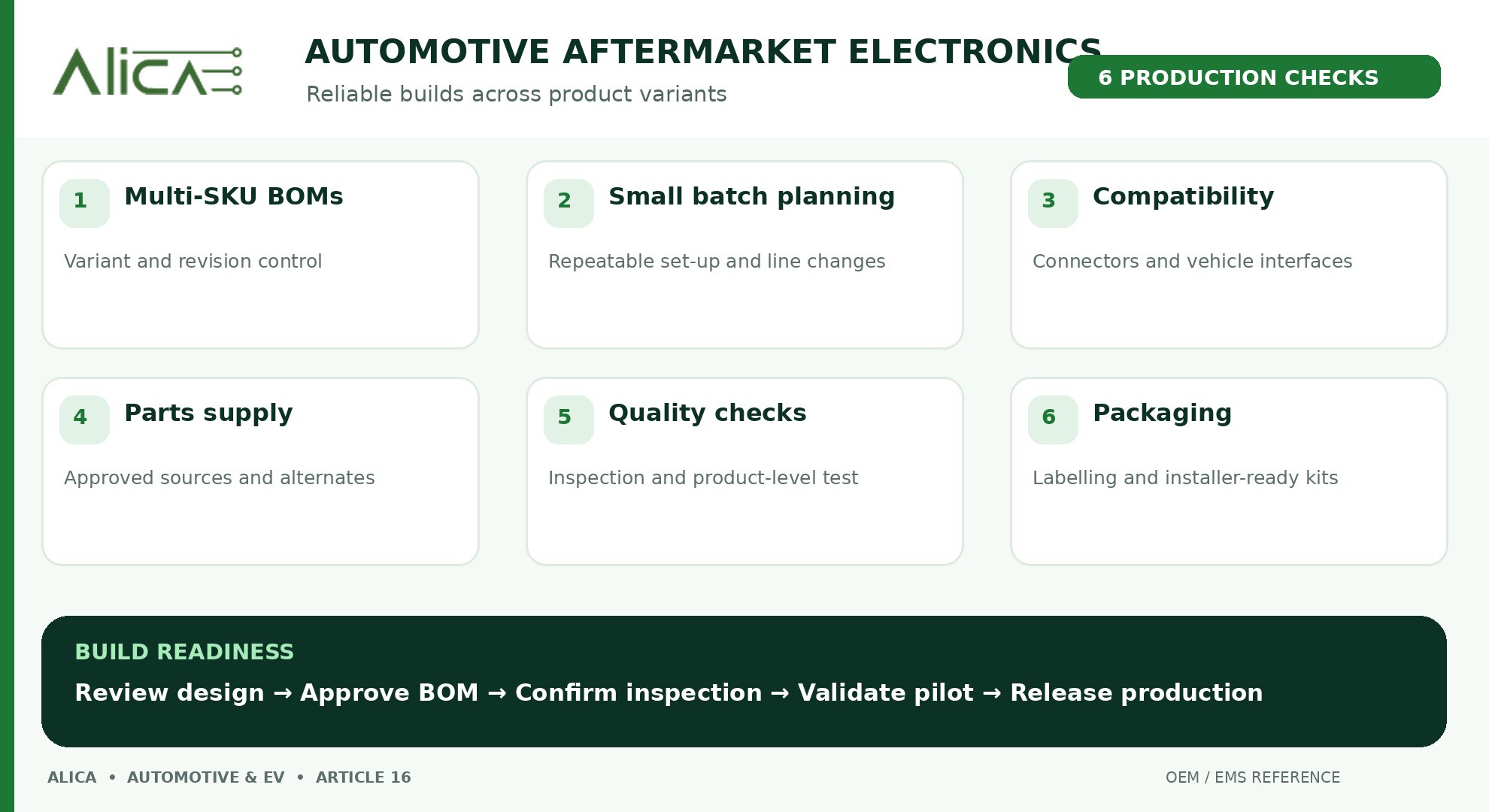
An OEM controller might run at 10,000 units a month in a single variant. An aftermarket GPS tracker company might have six variants (different communication modules for different markets), each running at 500 to 2,000 units per batch, with batches ordered monthly or quarterly depending on sales. The EMS partner has to manage multiple BOMs, multiple stencils, multiple test programmes, and frequent changeovers without the volume to amortise the setup costs over tens of thousands of units.
This is where the turnkey model earns its value. The aftermarket company hands off the BOM, the Gerbers and the test specification, and the EMS partner handles the sourcing, the assembly and the testing. The aftermarket company does not need to manage component inventory, track lead times, or coordinate between a PCB fabricator, a component distributor and an assembler. The EMS partner does that, and the aftermarket company focuses on design, sales and support.
Faster time to market
Aftermarket products compete on features and timing. Being first to market with a new dashcam chip, a new tracking protocol, or a new EV retrofit approach gives the company a window of higher margins before competitors catch up. The manufacturing partner needs to support rapid NPI: reviewing the design for manufacturability, procuring components for a prototype build, building and testing the prototypes, iterating on the design, and transitioning to production, all within weeks rather than months.
Design changes are frequent
Aftermarket products evolve faster than OEM products because the development cycle is shorter and there is no vehicle platform to synchronise with. A design change might be driven by customer feedback, by a component going end of life, by a cost reduction opportunity, or by a regulatory change. The EMS partner needs to manage these changes without disrupting production: updating the BOM, the stencil, the pick and place programme, and the test programme, verifying the change with a first article, and rolling the change into the next production batch.
Common Aftermarket Product Categories and Their Assembly Requirements
Dashcams and vehicle cameras
A dashcam board carries an image sensor, a video processor, a memory interface (SD card or eMMC), a power supply that handles the vehicle’s noisy 12V or 24V input, and sometimes a cellular or Wi-Fi module for cloud upload. The assembly is predominantly SMT, with fine pitch processor and memory packages, and the signal integrity requirements on the high speed digital interfaces are similar to any camera module. The board needs to handle the vehicle’s temperature range (a dashcam mounted on a windscreen in direct sunlight can reach 80 to 90 degrees) and the vibration from the mounting point.
GPS trackers and telematics devices
These devices are closely related to the automotive telematics modules covered elsewhere, but with some aftermarket specific differences. An aftermarket tracker is typically self-contained (its own power, its own SIM, its own antenna), so the board includes a battery management circuit, an antenna matching network, and sometimes a motion sensor for tamper detection. The assembly needs attention to the RF circuits and the antenna connection, because a poorly soldered antenna feed can reduce the GPS sensitivity or the cellular signal strength enough to cause tracking gaps.
For the Indian market, trackers that comply with AIS-140 (the vehicle tracking mandate for commercial vehicles) are a significant segment. AIS-140 specifies requirements for GPS accuracy, communication reliability, panic button, and tamper detection, and the manufacturing process has to deliver consistent performance across all these functions.
LED lighting upgrades
Aftermarket LED headlight and fog light modules replace the vehicle’s original halogen or HID bulbs with LED assemblies that deliver more light with less power. The electronics in these products include an LED driver (constant current source), thermal management (the LED and driver board are mounted on a heatsink, often with a fan), and sometimes a CAN bus interface to suppress error codes on vehicles with bulb monitoring.
The assembly challenge is primarily thermal. The LED driver board sits in a small space close to the LED heat source, and the solder joints have to handle the sustained temperature. The connector that carries power to the module has to handle the full LED current without heating, and the fan connector has to be reliable because a fan failure leads to an LED overtemperature and a reduced lifespan.
Parking sensors and blind spot monitors
These products add ultrasonic or radar sensors to vehicles that did not come with them from the factory. The electronics include the sensor interface, a processor for distance calculation and alert logic, a display or buzzer driver, and a wiring harness. The assembly is typically straightforward SMT with some through-hole connectors, but the product lives in a harsh environment (the sensors mount in the bumper, exposed to water, mud and impact) and the board needs appropriate environmental protection.
Performance tuning modules
Tuning modules (commonly called “chip tuners” or “ECU remappers”) modify the engine control parameters to increase power output or change the engine behaviour. These products interface with the vehicle’s OBD port or splice into the engine sensor wiring, and the electronics include a microcontroller, CAN or K-Line transceivers, and sometimes an on-board diagnostic function. The assembly is typically a small, dense SMT board in a compact enclosure, and the quality requirement is driven by the fact that a malfunction in the tuning module can damage the engine.
EV retrofit and conversion kits
EV retrofit kits convert internal combustion vehicles to electric drive, and the electronics include a motor controller, a BMS, a DC-DC converter, a charger interface, and a vehicle interface module that integrates with the original vehicle’s instrument cluster and accessory systems. This is the most complex aftermarket electronics category, because each vehicle model requires a different integration approach, and the product is safety relevant.
The assembly challenge combines all the requirements of power electronics (the motor controller and BMS), low voltage control electronics (the vehicle interface), and environmental protection (the components mount in the vehicle’s engine bay and underbody). The volumes are typically very low (tens to hundreds of kits per vehicle model), so the manufacturing partner needs to be efficient at low batch sizes.
Quality Requirements: Not OEM, but Not Low Either
A common misconception is that aftermarket quality standards are lower than OEM. They are different, not lower. An OEM product goes through the vehicle manufacturer’s quality gate, so defects are caught before the vehicle reaches the customer. An aftermarket product goes directly from the product company to the end user, so there is no OEM quality gate. Every defective unit that leaves the factory becomes a customer complaint, a warranty return, a negative review, or in the worst case, a safety incident.
The practical implication for manufacturing is that the inspection and testing coverage should be at least as thorough as for an OEM product, and arguably more so, because the consequences of a defect reaching the customer are more direct. SPI, AOI, X-Ray on hidden joints, functional testing and burn-in (where appropriate) are not extras for aftermarket. They are baseline requirements.
Sourcing for Aftermarket BOMs
The component sourcing for aftermarket products has specific dynamics.
Aftermarket companies often use the same components as OEM products (the same video processors, the same cellular modules, the same GPS receivers) but at lower volumes. This means they may not qualify for the tier-1 pricing that high volume OEM buyers get, and they may face allocation constraints during component shortages. A good EMS partner can mitigate this by aggregating demand across multiple customers and by maintaining relationships with both franchised distributors and authorised alternative channels.
The component grade decision is the aftermarket company’s to make. Some aftermarket products use full automotive grade components. Others use industrial grade parts and rely on the product’s environmental protection (enclosure, coating, potting) and the lower duty cycle (a dashcam is not a traction inverter) to deliver adequate reliability. The EMS partner’s role is to source what the BOM specifies, verify the authenticity and grade, and flag any concerns during the DFM review.
Box Build for Aftermarket Products
Most aftermarket vehicle electronics are sold as finished units, not as bare boards. The box build scope for aftermarket typically includes:
- PCB assembly (SMT, through-hole, selective soldering as needed)
- Board level inspection and testing
- Conformal coating or potting if specified
- Board mounting in the enclosure (plastic housing, aluminium case, or potted assembly)
- Cable and harness assembly (many aftermarket products include a wiring harness for vehicle integration)
- Module level functional test
- Firmware loading and verification
- Labelling, serialisation, BIS marking if required
- Packaging in retail or bulk packaging
The packaging step is worth noting because aftermarket products are often sold through distributors or online channels, so the product needs to arrive at the customer looking professional and including the installation instructions and accessories. The EMS partner should be able to handle the kitting and packaging as part of the production flow.
Testing Aftermarket Products
The test coverage depends on the product category and the aftermarket company’s quality requirements.
At minimum, every unit should receive:
- Functional power up test. Verify that the product powers up on the expected input voltage, runs its self test, and performs its primary function (records video, acquires GPS fix, drives LEDs, etc.).
- Communication test. If the product communicates over CAN, Bluetooth, cellular or Wi-Fi, verify the communication function.
- Visual and automated inspection. AOI on the populated board, visual inspection of the finished unit.
Additional tests depending on the product:
- Burn-in. Run the product at elevated temperature for a specified duration to screen for infant mortality. Particularly important for products that will be difficult or expensive to access after installation (underbody trackers, integrated units).
- Environmental protection verification. Check the conformal coating coverage, the enclosure seal, or the potting fill.
- RF performance. Verify GPS sensitivity, cellular signal strength, Bluetooth range, or Wi-Fi throughput. This may require specialised test equipment and an RF shielded enclosure.
EV Retrofit and Conversion Electronics
A growing segment within the automotive aftermarket is EV retrofit and conversion: taking an existing internal combustion engine vehicle and converting it to electric drive. This applies to both passenger vehicles (where companies offer conversion kits for popular models) and commercial vehicles (where fleet operators convert delivery vans, auto-rickshaws, or buses to electric to reduce operating costs and comply with emission regulations).
The electronics in an EV retrofit kit include a motor controller, a battery management system, a DC-DC converter for the 12V auxiliary systems, a charger interface, and an instrument cluster adapter or replacement. Each of these is a PCB assembly with its own design, BOM, and test requirements. The motor controller and BMS are the most complex, with power electronics, signal conditioning, and communication interfaces that need careful assembly and thorough testing.
The challenge for retrofit kit manufacturers is that volumes are low and highly variable, the product range is wide (different vehicle models need different mounting, different harness lengths, different calibrations), and the customer expects a finished, tested, plug-and-play kit, not a bare board. This makes the manufacturing model closer to the box build, kitting, and packaging model than to pure PCB assembly. The EMS partner needs to handle the board assembly, the mechanical assembly, the harness fabrication, the firmware loading and calibration, and the packaging into a kit that the installer can use without engineering support.
The Indian Aftermarket Opportunity
India’s automotive aftermarket is large and growing, driven by the size of the vehicle parc (over 350 million registered vehicles), the increasing adoption of electronics by vehicle owners, and the regulatory push for safety and tracking features. The aftermarket electronics segment includes domestic brands, international brands manufacturing in India, and white-label manufacturers supplying to multiple brands.
For aftermarket companies looking for a manufacturing partner, the key requirements are flexibility (handle multiple SKUs and variable batch sizes), speed (NPI in weeks, not months), quality (inspection and testing that catch defects before they reach customers), and turnkey capability (sourcing through box build in one place). These are the requirements that make an EMS partner valuable to an aftermarket business, more valuable, in many cases, than a partner who is optimised for high volume OEM work and cannot adapt to the aftermarket’s pace and variety.
Frequently Asked Questions
How is aftermarket electronics manufacturing different from OEM automotive?
Aftermarket products are sold separately from the vehicle and installed after purchase, so they do not go through the vehicle OEM’s validation and homologation process. This gives the aftermarket company more design freedom but also more responsibility for quality and reliability, since there is no OEM quality gate between the product and the end user. Manufacturing volumes are typically lower and more variable than OEM, the product range is wider with more SKUs, and the speed from design to market is faster. The EMS partner needs to handle smaller batches, faster changeovers and more part numbers than a typical OEM programme.
Can Alica handle the small batch sizes typical in aftermarket?
Yes. Alica supports prototype through low and medium volume production, which covers the typical aftermarket range of hundreds to low thousands of units per batch. The turnkey model, where Alica handles sourcing, assembly and testing, is well suited to aftermarket companies that do not want to manage their own component supply chain.
What about certification for aftermarket vehicle electronics?
Aftermarket vehicle electronics in India need to comply with applicable regulations, which may include AIS-140 for vehicle tracking devices, BIS certification for certain electronic products, and type approval where the product interfaces with the vehicle’s OBD or emissions systems. The product company is responsible for the certification, and the EMS partner provides the manufacturing documentation and test reports needed for the certification process.
Talk to Alica About Your Aftermarket Electronics
Whether you are launching a new dashcam, scaling a GPS tracker, developing an EV retrofit kit, or looking for a manufacturing partner who can handle your product range and your pace, the best way to start is with a conversation. Send your Gerbers, BOM and test specification through the contact page or call +91 97271 78787. The team will review your design, assess the assembly and testing requirements, and provide a quote. You can also review the full manufacturing capabilities and the industries Alica serves first.
Looking for a reliable EMS partner?
Get a quote for PCB assembly, turnkey manufacturing, or prototype builds.
Get in Touch