
Off-Highway and Agricultural Vehicle Electronics PCB Assembly and Manufacturing
 Utsav
•
Nov 7, 2026
A tractor working a field in Punjab does not care that the electronics in its engine controller were designed in an air conditioned office in Pune. The board in that controller is experiencing simultaneous vibration from the diesel engine, from the PTO drive, and from the unploughed soil. It is covered in a fine layer of crop dust that worked its way past the enclosure seal. The ambient temperature, depending on the season, is either hot enough to melt the thermal interface material or cold enough that the morning condensation has not yet cleared from the board surface. And the farmer who owns the tractor expects it to start and run perfectly for the next twelve years without anyone ever opening the controller enclosure.
That is the reality of off-highway vehicle electronics manufacturing, and it is why these boards, despite their often modest component counts, are among the most challenging assemblies for a contract manufacturer to get right. Off-highway equipment, whether agricultural tractors, combine harvesters, construction excavators, mining trucks, or material handling vehicles, operates in conditions that are beyond what most on-road vehicles ever see, and the electronics have to survive without the maintenance infrastructure that the automotive aftermarket provides.
This article covers what makes these boards demanding, what the assembly process has to deliver, and how Alica Technologies in Changodar, Ahmedabad approaches them as part of its automotive and EV electronics manufacturing work.
The Off-Highway Operating Environment
Understanding the environment is essential to understanding why the assembly matters. Off-highway equipment operates in conditions that most electronics are not designed for.
Vibration: continuous, broadband, severe
An on-road vehicle experiences vibration primarily from road surface irregularities, transmitted through the suspension. An off-highway vehicle experiences vibration from the engine (which is often a large displacement diesel producing significant low frequency vibration), from the working implements (a excavator bucket striking rock, a harvester’s threshing mechanism, a compactor’s vibratory plate), and from the terrain (which may be unpaved, uneven, or in the case of agricultural fields, actively being broken up).
The vibration spectrum is broad, covering frequencies from a few hertz (whole body oscillation on rough terrain) to hundreds of hertz (engine harmonics) to kilohertz (impact events). The amplitudes can be severe, particularly on equipment that strikes or impacts material as part of its function. For the solder joints on the PCB, this means continuous cyclic stress from multiple directions simultaneously, which is the worst case for solder fatigue.
The solder joints most at risk are the ones on heavy components (transformers, large capacitors, connectors) and on components with stiff leads (through-hole devices with thick pins). The assembly process has to produce joints with sufficient solder volume and proper wetting to resist this fatigue, and the DFM review should identify any components that need mechanical reinforcement (staking, adhesive bonding, or bracket support) in addition to their solder joints.
Temperature: wider range, longer extremes
Off-highway equipment operates across a temperature range that can exceed what on-road vehicles see. A tractor in Rajasthan may sit in direct sunlight at 50 degrees ambient, with the engine bay adding another 20 or 30 degrees around the controller. The same tractor, sold into northern India or exported to Central Asia, may need to start at minus 20 or minus 30 degrees. Construction equipment in the Middle East sees sustained temperatures above 50 degrees for months.
The key difference from on-road automotive is the sustained nature of the temperature extremes. A car’s engine bay temperature spikes during driving and drops when parked. A tractor engine runs for 10 or 12 hours continuously during planting or harvest season, so the electronics soak at high temperature for the entire working day. The cumulative thermal aging over a 15 year equipment life is substantial.
This pushes the component selection towards the extended temperature grades. AEC-Q100 Grade 1 (minus 40 to plus 125 degrees) is the minimum for most off-highway applications, and Grade 0 (minus 40 to plus 150 degrees) is specified for some engine bay mounted controllers. Passives should be AEC-Q200 rated with appropriate temperature coefficients.
Moisture, dust, chemicals
Off-highway equipment is exposed to water (rain, fording, washdown), dust (crop dust, construction dust, mine dust), mud, and in agricultural applications, chemical spray (pesticides, fertilisers, urea solution). The enclosure provides the primary protection, but the assembly has to assume that some contamination will reach the board over the product’s life, through connector seals that age, through breather valves that allow moisture cycling, or through handling during field service.
Conformal coating on the PCB is the standard secondary protection for off-highway electronics. The coating insulates the board surface from moisture, prevents dendritic growth between closely spaced traces, and provides some chemical resistance. The choice of coating material (acrylic, silicone, urethane, or parylene), the application method (spray, dip, selective, or vapour deposition), and the coverage area should be specified in the design documentation and verified during the DFM review.
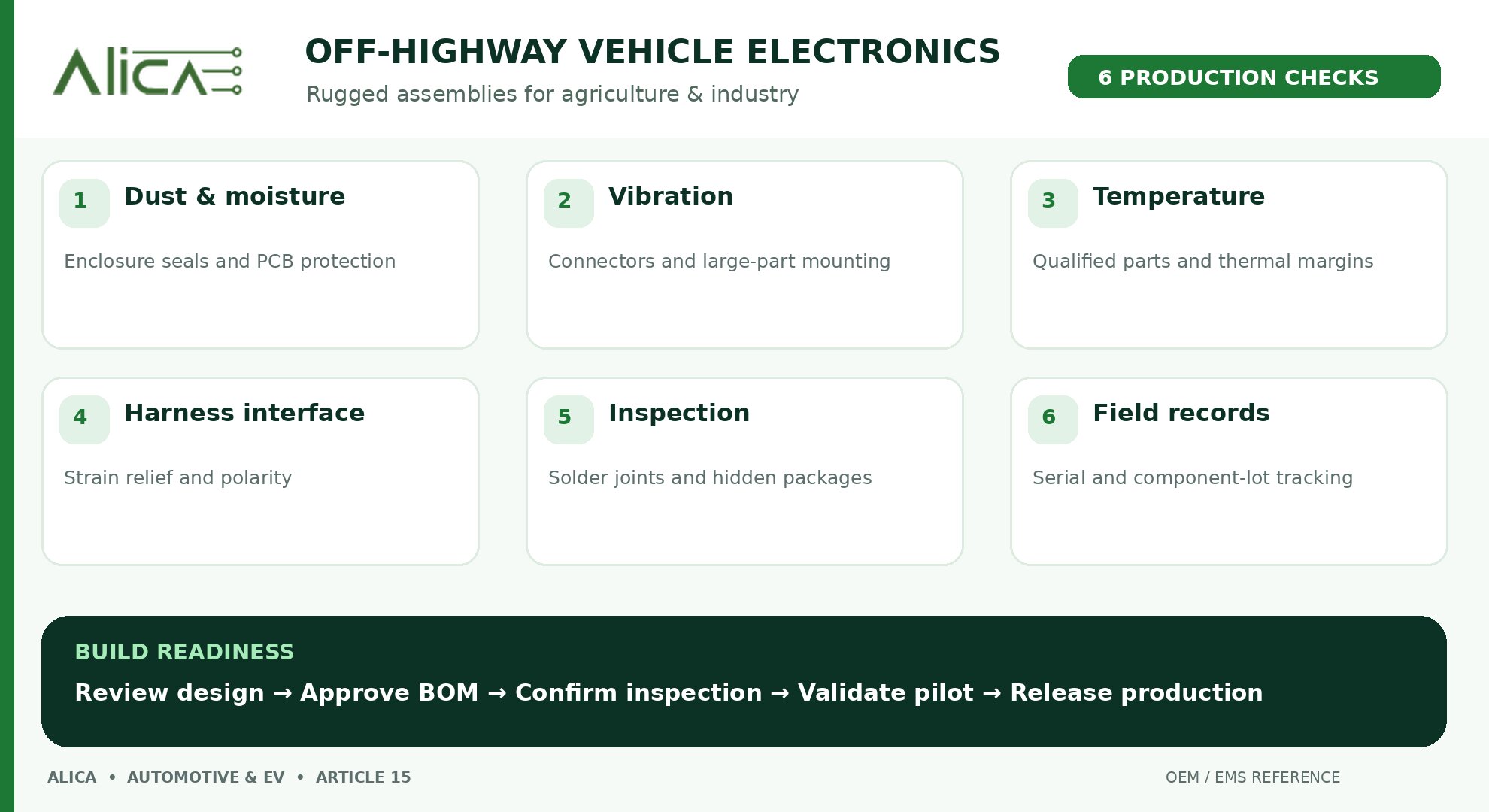
Typical Electronics Found on Off-Highway Equipment
Engine and powertrain controllers
The engine control unit manages fuel injection, timing, emissions aftertreatment, and diagnostics. On diesel engines, this includes common rail pressure control, injector timing, turbocharger wastegate or VGT control, and DEF (diesel exhaust fluid) dosing for SCR aftertreatment. The board is a mixed technology assembly with fine pitch MCU and power driver packages, through-hole connectors, and often an internal pressure or temperature sensor.
Hydraulic controllers
Hydraulic systems are the muscles of off-highway equipment, and their electronic controllers manage proportional valves, pressure sensors, flow sensors and position sensors. The controller adjusts the hydraulic flow and pressure to match the operator’s input and the load conditions. These boards carry power drivers for the proportional valve solenoids, analogue signal conditioning for the sensors, and a CAN bus interface for communication with the main vehicle controller.
Telematics and fleet management
Modern off-highway equipment includes telematics for fleet tracking, remote diagnostics, usage monitoring and service scheduling. The telematics unit typically includes a cellular modem, a GNSS receiver, a CAN bus interface, and sometimes an accelerometer and gyroscope for usage pattern monitoring. The assembly challenge is similar to the automotive telematics case, with the additional requirement of surviving the harsher off-highway environment.
Display and operator interface
The operator display on a modern tractor or excavator is a touchscreen or button panel unit that shows machine status, provides control inputs, and sometimes runs guidance or mapping software. The electronics include a display driver, a touchscreen controller, and a processor. The environmental challenge for these units is primarily temperature (the display must be readable in direct sunlight and function at temperature extremes) and vibration.
Electric and hybrid drive controllers
Electric and hybrid powertrains are entering the off-highway market, particularly in material handling (forklifts, platform lifts, AGVs), compact construction equipment (mini excavators, compact loaders), and increasingly in agricultural equipment. The drive controllers for these applications share the same assembly challenges as EV motor controllers, with the added environmental demands of off-highway operation.
Assembly Process Requirements
Mixed technology assembly
Off-highway controller boards are almost always mixed technology: SMT for the microcontroller, signal conditioning, power management and communication ICs, and through-hole for the connectors, some power components, and sometimes the pressure transducer or temperature sensor assembly. The SMT and THT assembly sequence follows the standard pattern, but the process parameters need to reflect the board’s specific demands.
Through-hole connector soldering
The connectors on off-highway boards are typically heavy duty types (Deutsch, Amphenol, Molex MX150 or similar) with thick pins and high insertion forces. These connectors are designed to withstand vibration, moisture and mechanical abuse, and they are expensive to replace if a solder joint fails. The through-hole joints on these connectors need full barrel fill and adequate fillet formation, verified by visual inspection and, on critical connectors, by cross section analysis on a first article basis.
Conformal coating
If the design specifies conformal coating, the assembly process includes a coating step after all soldering and testing is complete. The coating must cover the specified areas of the board (usually everything except the connectors and any components that should not be coated, such as pressure sensors or adjustment potentiometers) with uniform thickness and no voids, bubbles or pinholes.
Selective coating, where only specific areas are coated, requires masking or programming of the coating equipment to avoid the excluded areas. The masking and the coating coverage should be verified on every board, either visually (some coating materials fluoresce under UV light, making inspection easier) or by automated inspection.
Thermal management in box build
The box build for off-highway controllers often includes thermal interface material between the board and the enclosure, because the enclosure (typically cast or machined aluminium) serves as the heatsink. The TIM application and the mounting torque are critical: too little TIM or too low torque leaves air gaps, while too much TIM or too high torque can warp the board.
Testing for Off-Highway Reliability
The testing sequence for an off-highway controller mirrors the automotive process but may include additional environmental verification.
- Board level inspection. SPI, AOI, X-Ray on hidden joints, visual inspection of through-hole joints and conformal coating.
- Functional test. Power up, communication check, sensor input verification, output driver verification, protection function test.
- Burn-in. Run the board at temperature and load for a specified duration. The burn-in parameters for off-highway equipment may specify higher temperatures or longer durations than passenger vehicle electronics, reflecting the harsher operating environment.
- Hi-pot test. If the design includes isolated power stages or sensor inputs, verify the isolation.
Some OEMs also require environmental qualification testing on a sample basis: temperature cycling, vibration testing, salt spray, and dust ingress. These are typically done at the OEM’s or a third party test laboratory, not at the EMS partner’s facility, but the EMS partner should understand what the samples will be subjected to, because it informs the assembly decisions.
The India Off-Highway Market
India is one of the largest tractor markets in the world, with annual sales measured in hundreds of thousands of units. The major tractor manufacturers (Mahindra, TAFE, Escorts, Sonalika, John Deere India) are all increasing the electronics content of their products, driven by emission regulations (TREM Stage IV and beyond), precision agriculture features (GPS guidance, yield monitoring, variable rate application), telematics, and the beginning of electrification and hybridisation.
Construction equipment in India is also growing rapidly, driven by infrastructure spending. Excavators, loaders, compactors and cranes from both Indian and multinational manufacturers are adding electronic controls, telematics and in some cases hybrid or electric drive systems.
For these OEMs, having a local EMS partner who can handle prototype through pilot volume, provide written DFM feedback, and deliver end to end from bare board to tested box build reduces the iteration time and allows faster product development. The alternative, sending designs to a distant manufacturer and waiting weeks for each prototype iteration, is too slow for the pace at which the Indian off-highway market is adding electronics.
Testing Off-Highway Electronics
The testing requirements for off-highway electronics reflect the harsh operating conditions these products must endure. Standard automotive test protocols are a starting point, but off-highway applications often demand additional validation specific to their environment.
Vibration testing for off-highway equipment is more severe than for on-road vehicles. A tractor traversing a ploughed field or an excavator breaking concrete generates vibration profiles with higher amplitudes and broader frequency ranges than a passenger car on a paved road. The random vibration power spectral density (PSD) profiles specified by off-highway OEMs typically exceed those of SAEJ1211 or similar on-road standards. The assembled board must survive these profiles without cracked solder joints, broken wire bonds, or loosened connectors.
Temperature testing must cover the full operating range of the specific application. Engine-mounted controllers on a tractor may see ambient temperatures from -30 degrees Celsius during winter starts to above 100 degrees Celsius near the exhaust system. Thermal cycling between these extremes, often combined with humidity exposure, is a standard qualification requirement. The cycle count and dwell times depend on the OEM’s target product life, which for off-highway equipment is often 10 to 15 years or more.
Ingress protection testing validates the enclosure and connector sealing. An IP67-rated controller must survive temporary submersion, which a tractor-mounted unit might experience during monsoon flooding in a paddy field. The EMS partner’s box build process, including gasket installation, connector torque, and seal inspection, directly determines whether the finished unit passes the IP test.
EMC testing for off-highway equipment follows ISO 14982 (agricultural and forestry machinery) rather than the CISPR 25 and ISO 11452 standards used for on-road vehicles. The emission limits and immunity levels are different, and the test setup reflects the specific electromagnetic environment of the equipment. While the EMC qualification is ultimately the OEM’s responsibility, the EMS partner’s assembly quality, specifically the solder quality on ground planes, the shield can installation, and the cable harness routing in the box build, affects whether the product passes.
Sourcing for Off-Highway BOMs
The component sourcing for off-highway electronics shares the automotive grade requirements but has some specific differences.
Off-highway volumes are typically lower than passenger vehicle volumes, which means less negotiating leverage with component suppliers and potentially longer lead times for allocation-constrained parts. The BOM may include components from agricultural or industrial equipment suppliers that are not in the standard automotive supply chain, such as specific sensor interfaces, proprietary communication transceivers, or ruggedised connectors.
The EMS partner should be comfortable sourcing from both the standard automotive distributors and from the speciality suppliers that the off-highway industry uses, and should have incoming inspection procedures that can verify the grade and authenticity of parts from both channels.
Frequently Asked Questions
What makes off-highway electronics harder to build than standard automotive?
Off-highway equipment operates in conditions that are harsher than most on-road vehicles: continuous vibration from uneven terrain and heavy machinery, extreme temperatures from desert heat to winter cold, exposure to dust, mud, water and sometimes chemical spray, and operating cycles that can include sustained high load for hours at a time. The electronics have to survive all of this for equipment lifespans that often exceed a decade, with minimal maintenance. The assembly process has to deliver solder joints that resist vibration fatigue, components rated for the full temperature range, and environmental protection through conformal coating or potting.
Does Alica build complete enclosed controller units for off-highway equipment?
Yes. Alica provides box build alongside PCB assembly, delivering a fully enclosed, connectorised, tested and labelled unit. For off-highway applications, the enclosure is typically an IP-rated aluminium or steel housing with sealed connectors, and the assembly scope includes thermal interface material, conformal coating or potting if specified, and functional testing at temperature.
What certifications do off-highway electronics need?
Off-highway electronics do not follow the same certification path as on-road automotive. IATF 16949 is less common as a supplier requirement in agriculture and construction than in passenger vehicles. The relevant standards are typically ISO 25119 for tractors and agricultural machinery safety, ISO 13849 for machinery safety in general, and equipment specific EMC and environmental standards. The product’s OEM defines the certification requirements, and the EMS partner’s role is to build to those requirements and provide the documentation needed for compliance.
Talk to Alica About Your Off-Highway Electronics
Whether you are developing a new controller for a tractor, adding telematics to construction equipment, or electrifying a material handling vehicle, the best way to start is with a design conversation. Send your Gerbers, BOM and assembly data through the contact page or call +91 97271 78787. The team will review your design for manufacturability, assess the environmental and thermal requirements, and provide a quote. You can also review the full manufacturing capabilities and the industries Alica serves first.
Tagged in
Looking for a reliable EMS partner?
Get a quote for PCB assembly, turnkey manufacturing, or prototype builds.
Get in Touch