
Sourcing Automotive Electronic Components: AEC-Q Grades, Substitution Risk and Shortage Management
 Utsav
•
Nov 2, 2026
Most of what goes wrong on an automotive electronics programme goes wrong in the bill of materials rather than on the assembly line. A part that is three months late stalls a launch. A part that was quietly swapped for a cheaper equivalent passes every test and then produces a cluster of field failures eighteen months later, in a temperature range nobody tested because nobody knew the part had changed. The assembly process gets the blame, and the assembly process was fine.
Automotive component sourcing is therefore not a cost exercise with a reliability footnote. It is a reliability discipline that also has a cost dimension. This article is written for procurement, supply chain and sourcing leads working on vehicle and EV electronics, and it covers what automotive qualification actually means, where the substitution traps are, how to manage shortages without creating latent defects, and how to decide who should own sourcing on your programme. It complements the broader guide to automotive and EV PCB assembly in India.
What Automotive Qualification Means
Automotive components are qualified under a family of specifications published by the Automotive Electronics Council, usually referred to as AEC-Q. The relevant documents divide by component class:
| Specification | Covers |
|---|---|
| AEC-Q100 | Integrated circuits |
| AEC-Q101 | Discrete semiconductors, including transistors, diodes and power devices |
| AEC-Q102 | Optoelectronic components such as LEDs and photodetectors |
| AEC-Q200 | Passive components, including resistors, capacitors, inductors and crystals |
A qualified part has been subjected to a defined set of stress tests, which depending on the class may include temperature cycling, high temperature operating life, humidity exposure, mechanical shock, vibration, electrostatic discharge characterisation and others. It is also assigned a temperature grade describing the ambient range across which it is qualified, with the more demanding grades covering the conditions found in harsher vehicle locations.
Two things follow from this that matter commercially.
First, qualification is evidence rather than magic. It does not make a part immune to the vehicle environment. It demonstrates that the manufacturer tested it under defined automotive stress conditions and that it passed. That evidence is what your own validation and, where applicable, your functional safety argument rest on.
Second, grade matters as much as qualification. A part qualified to a temperature grade appropriate for a cabin location is not automatically appropriate for an engine bay or an inverter enclosure. Specifying AEC-Q qualification without specifying the grade you need leaves a real gap, and it is a gap that tends to be filled by whatever is available.
The Substitution Trap
This is where the most damage happens, and it happens for understandable reasons.
A commercial grade component and its automotive grade counterpart frequently share a part number family, an identical package, a very similar datasheet headline and a substantially different price. During a shortage, with a line waiting, the commercial version is available and the automotive version is not. The pressure to proceed is real and the logic looks sound: it is the same part, from the same manufacturer, in the same package.
It is not the same part. It may have a narrower qualified temperature range, different tested life behaviour, different variation control across production lots, or a different internal construction. It has not been through the same stress qualification, which means your assumption about how it behaves after eight years of thermal cycling is no longer supported by anything.
On a safety relevant assembly, the consequences extend past reliability. Your validation was performed on a specific configuration. Any certification you hold was granted against a specific configuration. Substituting a component changes that configuration, and in some cases invalidates work that cost many multiples of the component saving.
The rule to establish, in writing, before the first build
No component substitution without written approval from the customer’s engineering team.
Not verbal approval. Not approval from a purchasing contact. Written approval from the people who own the design, with the proposed part’s qualification and grade stated so they can evaluate it properly.
A good manufacturing partner will already expect this and will present alternates rather than implement them. Under Alica’s turnkey project delivery model, sourcing and full bill of materials management sit with the manufacturer with transparent cost breakdowns, long lead items are flagged early, and any alternate is proposed for customer approval rather than substituted silently. If a prospective supplier is reluctant to commit to that in writing, you have learned something worth knowing early.
Which Parts Actually Govern Your Schedule
Every automotive bill of materials has a handful of items that determine the programme timeline, and they are rarely the expensive-looking ones. Identifying them at design freeze and tracking them as programme milestones rather than purchase orders is one of the highest value things a sourcing team can do.
Typical culprits across vehicle and EV electronics:
- Power semiconductors, particularly silicon carbide devices, where allocation and qualified source lists are both constrained
- Automotive grade microcontrollers, often with long lead times and limited substitution options because firmware is tied to the part
- Isolated gate drivers and isolation components, which are safety relevant and not interchangeable on specification alone
- Current sensors, accuracy and bandwidth specific, with long qualification cycles if changed
- Cellular and GNSS modules, where regional variants and certification evidence are attached to specific part numbers
- DC link and bulk capacitors, specified on ripple current and lifetime rather than capacitance alone
- Custom or semi-custom magnetics, where tooling lead time dominates
- Connectors, especially automotive sealed connectors with certification implications
- Crystals and oscillators where timing stability over temperature is specified
A practical habit: at design freeze, ask your engineering team which five parts they would least like to change. That list is usually your real risk register, and it rarely matches the top five by spend.
Shortage Management Without Creating Latent Defects
Shortages are a permanent condition rather than an occasional event, and the question is not how to avoid them but how to respond without introducing problems that surface later. A hierarchy of responses, roughly in order of preference:
- Pre-approved alternates. The cheapest shortage response is one your engineering team already evaluated. Qualifying second sources for critical parts during design, rather than during a crisis, costs engineering time once and saves it repeatedly. Put approved alternates in the bill of materials with their grades stated.
- Forward buying on identified long lead items. Where a part is known to govern the schedule, buying ahead against a forecast is usually cheaper than the consequences of not having it. This requires committing inventory, which is a commercial decision rather than a technical one.
- Design-in flexibility. Footprints that accommodate more than one package option, or circuits tolerant of a wider component range, cost very little at design stage and create options later. This has to be a design decision, which means raising it during design rather than wishing for it during a shortage.
- Engineering evaluated substitution. Where a new alternate is needed, the process is evaluation, approval, documentation, and where warranted, validation. Slower than a purchase order and considerably faster than a field investigation.
- Schedule adjustment. Sometimes the correct answer is that the build waits. On a safety relevant automotive assembly this is a legitimate outcome and occasionally the only responsible one.
What is not on this list is unapproved substitution, and it is worth saying plainly because schedule pressure makes it tempting.
Channel Risk and Counterfeit Exposure
Where a part comes from matters as much as which part it is.
Components bought through franchised or authorised distribution come with a traceable chain back to the manufacturer. Components bought on the open or broker market during a shortage may be genuine, may be production rejects, may be relabelled parts of a different grade, may be recovered from scrapped assemblies, or may be outright counterfeit. The open market exists because it solves a real problem, and it also carries real risk.
For automotive work the exposure is specific. A relabelled commercial part sold as automotive grade will pass your functional test and then behave like a commercial part for the rest of its life, in an application that assumed otherwise. Counterfeit detection is difficult, often requiring specialist inspection, and the failure does not appear until the product is in service.
Practical steps for a sourcing team:
- Establish with your manufacturing partner what sourcing channels they use, and ask the question explicitly rather than assuming franchised supply
- Require notification and approval before any open market purchase is made for your build
- Require retention of supply chain documentation for traceability
- Agree what incoming verification, if any, is performed, and who pays for it when a part comes from a non-franchised source
- Treat an unusually attractive price on a constrained part as information rather than good fortune
Traceability: Your Containment Mechanism
Automotive is the industry where a component problem can become a field action across a production range, and traceability is what determines how wide that action has to be.
If a fault is traced to a component lot, the question becomes which units contain parts from that lot. A supply chain that can answer precisely lets you contain the issue to a specific batch. One that cannot lets you contain it to everything you have shipped. The difference is measured in money and in customer relationships.
What to establish with your manufacturing partner:
- How components are tracked from goods receipt through to finished unit
- Whether lot level records link to specific build batches and build dates
- How long records are retained
- How quickly a lot level trace can actually be produced, expressed in days
The last question is the one that distinguishes a real capability from an intention. Component traceability and documented, repeatable SOPs are what make that answer available on demand. The supplier evaluation article on choosing an automotive contract manufacturer in India covers how to assess this alongside the other selection criteria.
Turnkey, Consigned or Hybrid
A structural decision worth making deliberately rather than by default.
| Model | Suits | Trade-off |
|---|---|---|
| Turnkey: manufacturer sources everything | Teams wanting one accountable partner and fewer interfaces, and programmes with long lead content | Less direct control over channel choices, so the substitution and channel rules matter more |
| Consigned: customer supplies all parts | Teams with strong existing supplier relationships or strict approved vendor lists | Shortage risk and coordination overhead stay with you, and kitting errors become your problem |
| Hybrid: critical parts consigned, remainder turnkey | Most automotive programmes in practice | Requires clear ownership boundaries and kitting discipline |
The hybrid model is common for good reason. It lets you keep direct control of certification-relevant and safety relevant parts, where substitution risk is highest and where your approved vendor list is probably non-negotiable, while handing the long tail of passives and commodity parts to the manufacturer, where consolidation genuinely reduces overhead. If you are scoping how much to hand over, the article on what turnkey electronics manufacturing covers beyond PCB assembly is a useful reference.
Whichever model you choose, the boundary needs to be explicit: which parts are whose, who holds buffer stock, what happens when a consigned kit is short, and how discrepancies are reported. Most friction in hybrid arrangements comes from an undefined boundary rather than from the model itself.
Where Sourcing and the Build Meet
Two points that sit between procurement and manufacturing and tend to fall between them.
Moisture sensitivity. Plastic packaged components absorb atmospheric moisture, and packages that exceed their exposure limit can be internally damaged during reflow. This is governed by storage conditions, handling procedure and bake-out, which means it is affected by how long parts sat where and in what condition. Parts bought through unclear channels may arrive with unknown exposure history, and dry pack integrity on receipt is worth checking.
Package and process compatibility. An approved alternate that is electrically equivalent may have a different package, a different termination finish or a different thermal mass, any of which can affect assembly. Involving your manufacturing partner in alternate approval, rather than only your design team, catches this before a build rather than during one. This is one of the practical arguments for turnkey sourcing with a partner who runs SMT and THT assembly in-house and can speak to process impact directly.
A Sourcing Checklist for Automotive Programmes
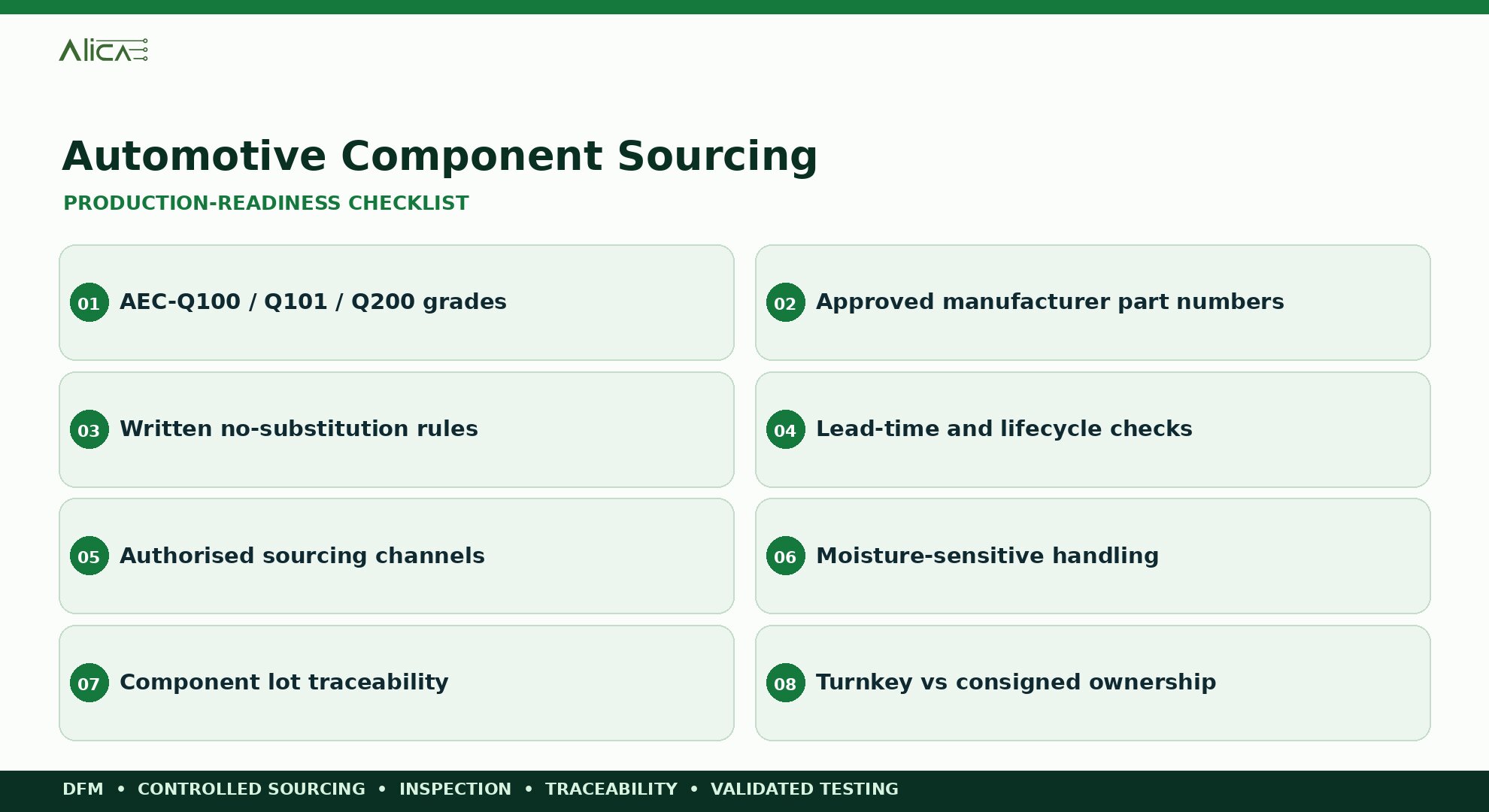
- Is the required AEC-Q specification and temperature grade stated for every relevant line of the bill of materials?
- Have approved alternates been qualified during design rather than left for a shortage?
- Are your five hardest-to-change parts identified and tracked as programme milestones?
- Is the no substitution without written engineering approval rule agreed in writing?
- Are safety relevant and certification relevant parts explicitly flagged as locked?
- Have you established what sourcing channels your manufacturer uses?
- Is open market purchasing subject to notification and approval?
- Is supply chain documentation retained for traceability?
- Can a lot level trace be produced in a stated number of days?
- Is the turnkey, consigned or hybrid boundary explicitly documented?
- Does your manufacturing partner review alternates for process compatibility, not just electrical equivalence?
- Is dry pack integrity and moisture exposure history checked on receipt?
Frequently Asked Questions
What does AEC-Q qualification actually mean for a component?
AEC-Q is a family of stress test qualification specifications from the Automotive Electronics Council, with AEC-Q100 covering integrated circuits, AEC-Q101 discrete semiconductors, AEC-Q102 optoelectronics and AEC-Q200 passive components. A qualified part has been subjected to a defined battery of environmental and life stress tests and assigned a temperature grade covering the ambient range it is qualified across. It is evidence that the part was tested under automotive conditions, which is why a commercial grade equivalent is not a drop-in replacement even when the datasheet looks similar.
Can a commercial grade component be substituted for an automotive grade one during a shortage?
Not as a purchasing decision. It is a design change on a safety relevant assembly and it needs engineering evaluation and approval, because the substitute has not been through the same qualification and may have a narrower temperature range, different wear-out behaviour or different variation control. In some cases the change can also invalidate validation and certification work that cost far more than the component saving. The correct process is for the manufacturer to propose the alternate with its grade stated and wait for written engineering approval.
Who should own component sourcing on an automotive electronics programme?
It depends on your team’s sourcing strength and on how strict your approved vendor list is. A turnkey arrangement, where the manufacturer owns bill of materials management and sourcing, reduces the number of interfaces to manage and puts shortage visibility with the party doing the building. A consigned arrangement suits teams with established supplier relationships or strict approved vendor constraints. Many programmes use a hybrid, with critical or certification-relevant parts consigned and the remainder turnkey.
Discuss Your Bill of Materials With Alica
The most useful first step on a sourcing conversation is a real bill of materials, because the risks are visible in it. Send your BOM and design data through the contact page and Alica will come back with sourcing observations, long lead flags and a transparent quote. If you are also evaluating manufacturing partners more broadly, the guide to choosing an automotive contract manufacturer in India sets out the full criteria, and the manufacturing capabilities page covers what Alica handles in-house.
Looking for a reliable EMS partner?
Get a quote for PCB assembly, turnkey manufacturing, or prototype builds.
Get in Touch