
How to Choose an Automotive Electronics Contract Manufacturer in India: 10 Criteria
 Utsav
•
Nov 1, 2026
Supplier selection in automotive electronics has an unusual risk profile. In most categories, picking the wrong manufacturer costs you a bad batch, some rework and a difficult quarter. In automotive, the realistic downside is a field action across a production range, with warranty exposure, a customer audit and a commercial relationship that may not survive it. The decision carries weight that is out of proportion to the size of the purchase order that starts it.
What makes choosing an automotive contract manufacturer in India harder is that the things which actually predict field reliability are not the things that appear on a quotation. Price per board, lead time and a capability list tell you very little about whether a supplier will produce consistent solder joints on a connector in month fourteen of a programme. This guide sets out ten criteria that do predict it, written for procurement, supply chain and sourcing leads. For the technical background on why automotive boards are demanding, start with the guide to automotive and EV PCB assembly in India.
1. Ask About Certification First, and Get It in Writing
Start here, because the answer determines whether the rest of the conversation is worth having for your specific programme.
The automotive quality management standard is IATF 16949. Direct supply of volume safety critical parts to a vehicle OEM or a tier-1 generally requires it, and plenty of buyers will not place production volume with an uncertified supplier regardless of how good the process looks. Alongside it sits the production part approval process, commonly called PPAP, which is the formal documentation package demonstrating that a supplier can make the part repeatably to specification.
Several points worth being clear about:
- Ask directly and early. Certification status is a yes or no, and a supplier should be able to answer it in a sentence with a certificate to follow.
- Distinguish certified, in progress and not certified. All three are legitimate answers for some programmes. A supplier working toward certification with a defined timeline is a different proposition from one with no intention of pursuing it.
- Do not confuse it with ISO 9001. A general quality management certification is not the automotive standard, and a supplier conflating the two is telling you something.
- Match the requirement to the programme stage. Prototype and NPI builds, pilot batches, low volume production, aftermarket and retrofit products, off-highway and specialist vehicles, and tier-2 or tier-3 supply into a larger assembly frequently proceed on demonstrated process control and traceability rather than on certification. If that is your context, certification may not be the binding constraint. If you are heading for volume OEM supply, it will be.
The failure mode to avoid is discovering the gap at the production gate, after a supplier has built your prototypes and you have designed around their process. Ask at the first meeting.
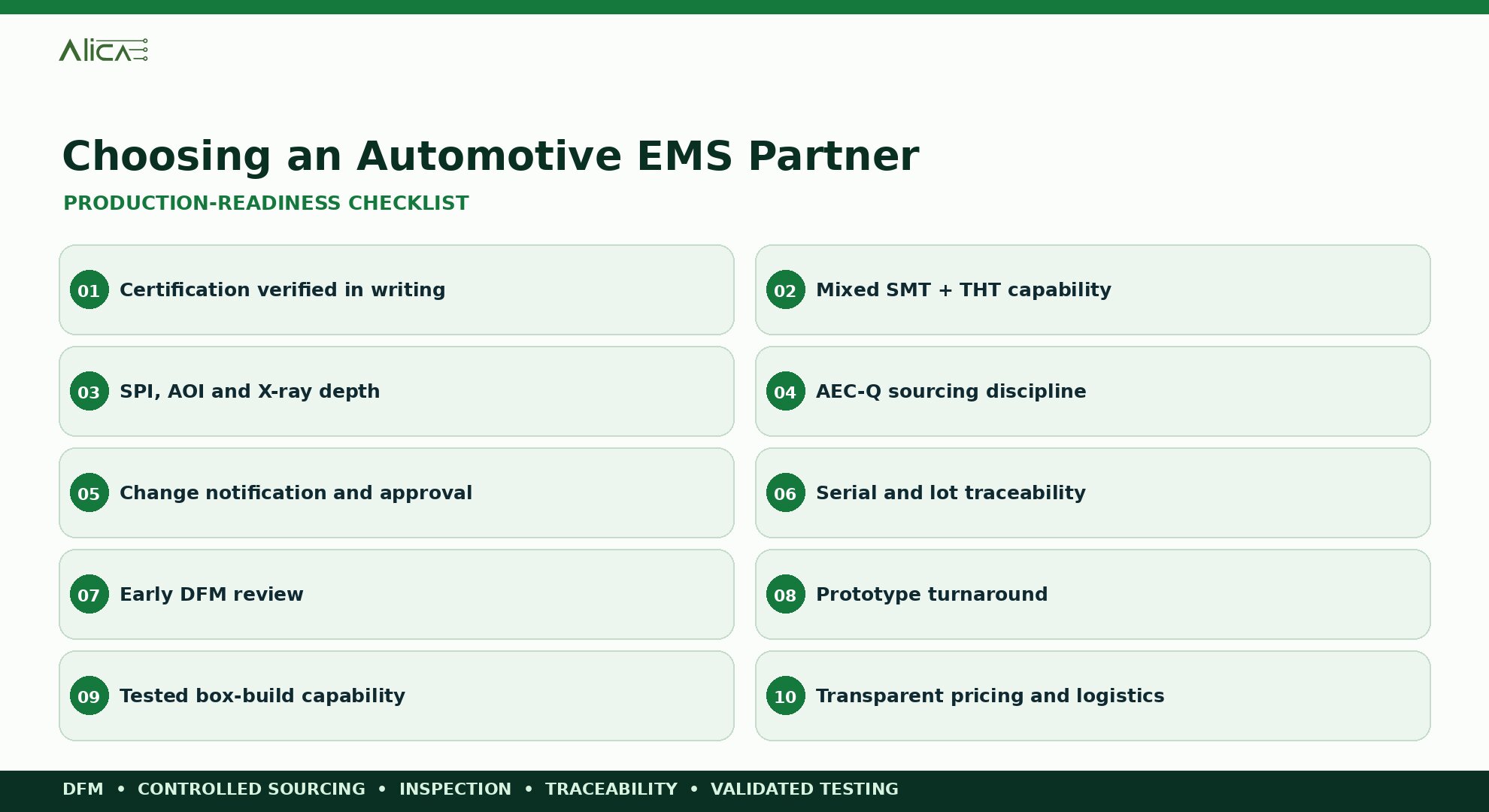
2. Mixed Technology Capability Under One Roof
Almost every automotive board combines fine pitch surface mount electronics with substantial through-hole content: harness connectors, terminals, large capacitors, power components. If a supplier subcontracts one of those processes, you have added a handoff, and handoffs are where variability enters and where accountability blurs when a defect appears.
Ask specifically whether surface mount and through-hole assembly are both performed in-house, and what inspection happens between the stages. Alica performs SMT and THT PCB assembly in-house with inspection between stages, which is the configuration you want for mixed technology vehicle electronics.
3. Inspection Depth, Specifically on Hidden Joints
Every supplier claims quality control. The useful questions are narrower.
On an automotive board, the joints most likely to cause a field failure are often invisible: connections under BGA packages, quad flat no-lead parts and power devices with exposed thermal pads. Optical inspection cannot assess them because it looks at the board from above. Only X-Ray can.
Ask:
- Does inline solder paste inspection run before placement, and on every board or on samples?
- Is automated optical inspection applied to 100 percent of boards?
- Is 3D X-Ray available in-house, and is it used on every board that carries hidden joints?
- Can you obtain the inspection data and X-Ray images when you need to investigate something?
That last question separates suppliers who inspect from suppliers who inspect and can prove it. Alica applies inline SPI, AOI and 3D X-Ray with 100% inspection coverage under IPC-compliant SOPs, described on the testing and inspection page.
Solder volume consistency deserves a specific mention in your discussions. On automotive boards the dominant field failure mechanism is solder joint fatigue under thermal cycling, and a joint that started with less solder than designed has less fatigue life than designed. A supplier who talks about solder volume as a reliability parameter rather than a cosmetic one understands your product.
4. Component Grade Discipline and the Substitution Rule
This is the criterion where the most damage gets done quietly.
Automotive components are qualified under the AEC-Q family of specifications: AEC-Q100 for integrated circuits, AEC-Q101 for discrete semiconductors, AEC-Q102 for optoelectronics and AEC-Q200 for passives, with temperature grades defining the range each part is qualified across. A commercial grade part may share a similar part number, an identical package and a comparable datasheet summary, and cost substantially less.
Substituting one for the other to resolve a shortage is not a procurement decision. It is a design change on a safety relevant assembly, and it can invalidate validation work worth many times the saving.
So establish one rule in writing before the first build: no component substitution without written approval from your engineering team. A good supplier will propose alternates, state clearly what qualification and temperature grade they carry, and then wait for your answer. Under Alica’s turnkey project delivery model, sourcing and full BOM management sit with the manufacturer, shortages are flagged early, and alternates go forward for customer approval rather than being substituted silently.
5. Change Control and Notification
The companion to the substitution rule is broader change control. Your validation was performed against a specific configuration: specific components, a specific process, specific sub-suppliers. If any of those change without your knowledge, your validation no longer describes what you are receiving.
Agree that process changes, material changes, sub-supplier changes and site changes all require written notification and approval. Ask how a supplier manages this internally, because a verbal assurance from a sales contact is not a process. In automotive this is normal practice and a serious supplier will not be surprised by the request.
6. Traceability Depth and Speed
Traceability is your containment tool, and its value is entirely determined by how precise and how fast it is.
If a fault is traced to a component lot or a process window, the question becomes which units are affected. A supplier who can identify the specific batch and the specific component lots lets you contain the problem to hundreds of units. A supplier who cannot lets you contain it to everything you have shipped.
Three questions:
- How are components tracked from goods receipt through to finished unit?
- How long are records retained?
- How quickly can a lot level trace actually be produced, in days?
The third one is the revealing question. Most suppliers can produce records eventually. Ask for a number, and ask whether they have ever actually done it.
7. Real DFM Support Before Tooling
Design for manufacturability review is the cheapest risk reduction available on an automotive programme, and the quality of it varies enormously between suppliers.
What a good review covers on a vehicle board: connector footprint and barrel fill expectations, thermal relief on high current pads, keep-out zones around stiff components near panel breakout points so depanelling does not crack ceramic capacitors, stencil aperture approach for large thermal pads, spacing around high voltage nets, and test access that a fixture can physically reach.
Ask for a redacted example of a previous DFM report. A supplier who produces one is showing you the standard of engineering attention you will receive. A supplier who responds to design files with only a price has told you that engineering review is not part of what you are buying.
8. Prototype Turnaround That Matches Your Programme
Automotive programmes rarely complete on one board revision, and the cumulative cost of slow iteration is often larger than any per-unit saving. If each revision takes a month, three revisions have cost you a quarter.
Alica supports a 5 to 10 day NPI turnaround with early DFM review. When evaluating any supplier’s quoted turnaround, ask what the figure assumes: parts in stock, complete and consistent data package, no open DFM queries. A supplier who states the assumptions is giving you a usable number. One who quotes a headline figure without them is giving you a marketing figure.
9. Can They Deliver a Tested Unit
A board is not a product. For most automotive electronics, what your line needs is a complete unit: board in enclosure, connectors fitted, any thermal interface in place, functionally tested and ideally burned in.
Burn-in matters particularly on vehicle electronics, because early life failures in semiconductors and electrolytic capacitors tend to appear under sustained thermal and electrical load rather than during a brief functional check. A unit that has run for hours under load has told you something a unit that was powered on for ten seconds has not.
Through end-to-end electronic manufacturing, Alica can take a product through box build with functional and burn-in testing. When scoping this with any supplier, settle four things: who writes the functional test procedure, who provides fixtures, whether firmware is loaded in production and how versions are controlled, and who owns any environmental rating on the finished enclosure. If you are deciding how much of the build to hand over, the article on what turnkey electronics manufacturing covers beyond PCB assembly is a useful reference.
10. Commercial Transparency and Supply Chain Geography
Finally, the commercial read. Look for an itemised cost breakdown across components, assembly, testing and logistics, with stencils, fixtures, tooling and rework treated explicitly rather than left vague. A supplier who explains the structure of their quote is easier to manage over a multi-year programme than one who gives you a single lower number with unstated exclusions.
Domestic manufacturing also changes the operational picture in ways that matter on automotive timelines: shorter logistics lead times, easier facility visits and audits, no import and customs exposure on the critical path, and time zone overlap for engineering discussions. Alica manufactures from Changodar, Ahmedabad, serving OEMs across India and exporting to the USA, Europe and Taiwan.
Good Signs and Red Flags
| Area | Good sign | Red flag |
|---|---|---|
| Certification | Clear status, certificate available, honest about scope | Vague answers, or ISO 9001 offered as if it were the automotive standard |
| Inspection | SPI, AOI and X-Ray with stated coverage, data available | “We do thorough visual checks” |
| Sourcing | Early shortage alerts, alternates proposed with grade stated | Substitutions discovered after delivery |
| Change control | Documented notification process | Verbal assurance from a sales contact |
| Traceability | A specific number of days for a lot trace | “Records are available on request” |
| DFM | Written findings before tooling, example available | Price quoted with no engineering comment |
| Testing | Functional and burn-in options, fixture discussion | Power-on check described as functional test |
| Commercials | Itemised, assumptions stated | Lump sum, vague exclusions, unexplained low price |
What to Send in an Automotive RFQ
The quality of a quote depends on the quality of the package behind it. Include:
- Gerber files and fabrication notes, including layer stack and material requirements
- A complete bill of materials with manufacturer part numbers, AEC-Q grade where applicable, and approved alternates
- Pick and place data and assembly drawings
- Any special process requirements: conformal coating, potting, cleanliness specification, press-fit insertion
- Functional test procedure, or a statement of who will write it, plus firmware loading requirements
- Box build scope, enclosure drawings and any environmental rating requirement
- Expected annual volume, batch size and ramp profile
- Inspection and documentation requirements, including acceptance criteria such as void percentage limits under power devices
- Traceability and change control expectations
Suppliers who ask intelligent questions about this package are usually the ones worth shortlisting. Suppliers who quote without questions have either done this many times or have not read it.
Validate With a Paid Pilot
No amount of evaluation substitutes for a build. Run a paid pilot batch and treat it as the real assessment. Read the DFM feedback. Examine the inspection records. Note how shortages were communicated, how fast a lot trace could be produced when you asked, and crucially whether defects were reported to you or quietly reworked. Visit the facility while the build is running rather than before it starts.
Behaviour during a low stakes pilot predicts behaviour during a production problem, and the pilot is far cheaper than learning the same lesson at volume. If you are still clarifying how supplier models differ, the comparison of contract manufacturing and EMS partnership is a useful starting point, and the detail of what an ECU build involves is covered in automotive ECU manufacturing.
Frequently Asked Questions
Does an automotive electronics supplier always need IATF 16949 certification?
Not for every programme, but you should always ask and get the answer in writing. Direct supply of volume safety critical parts to a vehicle OEM or a tier-1 generally requires it, and many buyers will not place production volume without it. Prototype and NPI builds, pilot batches, low volume production, aftermarket and retrofit products, off-highway and specialist vehicles, and tier-2 or tier-3 supply into a larger assembly often proceed on the basis of demonstrated process control, inspection depth and traceability instead. What matters is matching the supplier to the programme honestly rather than discovering a gap at the production gate.
What is the single most important clause to agree with an automotive electronics supplier?
No component substitution and no process change without written engineering approval. Automotive components are qualified under the AEC-Q specifications and carry defined temperature grades, so swapping in a commercial grade equivalent to solve a shortage is a design change, not a purchasing decision, and it can invalidate validation work worth far more than the saving. The same logic applies to process, material and sub-supplier changes, because your validation was performed against the previous configuration.
How should a buyer validate an automotive electronics supplier before awarding volume?
Run a paid pilot batch and treat it as the real evaluation. Look at the design for manufacturability feedback, the inspection records, how shortages were communicated, how quickly a lot level trace could be produced, and how defects were reported rather than hidden. Visit the facility. Behaviour during a low stakes pilot is the best available predictor of behaviour during a production problem, and it is much cheaper information than the same lesson learned at volume.
Evaluating Suppliers? Start With a Real Build
The most efficient way to assess any manufacturing partner is to give them a design and read what comes back. Send your Gerbers, BOM and assembly data through the contact page, and Alica will respond with DFM feedback and an itemised quote. The full manufacturing capabilities set out what is and is not in scope, which is usually the quickest way to work out whether a conversation is worth both parties’ time.
Looking for a reliable EMS partner?
Get a quote for PCB assembly, turnkey manufacturing, or prototype builds.
Get in Touch