
Automotive and EV PCB Assembly in India: A Guide for Vehicle and Component OEMs
 Utsav
•
Nov 1, 2026
An electronic control unit that works perfectly on a bench in Pune can fail eighteen months later on a vehicle running the Mumbai to Nashik route in May. Nothing about the design changed. What changed is that the board spent 500 hours above 85 degrees, absorbed a few million vibration cycles through its connector, and sat through a monsoon with condensation forming and clearing on its surface every morning. The failure, when it finally comes, is usually a cracked solder joint on a large component, and it was created on the assembly line long before the vehicle left the factory.
That gap between bench behaviour and field behaviour is the whole challenge of automotive PCB assembly, and it is why vehicle electronics is one of the least forgiving things an electronics manufacturer can take on. India’s vehicle electronics content is climbing fast, driven by electrification, connected vehicle mandates and the steady migration of mechanical functions into software. For hardware, procurement and operations teams building that content, the choice of manufacturing partner is a reliability decision as much as a cost one. This guide sets out what makes these boards hard, what to demand of a partner, and where Alica Technologies, an EMS company manufacturing from Changodar, Ahmedabad, fits into that picture.
Why Automotive Electronics Is a Different Class of Build
Most electronics products are designed around an assumption of moderate conditions and a service life of a few years. Automotive assumes neither. A board destined for a vehicle has to survive conditions that would be considered abuse almost anywhere else, and it has to do so for ten or fifteen years with no maintenance.
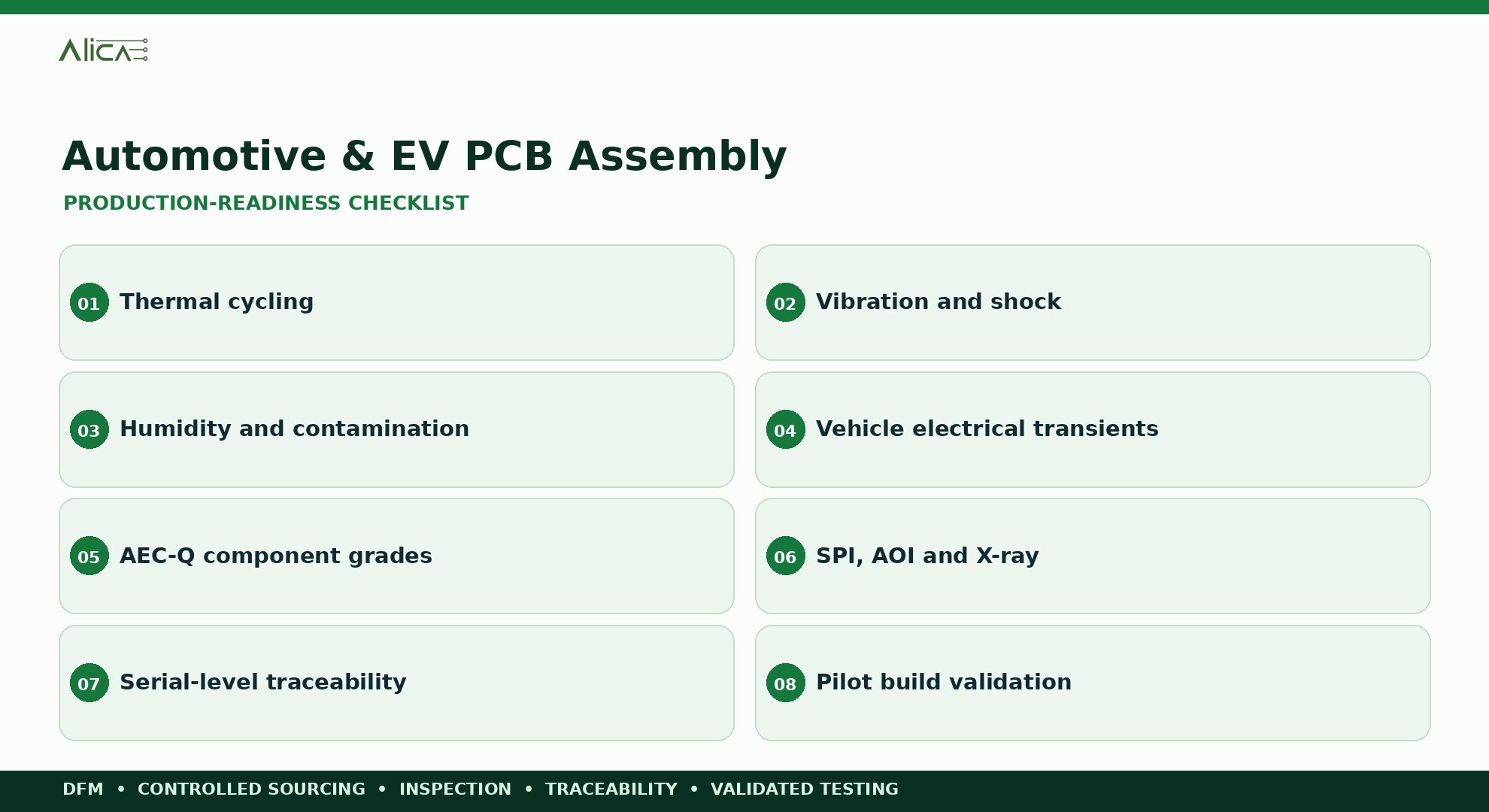
Thermal cycling is the primary enemy
Depending on where in the vehicle a unit sits, it may see an operating range from well below freezing to well above the boiling point of water. A cabin unit has an easier life than something mounted in the engine bay or near a traction inverter, but every unit goes through the same daily cycle: cold start, warm up, soak at temperature, cool down. Repeat that a few thousand times.
Each cycle matters because the materials in an assembly expand at different rates. The board, the solder, the component body and the component’s internal structure all have different coefficients of thermal expansion. Every temperature swing works the solder joint slightly, and over thousands of cycles that accumulated strain propagates as a crack. The joints most at risk are the ones under the largest components and the stiffest ones: big BGAs, power packages, and large ceramic capacitors whose rigid bodies transfer stress straight into their terminations.
This is the mechanism behind a great many automotive field failures, and it is why solder joint quality on an automotive board is not a cosmetic concern. A joint with a void, an incomplete fillet or an inconsistent solder volume starts its life with less material to resist that cycling. It will survive the factory test, pass the vehicle inspection, and fail in the field.
Vibration never stops
A vehicle is a vibrating platform. Road input, engine or motor harmonics and body resonance all reach the electronics, and heavy components with tall bodies act as levers against their own solder joints. Connectors are a particular concern, because they combine mass, mechanical leverage from the mating harness and the repeated insertion forces of assembly and service. Through-hole terminals carrying both mechanical load and current need full, well formed joints, and that is a process control question.
Humidity, contamination and electrochemical effects
Indian operating conditions add humidity and dust to the thermal and mechanical load. Where moisture, ionic residue and a voltage gradient meet on a board surface, you get the conditions for electrochemical migration: conductive growth between adjacent nets that can cause leakage or a dead short. Flux residue management, handling cleanliness and the design’s own spacing choices all feed into whether a board is vulnerable. Many automotive products address this with conformal coating or potting, which is a design decision to settle early and to confirm your manufacturing partner can accommodate.
Electrical environment
Vehicle power is noisy. Load dump, cold crank, reverse polarity and transient spikes are all normal events on an automotive supply rail, and the electronics has to tolerate them. On the manufacturing side this translates into protection components, filter networks and bulk capacitance that need to be placed and soldered exactly as designed, because a protection device with a marginal joint is a protection device that will not be there when it is needed.
What Goes Into an EV: The Boards Behind Electrification
Electrification has multiplied the electronics content of a vehicle, and it has introduced categories that did not exist in a conventional powertrain. Each brings its own assembly considerations.
| System | What the board does | Main assembly consideration |
|---|---|---|
| Battery management system | Cell voltage and temperature monitoring, balancing, protection, pack communication | Precision analog sensing, mixed SMT and high current THT, measurement accuracy depends on consistent solder volume |
| Traction inverter and motor controller | Converts DC pack voltage to drive the motor, gate drive, current sensing | High voltage spacing, isolation barriers, thermal interface to power devices, void control under power packages |
| On-board charger | Converts AC input to DC for the pack, power factor correction | Heavy magnetics, high current paths, thermal management, mixed technology |
| DC-DC converter | Steps high voltage pack down to the 12 volt accessory rail | Isolation, thermal, high current terminals |
| Vehicle control unit | Supervisory logic, torque arbitration, diagnostics | Dense multi-layer, fine pitch microcontrollers, high pin count connectors |
| Telematics and tracking unit | GNSS position, cellular backhaul, CAN interface, event logging | RF layout sensitivity, antenna integration, backup battery handling |
| Instrument cluster and HMI | Driver display, warnings, controls | Display and backlight integration, box build fit, optical cleanliness |
| Charging infrastructure | AC and DC charge points, metering, connectivity, safety interlocks | Outdoor enclosure, high current switching, mixed technology, full unit testing |
Battery management is substantial enough to be its own subject. If a BMS board is part of your programme, our detailed treatment of BMS PCB assembly for EV, energy storage and industrial packs covers the sensing, balancing and power path issues in depth.
High voltage changes the ground rules
Conventional vehicle electronics works at 12 or 24 volts. An EV traction system may run at 400 or 800 volts, and that single change cascades through the design and the build. Creepage and clearance distances between high voltage nets grow, which constrains component placement. Isolation barriers between the high voltage and low voltage domains have to be respected physically on the board, not just in the schematic. Cleanliness matters more, because contamination that is harmless at 12 volts can start tracking at 400. Handling and test procedures have to account for stored energy in bulk capacitance.
None of this is exotic, but it does mean a high voltage board is not simply a low voltage board with bigger numbers on it, and your manufacturing partner should be able to discuss these constraints rather than hear them for the first time from you.
The Policy Backdrop, Briefly
India’s electrification push has a direct effect on hardware volumes. The central PM E-DRIVE scheme, administered by the Ministry of Heavy Industries, has been extended to run until 31 March 2028 within its existing outlay of ₹10,900 crore. The extension is targeted rather than blanket: the terminal date for registered electric two wheelers, e-rickshaws, e-carts and L5 category three wheelers remains 31 March 2026, while the additional runway is aimed principally at electric trucks, electric buses and the testing agencies building out capacity. The scheme is fund limited, so components can close earlier if their allocation is exhausted.
For a component or systems OEM, the practical reading is that demand in the heavier vehicle categories and in supporting infrastructure has a defined policy runway, and that testing and homologation capacity is itself being expanded. If your product roadmap depends on scheme timelines, confirm the current position for your specific vehicle category directly, because these dates and allocations do move.
Component Grade Discipline: The AEC-Q Question
Automotive components are qualified to a different standard than commercial parts. The AEC-Q family of specifications, developed by the Automotive Electronics Council, defines stress test qualification for different component classes: AEC-Q100 for integrated circuits, AEC-Q101 for discrete semiconductors, AEC-Q102 for optoelectronics and AEC-Q200 for passive components. Parts are also assigned temperature grades according to the ambient range they are qualified for.
This matters enormously during sourcing, and it is where a lot of avoidable damage gets done. A commercial grade part and its automotive grade equivalent may share a similar part number, a similar package and a similar datasheet headline, and cost very differently. Substituting one for the other to solve a shortage is not a procurement decision, it is a design change, and on a safety relevant system it can invalidate validation work that cost far more than the saving.
The rule to establish with any manufacturing partner before the first build is simple: no component substitution without written approval from your engineering team. A good partner will propose alternates, state clearly what grade and qualification they carry, and wait. Under Alica’s turnkey project delivery model, sourcing and full BOM management sit with the manufacturer, shortages are flagged early, and alternates are put forward for the customer’s approval rather than quietly swapped in.
Inspection: Seeing What You Cannot See
On an automotive board, the joints most likely to cause a field failure are frequently the ones you cannot look at. Ball grid arrays, quad flat no-lead packages and bottom terminated power devices all hide their solder connections underneath the component body. Visual inspection cannot assess them. Automated optical inspection cannot either, because it is still, fundamentally, looking at the board from above.
This is the case for layered inspection, and each stage catches a different class of problem:
- Inline solder paste inspection checks paste volume, area and alignment after printing and before any component is placed. Paste problems are the cheapest defects in the entire process to fix, because nothing has been committed yet. On automotive boards, where solder volume directly affects how much material is available to resist thermal cycling, this stage is doing reliability work, not just quality work.
- Automated optical inspection after reflow verifies presence, placement, orientation, polarity and visible joint formation across the whole board.
- 3D X-Ray inspection reaches the hidden joints. It is how voiding under a power device gets found, how head in pillow defects on a BGA get caught, and how bridging under a fine pitch package gets detected before the unit ships. Voiding under a power package is doubly important because it degrades the thermal path as well as the mechanical joint, so a voided device runs hotter and ages faster.
Alica applies inline SPI, AOI and 3D X-Ray with 100% inspection coverage under IPC-compliant SOPs. The detail of how each stage is used is set out on the testing and inspection page. For automotive work, the question to ask any potential partner is not whether they inspect, but which stages run on every board rather than on a sample, and whether the resulting data is available to you when something needs investigating.
Traceability Is a Containment Tool
Automotive is the one industry where the realistic worst case is not a product return but a field action across a production range. When that possibility exists, traceability stops being paperwork and becomes the thing that decides whether a problem costs you a batch or a model year.
What you want to be able to establish, quickly, is which units were built in which batch, which component lots went into them, and what the process was doing at the time. The narrower that window, the narrower your containment. Component traceability and documented, repeatable SOPs are what make that answer available on demand instead of reconstructed under pressure.
Ask a prospective partner how components are tracked from goods receipt through to finished unit, how long records are retained, and how fast a lot level trace can actually be produced. The last question is the revealing one. Many suppliers can produce records eventually. Few can do it in a day.
What Each Decision-Maker Should Be Asking
R&D and hardware engineering
Your constraint is iteration speed, and automotive programmes rarely get through on one board revision. What helps is a partner who reviews your files before tooling and tells you what will cause trouble: footprint choices on power packages, thermal relief on high current pads, spacing around high voltage nets, panelisation that will stress ceramic capacitors at depanelling, and test access that a fixture can actually reach. Written feedback at that stage costs a day. Finding the same issue after a build costs a revision.
Alica supports a 5 to 10 day NPI turnaround with early DFM review, backed by high density multi-layer SMT and THT assembly on the same line, which matters because almost every automotive board mixes fine pitch surface mount parts with substantial through-hole connectors and terminals.
Procurement and supply chain
Your exposure is in long lead automotive grade semiconductors and in the coordination overhead of running fabrication, sourcing and assembly across separate vendors. Each handoff is a place for a schedule to slip and for accountability to blur. Consolidating sourcing and assembly with one partner reduces the number of interfaces you manage, and domestic manufacturing shortens lead times and removes import and customs friction from the critical path. What you should insist on is an itemised cost breakdown, early shortage visibility, and the substitution rule described above, in writing.
Operations and plant leadership
Your concern is whether unit one thousand matches unit one, and whether what arrives at your line is ready to integrate. That comes down to process discipline, inspection coverage on every board, traceability depth, and whether the partner can deliver a complete unit. Through end-to-end electronic manufacturing, Alica can take a product through mechanical box build, cabling and functional and burn-in testing, so what reaches your plant has been exercised rather than simply powered on once.
Where an EMS Partner Fits in an Automotive Supply Chain
It is worth being precise about roles, because the terminology gets used loosely and it affects what you should expect. An EMS partner manufactures to your design and specification. You own the intellectual property, the design decisions and the product. This is different from an ODM arrangement, where the manufacturer brings a design of its own. If that distinction is relevant to how you are structuring a programme, our comparison of EMS, OEM and ODM models sets out the differences, and the article on what turnkey electronics manufacturing covers beyond PCB assembly is useful when scoping how much of the build you want to hand over.
A realistic view of where an EMS partner of Alica’s profile adds most value in automotive: prototype and NPI builds, pilot batches, low and medium volume production, aftermarket and retrofit electronics, EV startup programmes, charging infrastructure, and tier-2 and tier-3 supply into larger assemblies. Very high volume safety critical production for a global vehicle OEM runs through a different procurement gate, and any honest supplier will tell you so rather than pretend otherwise.
A Practical Checklist Before You Commit
- Are fine pitch SMT and heavy through-hole assembly both done in-house, or is one subcontracted?
- Does inline SPI run before placement, and on every board?
- Is 3D X-Ray available in-house for hidden joints under power devices and BGAs?
- Will you receive written DFM feedback before tooling, and can you see a redacted example?
- What is the realistic NPI turnaround, and what does that figure assume about parts and file completeness?
- Who owns BOM sourcing, and how are shortages communicated?
- Is the no substitution without written approval rule accepted in writing?
- How deep is component traceability, and how quickly can a lot level trace be produced?
- Can the partner deliver a box built, functionally tested and burned in unit?
- If your product needs conformal coating, potting or specialised cleaning, can that be accommodated, in-house or otherwise?
- What quality system and automotive specific certifications are held, and does your programme’s stage actually require them yet?
The last two deserve a straight conversation rather than a brochure answer. Ask early, get the answer in writing, and make the decision with the real information. A supplier who tells you clearly what they do not do is more useful than one who tells you what you want to hear.
Validate With a Pilot
Whatever a supplier’s capability list says, the most reliable assessment is a small build. Run a prototype or pilot batch and look at what comes back: the DFM feedback, the inspection data, how shortages were handled, how questions were answered, how defects were reported. Visit the facility if you can. The way a partner behaves during a pilot, when there is little commercial pressure and nothing much at stake, is a good predictor of how they will behave in production when there is a lot at stake.
Frequently Asked Questions
What makes automotive PCB assembly different from standard electronics assembly?
Automotive boards live in a harsher environment than most electronics and are expected to work for the life of the vehicle. They face wide temperature swings, constant vibration, humidity and electrical noise, and the dominant failure mode is solder joint fatigue rather than component failure. That pushes the requirements onto process control, inspection coverage of hidden joints, component grade discipline and batch traceability, because a defect that escapes is not a return, it is a field action across a production run.
What should an EV startup look for in an automotive electronics manufacturing partner?
Early on, the things that matter most are prototype turnaround, written design for manufacturability feedback before tooling, honest sourcing support for long lead automotive grade parts, and inspection that can actually see hidden solder joints under power devices and fine pitch packages. Volume certification questions matter later. What slows an EV programme down in its first year is slow iteration and parts that arrive late or wrong, not a quality system audit.
Can Alica Technologies supply a tested automotive unit rather than only a bare board?
Yes. Alica offers box build integration with functional and burn-in testing alongside PCB assembly, so a vehicle or EV OEM can receive an assembled and exercised unit ready for its own validation and vehicle integration steps rather than a bare board.
Talk to Alica About Your Automotive or EV Programme
Whether you are prototyping a vehicle control unit, scaling a charging product or looking for a dependable second source for an existing board, the fastest way to assess a manufacturing partner is to put a real design in front of them. Send your Gerbers, BOM and assembly data through the contact page or call +91 97271 78787, and the team will come back with DFM feedback and a quote. You can also review the full manufacturing capabilities and the industries Alica serves first.
Tagged in
Looking for a reliable EMS partner?
Get a quote for PCB assembly, turnkey manufacturing, or prototype builds.
Get in Touch